NYC Mayor Zohran Mamdani Calls for Public Pushback Against AI Overreach
At an AI Now Institute event, NYC Mayor Zohran Mamdani criticized federal inaction on AI, highlighting local bans in schools and new real estate disclosure rules.
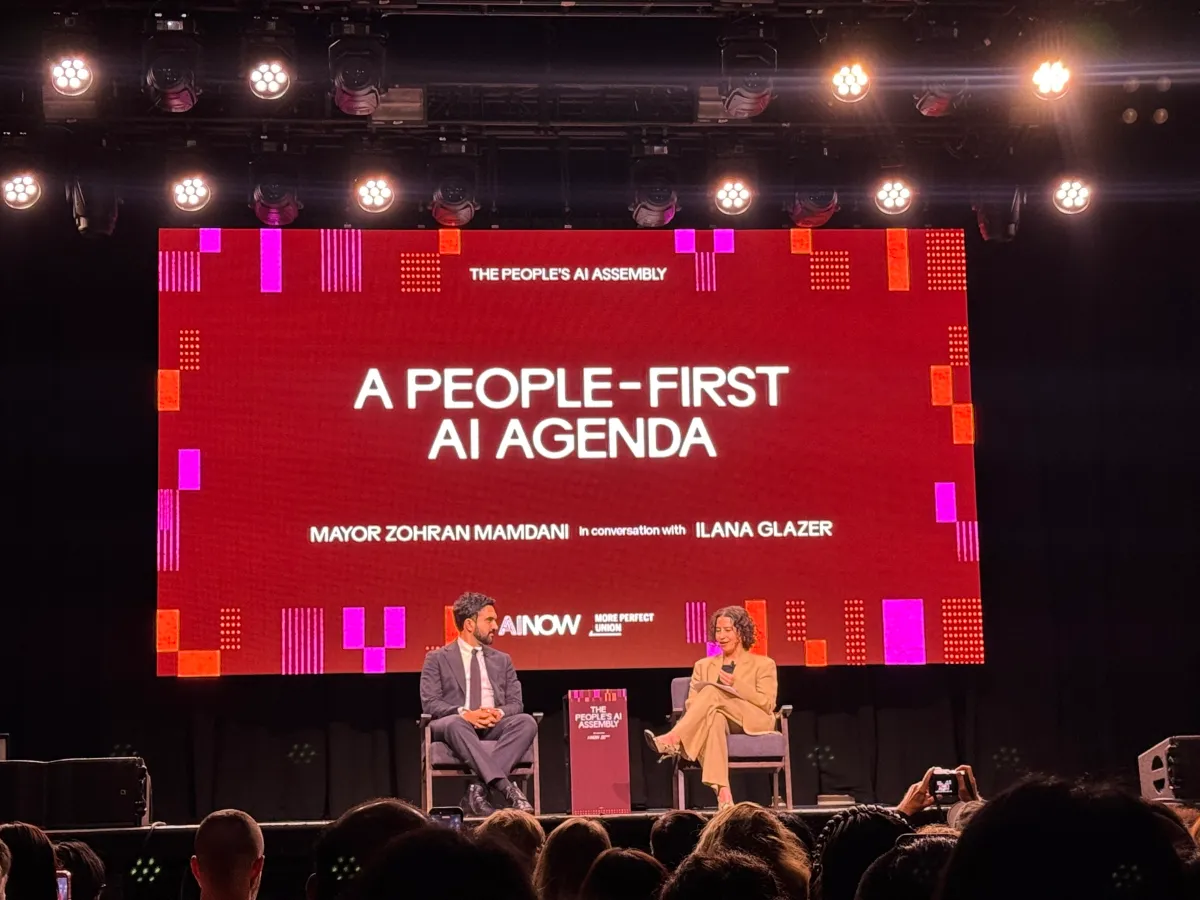
Speaking at Webster Hall in Manhattan on Monday night, New York City Mayor Zohran Mamdani urged citizens to push back against the perception that artificial intelligence is an unalterable force reshaping everyday life. Appearing alongside activist and "Broad City" star Ilana Glazer at The People’s AI Assembly—an event organized by the AI Now Institute—the mayor argued that society should not passively accept the rollout of automated systems across employment, education, and public spaces.
Mamdani’s comments reflect a growing divide between city-level initiatives and federal policy. With national authorities largely deferring comprehensive oversight, local governments are increasingly crafting their own guardrails to hold technology companies accountable.
City-Level Interventions in New York
New York City has already begun implementing policies designed to restrict or monitor AI deployments. Last month, Mamdani enacted a ban on AI software across elementary and middle schools. During the event, Glazer noted her own concerns as a parent regarding how quickly generative tools entered educational environments, questioning why classrooms are being pressured to adopt technologies that were barely present two years ago.
The city has also targeted commercial transparency. Over the summer, Mamdani announced rules obligating landlords, real estate brokers, and listing platforms to disclose when photos or videos of properties are generated or modified using AI. The measure seeks to curb "house-phishing," a practice where potential renters or buyers are misled by altered media.
Mamdani stated that the rapid spread of AI is characterized by an attempt to overwhelm users until they feel there is no alternative. Pointing to past examples, he noted that major tech companies like Facebook adopted a similar stance as early as 2008, presenting their platforms as untouchable systems that only their creators could properly govern.
Critiques of Federal Policy and Corporate Interests
During his remarks, Mamdani criticized what he described as a complete abdication of federal regulation. In Washington, the conversation around artificial intelligence has predominantly focused on international competition and an arms race with China, often sidelining humanistic and ethical safeguards.
Earlier this month, President Donald Trump introduced the Superintelligence Task Force, which largely prioritizes industry self-regulation over mandatory federal restrictions. This approach persists despite public concerns and explicit warnings from whistleblowers at Anthropic, Google DeepMind, and OpenAI regarding extreme risks, including the potential for human extinction.
Mamdani argued that the resistance to government oversight among developers is fundamentally tied to financial motivations, especially as firms seek to protect their valuations ahead of public listings. Anthropic is projected to pursue an initial public offering this year, while OpenAI has stated plans to go public by 2027.
The mayor also warned against treating algorithmic systems as infallible. To illustrate the severe risks of unchecked deployment, he cited a February U.S. military strike on a school in Iran that resulted in more than 150 deaths, including at least 123 children. An internal Pentagon inquiry reported by Bloomberg found that overreliance on automated targeting played a direct role in that incident.
What it means for developers
For software engineers and engineering teams, the divergence between federal permissiveness and municipal regulation introduces a fragmented legal landscape. While national standards remain minimal, developers building consumer-facing products must prepare for localized mandates, such as disclosure requirements for synthetic media and strict limitations on deploying tools in public education.
Teams developing real estate, marketing, or visual tools will need to integrate clear metadata and labeling pipelines to comply with rules against misleading imagery. More broadly, the scrutiny directed at automated decision-making highlights the necessity of maintaining robust human-in-the-loop workflows rather than relying blindly on model outputs for high-stakes tasks.
As organizations balance compliance requirements and evaluate which systems best serve their applications, engineers can experiment with frontier systems—including models from OpenAI, Anthropic, and other providers—through cost-effective, unified API platforms like https://apixoai.online. By testing multiple model architectures against specific transparency and reliability benchmarks, development teams can build products that withstand increasing regulatory and public oversight.
Source: Mamdani says feds have abdicated on AI, urges New Yorkers to push back — TechCrunch AI. Written by the Apixo team from that report.
One key for Claude, GPT, GLM, DeepSeek and more. Pay per token with crypto.
Get your API key