Open-Source Skills and Instructions Emerge as Key Drivers for AI Coding Agents
Popular GitHub repositories composed of simple Markdown instructions are transforming terminal coding agents like Claude Code, Codex, and OpenCode into structured software teams.
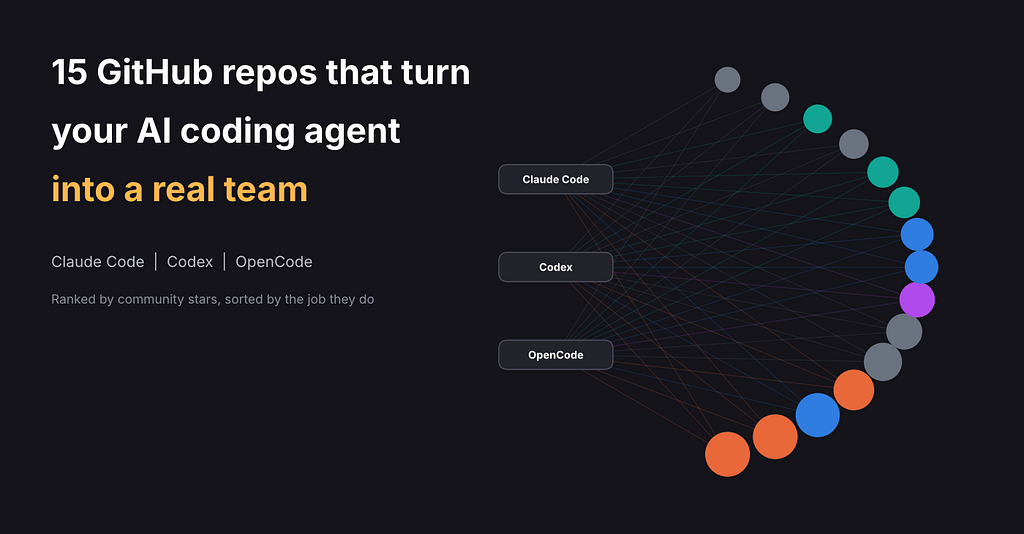
A shift is underway in how software engineers interact with autonomous programming assistants. On GitHub, repositories consisting largely of plain text Markdown files are amassing hundreds of thousands of stars. Rather than shipping binaries, complex servers, or proprietary model weights, these projects provide specialized behavioral guides known as skills. For tools such as Anthropic’s Claude Code, OpenAI’s open-source Codex CLI, and the provider-agnostic OpenCode—which crossed 200,000 stars in September—the performance of an agent is increasingly defined by the instructional harnesses wrapped around it.
Mechanically, a skill operates as an isolated folder containing a SKILL.md instruction file. The coding agent reads a brief description during initialization and injects the comprehensive guidelines only when a user's task matches the skill's triggers. Distributed through open formats and tooling like npx skills add or Claude Code’s plugin registry, these repositories standardize workflows, persistent memory, and design systems.
Enforcing process, memory, and token discipline
A primary focus among the most popular repositories is preventing agents from acting impulsively on ambiguous requirements. The most-starred project, Jesse Vincent’s obra/superpowers (around 310,000 stars), enforces a rigid development sequence: upfront design planning, isolated Git branch execution, breakdown into two-to-five-minute subtasks reviewed by secondary agents, and mandatory test-driven development before declaring completion. Similarly, mattpocock/skills (around 308,000 stars) relies on an interview skill named grill-me to probe user specifications and a handoff skill that captures session states, allowing work to resume in fresh sessions or across alternative agents.
Other repositories aim to eliminate agent overreach and unnecessary token consumption. The multica-ai/andrej-karpathy-skills project (around 228,000 stars) packages rules inspired by Andrej Karpathy’s January 2026 feedback, stopping agents from silently making assumptions, adding unwanted boilerplate, or rewriting neighboring code. For session persistence, thedotmack/claude-mem (around 108,000 stars) analyzes agent actions to compress them into cross-session summaries. To counter escalating API bills in extended sessions, JuliusBrussee/caveman (around 117,000 stars) strips conversational filler, cutting output tokens by an average of 65% in its author’s preliminary tests.
Broader bundles also command large followings. The affaan-m/ECC toolkit (around 294,000 stars) bundles rules, security hooks, and memory modules, earning the highest fork count among the surveyed repositories.
Visualizing architectures and managing multi-agent setups
Beyond basic text editing, community skills increasingly tackle visual documentation and cross-agent plumbing. Projects like tt-a1i/archify (around 92,000 stars) generate self-contained HTML architecture and data-flow diagrams exportable to PNG or SVG directly from repository analysis. For onboarding, Egonex-AI/Understand-Anything (around 89,000 stars) converts an existing codebase into an interactive, node-based knowledge graph. In interface engineering, nextlevelbuilder/ui-ux-pro-max-skill (around 143,000 stars) supplies design tokens and UI constraints to counteract generic default aesthetics.
As developer setups grow more fragmented, orchestration layers have emerged to unify these environments. The desktop application farion1231/cc-switch (around 152,000 stars) manages configuration files, Model Context Protocol (MCP) servers, and skill registries across Claude Code, Codex, and OpenCode simultaneously. For coordinated workflows, code-yeongyu/oh-my-openagent (around 71,000 stars) routes specialized tasks in parallel to distinct models—a setup where developers orchestrating multi-agent systems across Claude, Codex, or OpenCode can try top AI models cheaply through one API at https://apixoai.online.
What it means for developers
The explosive adoption of skill repositories highlights that operational discipline often yields higher output quality than raw foundation model performance alone. However, incorporating these community packages introduces measurable technical trade-offs.
First, context budgets are finite. Loading large collections of skills increases token overhead on every query. In one benchmark by Vercel Labs—the creators of the vercel-labs/skills installer—an installed documentation skill was left completely unused in 56% of standard interactions. Overloading an agent with kits like affaan-m/ECC or strict frameworks like superpowers can slow execution and inflate prompt costs without delivering proportional gains on trivial edits.
Second, security remains an unaddressed risk. Stars do not represent security audits, and skills that execute local scripts can introduce unvetted network calls into developer environments. Teams evaluating community skills are advised to audit the raw SKILL.md instructions, verify internal scripts, and pin versions rather than pulling live branches.
Ultimately, many of the performance benefits found in these repositories stem from fundamental practices: mandatory planning phases, concise output constraints, and test-first verification. Developers can often capture the core value of these tools simply by adapting their underlying principles into a localized configuration file without adopting the baggage of third-party frameworks.
Source: 15 GitHub Repos That Turn Claude Code, Codex and OpenCode Into a Real Team — Towards AI. Written by the Apixo team from that report.
One key for Claude, GPT, GLM, DeepSeek and more. Pay per token with crypto.
Get your API key

