Overcoming the Multi-Hop Blindspot: Building an Auditable GraphRAG Engine
Discover how combining knowledge graphs with LLMs eliminates hallucinations and unlocks verifiable multi-hop reasoning for complex enterprise domains.
Retrieval-Augmented Generation has established itself as the standard template for enterprise generative AI initiatives. Traditional setups typically rely on dividing unstructured files into smaller text fragments, creating dense vector embeddings via providers like OpenAI, Cohere, or Google, and performing similarity searches to supply relevant content to a Large Language Model. While this method handles simple FAQ queries adequately, naive vector RAG stumbles in complex operational environments such as legal analysis, regulatory compliance, and cross-border trade due to its blindness to interconnected relationships.
The Multi-Hop Limitation in Practice
Complex enterprise frameworks often require an AI to synthesize disjointed information spread across multiple documents. For example, evaluating trade regulations for exporting processed goods under specific continental frameworks requires connecting multiple distinct data points: product classifications, preferential tariff criteria, institutional registrations, and transit corridors. A standard vector database relies on semantic similarity against isolated sections. Consequently, it might successfully fetch data on product origins and transit paths while completely omitting mandatory certification or regulatory registration rules because individual paragraphs lack high keyword overlap with the exact phrasing of the prompt.
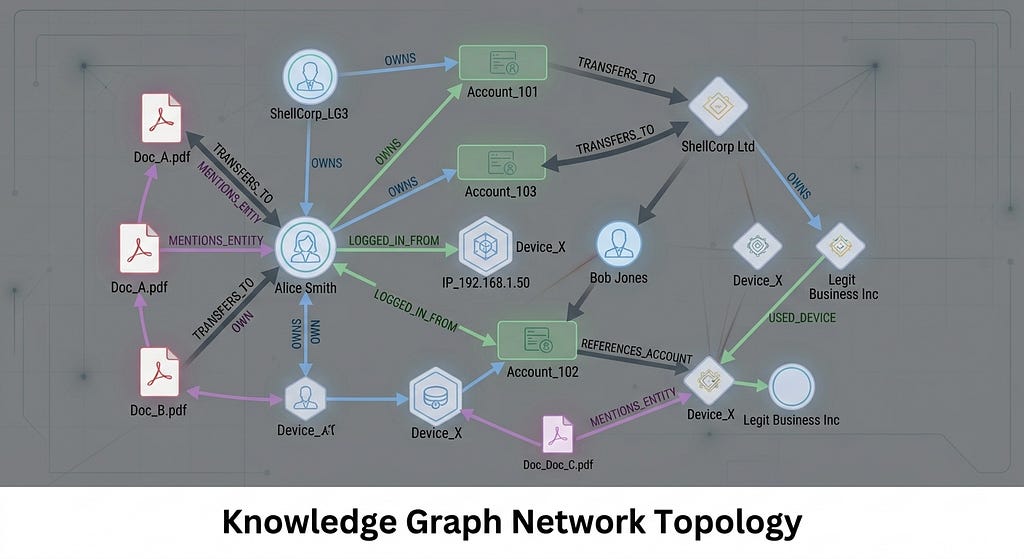
To bridge this gap, data must be structured into an interconnected network of entities and relationships, mirroring how human experts understand complex domains. Storing domain information inside a labeled property graph like Neo4j turns entity connections into first-class citizens. Instead of guessing similarities across flat text documents, the architecture systematically traverses deterministic relational paths.
Engineering an Enterprise GraphRAG Platform
An open-source intelligence platform termed the Universal GraphAI Platform leverages Neo4j Aura Cloud GDS alongside Google Gemini models to address these hurdles. The ingestion pipeline begins by passing multi-format enterprise files through a sliding-window chunking mechanism. Next, an LLM knowledge triple extractor processes the text to isolate semantic nodes and relationships in a structured JSON format.
def extract_universal_knowledge_graph(full_text):
    client = get_gemini_client()
    chunk_size = 3500
    chunks = [full_text[i:i+chunk_size] for i in range(0, len(full_text), chunk_size)]
    combined_graph = {"nodes": [], "relationships": []}
    for idx, chunk in enumerate(chunks[:5]):
        prompt = f"""
        Analyze the following text excerpt and extract structured knowledge graph entities and relationships.
        DOCUMENT TEXT: {chunk}
        Extract all key entities, facts, and relationships into JSON:
        {{
          "nodes": [
            {{"id": "EntityNameOrValue", "label": "EntityType"}}
          ],
          "relationships": [
            {{"source": "EntityA", "type": "RELATIONSHIP_TYPE", "target": "EntityB"}}
          ]
        }}
        Return ONLY valid JSON.
        """
        response = client.chats.create(model='gemini-3.5-flash-lite').send_message(prompt)
        clean_json = response.text.replace("```json", "").replace("```", "").strip()
        data = json.loads(clean_json)
        # Merge nodes & relationships into combined graph...
    return combined_graph
Once extracted, parameterized Cypher operations ingest these elements into Neo4j with specific metadata tags to maintain source document lineage. When users submit inquiries, the engine isolates key entity anchors and executes a multi-hop topological traversal. The first hop identifies direct relationships, while the second discovers complex multi-hop constraints, ensuring the system retrieves a complete factual subgraph instead of isolated text snippets.
What it means for developers
For engineers building production-grade AI systems, moving beyond naive vector search is critical for eliminating hallucination risks in high-stakes environments. By feeding retrieved graph facts directly into models with strict zero-hallucination groundings, applications refuse to guess when contextual proof is missing. Developers can try top AI models cheaply through one API at https://apixoai.online to experiment with similar generative architectures. Utilizing property graphs alongside advanced LLMs ensures that applications trace exact structural linkages and deliver auditable proof trails for enterprise decision-makers.
Source: Why Vector Search Fails at Multi-Hop Reasoning: Building an Auditable GraphRAG Engine with Neo4j… — Towards AI. Written by the Apixo team from that report.
One key for Claude, GPT, GLM, DeepSeek and more. Pay per token with crypto.
Get your API key