RAG and Long Context Windows: Balancing Recall, Latency, and Costs
Even with 1-million-token context windows in frontier models like Claude Sonnet 5 and Gemini 3.1 Pro, retrieval remains essential due to cost, latency, and context rot.
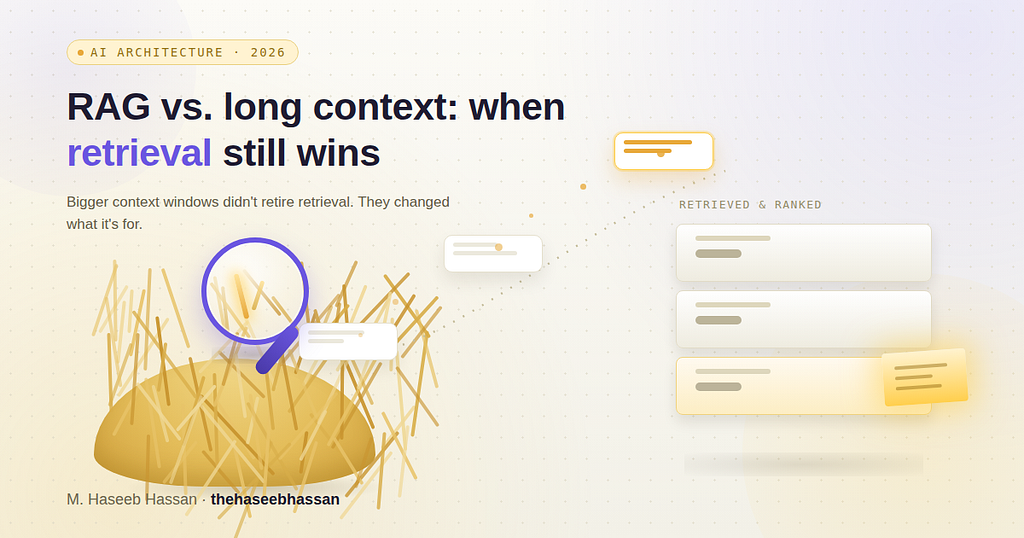
As context windows expand across frontier language models, developers face a shift in architectural priorities. Two years ago, Retrieval-Augmented Generation (RAG) was primarily used to work around restrictive context limits that capped out at 32,000 tokens. Today, models like Anthropic's Claude Sonnet 5 and Google's Gemini 3.1 Pro feature massive 1-million-token context windows. However, expanded capacity has not eliminated the necessity of retrieval systems. Even with ample context space, benchmarks show that raw window size does not guarantee reliable information processing. Anthropic's research into contextual retrieval revealed that standard retrieval missed target chunks 5.7% of the time, requiring additional retrieval refinements rather than simply expanding prompt limits.
Context rot and recall limitations
The main drawback of filling million-token windows is the degradation of recall accuracy. NVIDIA's RULER benchmark evaluated models against their advertised context capacities and discovered that only half sustained satisfactory performance at a 32,000-token length, despite near-perfect scores on simple needle-in-a-haystack tests. Research by Chroma on "Context Rot" further evaluated 18 models—including Claude 4, Gemini 2.5, and GPT-4.1—by increasing input sizes from 25 to 10,000 words while keeping task difficulty constant. Accuracy declined unevenly, suffering more severely when query phrasing differed from the source text and when single distractor sentences were added. Chroma observed a clear performance gap when comparing concise ~300-token prompts against full ~113,000-token prompts on identical tasks. This aligns with findings from the 2023 "Lost in the Middle" research, which proved that language models consistently process information at the beginning and end of long prompts better than content situated in the center.
Cost dynamics and processing latency
Beyond accuracy concerns, pushing massive documents into every prompt incurs financial and latency penalties. Claude Sonnet 5 pricing stands at $2 per million input tokens and $10 per million output tokens, with cached reads priced at $0.20 per million tokens. Gemini 3.1 Pro charges $2 per million input tokens up to 200,000 tokens, increasing to $4 per million tokens beyond that threshold. Re-sending a 150,000-token knowledge base on every query without caching costs approximately $0.30 per call before output generation even begins. While prompt caching reduces repeated read costs significantly, its effectiveness depends heavily on data stability. A knowledge base that updates hourly frequently invalidates cached entries, triggering full-price re-sent calls. Furthermore, processing long context inputs directly increases time-to-first-token latency, making real-time interactive applications slower for end users compared to lightweight, retrieval-based prompts that only feed a few thousand tokens.
What it means for developers
For modern system architecture, choosing between full context and retrieval depends on knowledge base scale, update frequency, query volume, and task type. Anthropic's documentation highlights that static datasets under approximately 200,000 tokens (roughly 500 pages) can often be placed directly into the prompt to leverage caching, avoiding complex retrieval pipelines altogether. Full-context prompts are also ideal for tasks requiring comprehensive, whole-document reasoning—such as summarizing complete legal contracts or mapping all variable references across an entire codebase.
However, when datasets exceed 200,000 tokens, experience frequent updates, or demand high-volume production querying, retrieval remains essential. A hybrid model is increasingly common: using prompt caching for a stable, core document set while layering RAG on top for rapidly shifting dynamic context. Developers building and evaluating these complex architectures can try top AI models cheaply through one API at https://apixoai.online. Ultimately, expanded context windows offer crucial space for complex reasoning, but precise retrieval techniques remain critical for cost control, lower latency, and output accuracy.
Source: RAG vs. Long Context in 2026: When Retrieval Still Wins — Towards AI. Written by the Apixo team from that report.
One key for Claude, GPT, GLM, DeepSeek and more. Pay per token with crypto.
Get your API key