Ramp Data Shows 1% of Companies Drive 80% of OpenAI and Anthropic Revenue
Ramp's latest index shows top enterprise spenders outspending median firms by 625x on AI, even as token prices fell 21% in a single month.
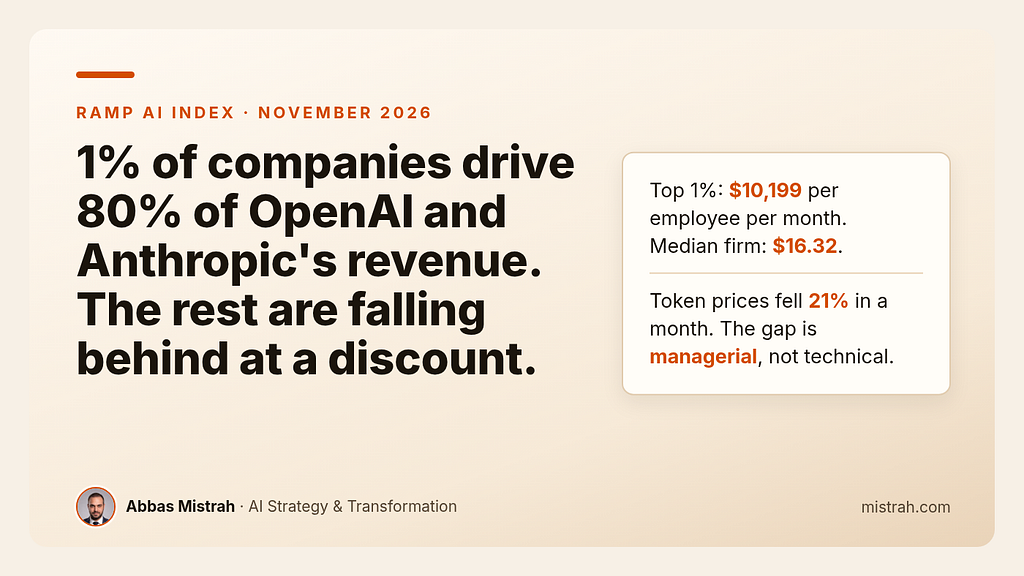
A newly released corporate spending report highlights a growing divergence in how US businesses invest in artificial intelligence. According to Ramp’s November AI Index—which analyzes transaction data across more than 85,000 American companies—a minuscule fraction of enterprise buyers accounts for the vast majority of total AI spending, even as underlying raw compute and token costs rapidly decline.
A 625-fold disparity amid plummeting token costs
The index, authored by Ramp lead economist Ara Kharazian, reveals that the top 1% of AI-paying businesses recorded a median spend of $10,199.20 per employee per month in October, reflecting a 9% increase from September. In contrast, the median firm spent just $16.32 per employee per month over the same timeframe. This translates to a roughly 625-fold gap between the highest spenders and the typical business. Meanwhile, the top 10% of spenders averaged $800.84 per employee monthly.
According to the data, 1% of businesses generate 80% of total enterprise revenue for leading model providers OpenAI and Anthropic. This top segment is concentrated primarily in venture-backed technology, finance, and technical services firms.
Crucially, this spending gap is occurring during a sharp decrease in unit costs. Average token prices fell 21% in October alone. Data from the week ending November 1 showed overall token spending grew 10.5% compared to the previous month, while overall token volume surged by 29%. This indicates companies are securing significantly higher model output per dollar spent.
Shifts across departments and model usage
While software development continues to dominate AI utilization, spending patterns are beginning to diversify across organizational functions. Engineering departments accounted for 72% of all classified AI spending in October. However, engineering spending has moderated from peak levels recorded during the summer, even as code generation usage continues to climb.
The fastest growth was recorded in customer success and support operations. This category represented 13.3% of classified AI spend in October, up from 0.8% in June, largely driven by automated customer support deployments. Executive leadership teams also showed modest spending increases.
Despite the rise of smaller, specialized models, high-performance frontier models still captured 69.5% of total spend in October. At the same time, major technology firms have introduced cost controls to manage budget exposure. Apple, Uber, and Tesla have established formal caps, with Apple placing a $200-per-day limit on individual developer AI usage.
What it means for developers
For developers and technical leads, these metrics underscore the transition from unstructured AI experimentation to disciplined usage. Engineering teams remain the primary users of AI tooling, but the falling cost per token means developers must focus on architecture and routing efficiency. High-capability frontier models remain essential for complex software creation, yet routine tasks like customer support workflows are increasingly handled by lower-cost, high-speed alternatives.
To optimize these workflows, developers can evaluate top AI models cheaply through unified access at https://apixoai.online, which provides pay-per-token API entry to systems like Claude, GPT, Gemini, Grok, and DeepSeek under a single key. By combining multi-model access with task-based model routing, engineering teams can minimize expenditure without sacrificing output quality.
Ultimately, the data indicates that corporate AI adoption is being shaped by internal management structures, resource allocation, and accountability rather than technology pricing alone. Developers who establish clear performance metrics—such as deployment velocity or resolved support tickets—will be best positioned to scale their AI integration effectively.
Source: 1% of Companies Drive 80% of OpenAI and Anthropic’s Revenue. — Towards AI. Written by the Apixo team from that report.
One key for Claude, GPT, GLM, DeepSeek and more. Pay per token with crypto.
Get your API key