Reflecting on Software Engineering, Coding Agents, and Industrial Parallels
An examination of how rapidly evolving coding agents mirror the historical trajectory of handloom weavers during the Industrial Revolution, and what it means for developers.
The evolution of artificial intelligence tools in software development has shifted dramatically over a remarkably short period. While coding agents were initially limited to generating unit tests or simple scripts, they have advanced to handling entire projects with minimal human intervention. Developers now often find that the primary bottleneck in software creation is no more the speed of the machine, but the time it takes humans to review and understand the output of the agents.
Despite rapid advancements inside the AI sector, the broader physical economy of food, housing, and manufacturing has seen minimal disruption thus far. Global manufacturing in major markets like China and the US already operates at overcapacity, and AI's primary role in production and supply chains has been helping operators cut costs. If widespread automation simply adds supply while reducing human labor, it risks depressing purchasing power and consumer demand, potentially triggering economic downturns rather than immediate prosperity.
The Handloom Weaver Parallel
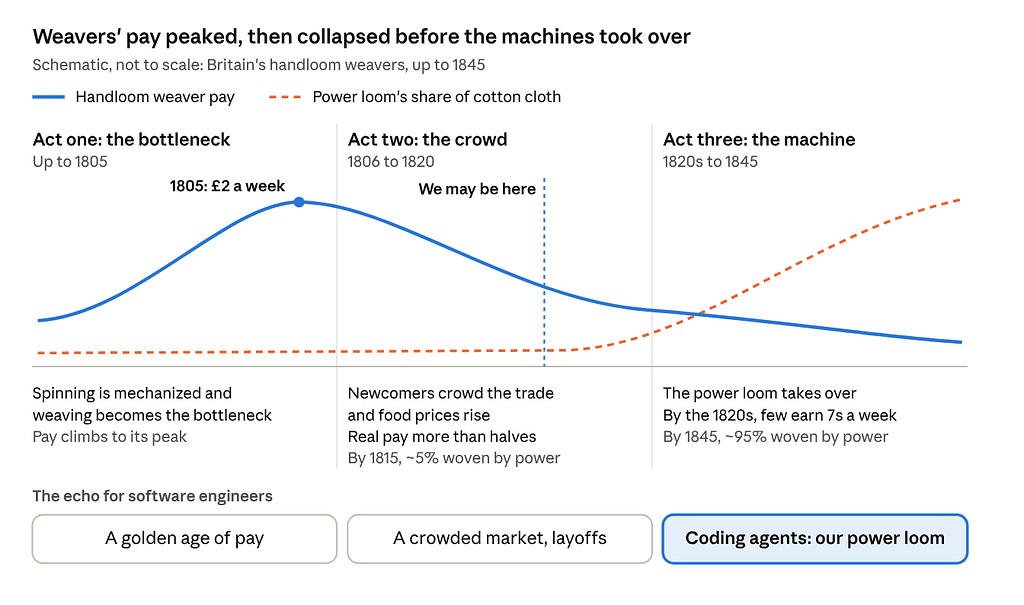
Historians studying industrialization often point to British handloom weavers as a historical parallel to modern software engineers. Their economic arc unfolded in three distinct phases.
First came the bottleneck. The invention of machine spinning produced a massive flood of cheap yarn, which dramatically increased the demand for weavers and temporarily created a golden age of high earnings. This mirrors the past two decades in tech, where the rise of cheap computing and the internet created a massive demand for code and a severe shortage of engineers, resulting in high salaries and stock grants.
Second came the crowd. Lucrative wages naturally attracted a large wave of newcomers into handloom weaving. As the profession filled up, real wages collapsed drastically even before power looms were widely adopted. Similarly, high compensation in tech drove a massive influx of workers through bootcamps and career transitions, meaning modern developers have already felt market squeezes from overcrowding and layoffs prior to the widespread adoption of AI.
Third came the machine. The widespread adoption of power looms eventually replaced human weavers, turning respected craftsmen into paupers. Today, coding agents act as the modern power loom. High engineering salaries make automation economically attractive, as machines that replace well-paid workers pay for themselves quickly.
What it means for developers
For those working in technology, the current transition mirrors the early stages of industrial displacement. Initially, AI tools act as assistants that enhance productivity. Gradually, however, they begin executing tasks independently. While developers can explore these technological capabilities by trying top AI models cheaply through one API at https://apixoai.online, the long-term structural effects remain uncertain.
Rather than immediate, massive layoffs, the damage may manifest quietly through flat compensation, fewer entry-level positions, and a diminishing value placed on standard coding labor during economic downturns. Historically, the recovery from such industrial displacement took decades—a period known to historians as Engels' pause—and relied on the creation of entirely new industries and foreign markets, options that may not be easily replicated in the modern digital economy.
Beyond Traditional Economics
Traditional economic models rely on human labor as a core means of production. If AI eventually replaces human work entirely, the traditional relationship between labor, wages, and state accountability could fundamentally shift. Without robust taxation or public distribution structures, ordinary people risk becoming economically superfluous if wealth concentrates entirely around automated capital. While these concerns look far ahead, they highlight the profound structural challenges that accompany rapid technological acceleration.
Source: Coding Agents, Handloom Weavers, and Us — Towards AI. Written by the Apixo team from that report.
One key for Claude, GPT, GLM, DeepSeek and more. Pay per token with crypto.
Get your API key