Reflection AI Open-Sources 500B-Parameter Beam Model and Training Recipes
Reflection AI has open-sourced Beam, a 500-billion-parameter LLM, releasing weights, quantization variants, speculative decoding tools, and post-training recipes on Hugging Face.
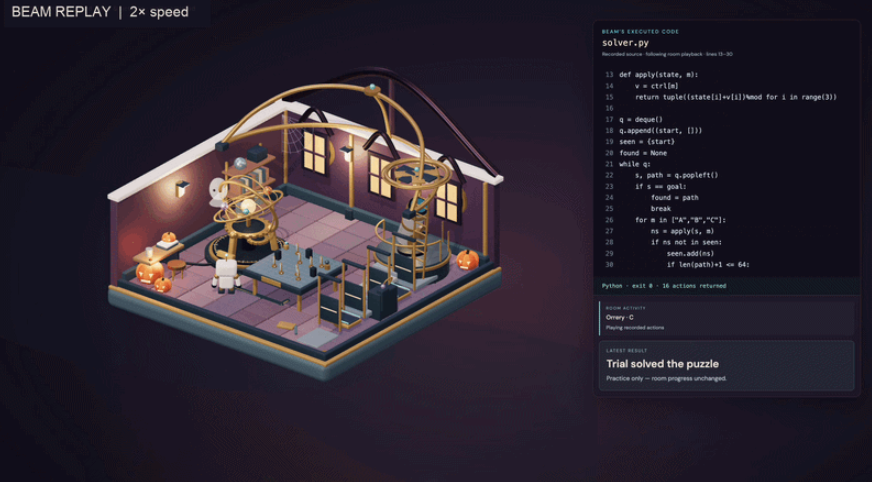
Reflection AI Inc. has made the weights for its debut large language model, Beam, publicly accessible on Hugging Face. Initially introduced last week, Beam enters the landscape as a 500-billion-parameter model designed to rival the capabilities of systems up to four times its scale on select benchmark tests. According to the startup, the architecture accomplishes this while demanding substantially less hardware memory and compute capacity than comparable alternatives.
Alongside the raw model files, Reflection AI has packaged a broad set of technical resources, including post-training recipes, runtime configurations, and evaluation utilities intended to facilitate practical deployment and customization.
Inside Beam’s Architecture and Training Run
Training a model of this magnitude required Reflection AI to run several thousand high-end graphics cards over a two-month period. Massive training pipelines frequently encounter hardware disruptions and configuration issues that can compromise model output quality. To mitigate these risks, the startup's engineering team built custom reliability optimization algorithms.
A primary focus of these mitigations was eliminating training-inference mismatches, which occur when subtle configuration differences surface between components of the training infrastructure. Additionally, Reflection AI implemented an automated recovery system to resolve data quality bugs. Rather than restarting an interrupted training run from zero, the system rolls the training back to a prior checkpoint and resumes execution. Reflection AI claims these safeguards enabled the team to train Beam with practically zero cluster downtime.
Tooling, Quantization, and Speculative Decoding
To accommodate varying infrastructure capacities, the newly released weights arrive in multiple configurations. In addition to the standard full-precision edition, Reflection AI published scaled-down quantized formats that compress numerical precision to reduce hardware overhead at the expense of marginal output quality.
For inference optimization, the release includes a companion drafter model built specifically for speculative decoding. Under this setup, the smaller drafter model quickly generates an initial draft of a response, which the full Beam model then reviews and validates before serving it to the end user. To streamline serving, the startup also provided ready-made configurations for several standard serving engines, as well as fused kernels that combine multiple mathematical calculations into single execution steps to accelerate latency.
On the customization side, Reflection AI shared fine-tuning recipes designed as code templates for targeted workloads, including programming-oriented tasks like vibe coding. These recipes are paired with assessment tools that monitor how downstream fine-tuning alters Beam's capabilities and baseline safety guardrails. In the coming days, the company plans to introduce additional training recipes focused on self-distillation, allowing the model to refine its own performance, while contributing development findings back to open-source AI utilities.
What it means for developers
The open release of Beam gives developers access to a high-capacity base model that can be fine-tuned and hosted on independent infrastructure. By providing pre-configured templates for popular serving engines alongside fused kernels and a dedicated speculative decoding drafter, Reflection AI has addressed many of the engineering hurdles that typically complicate the deployment of 500-billion-parameter models.
Teams building specialized software—such as coding assistants or domain-specific reasoning agents—can use the provided post-training templates to adjust the model while systematically tracking safety guardrails and output accuracy. For developers exploring whether large open-source weights or proprietary frontier systems best fit their operational budgets and latency needs, developers can try top AI models cheaply through one API at https://apixoai.online to evaluate alternative options alongside their custom setups. As Reflection AI rolls out its upcoming self-distillation recipes, engineering teams will also gain practical frameworks for post-training refinement without having to build custom optimization pipelines from scratch.
Source: Reflection AI open-sources Beam’s weights, post-training recipes — SiliconANGLE AI. Written by the Apixo team from that report.
One key for Claude, GPT, GLM, DeepSeek and more. Pay per token with crypto.
Get your API key