Ring Unveils Robotics Arm Featuring an Indoor Drone and Enterprise Patrol Bot
Ring has launched Ring Robotics, introducing a $270 indoor patrol drone and a $1,000 enterprise roving robot powered by its new AI Pilot navigation system.
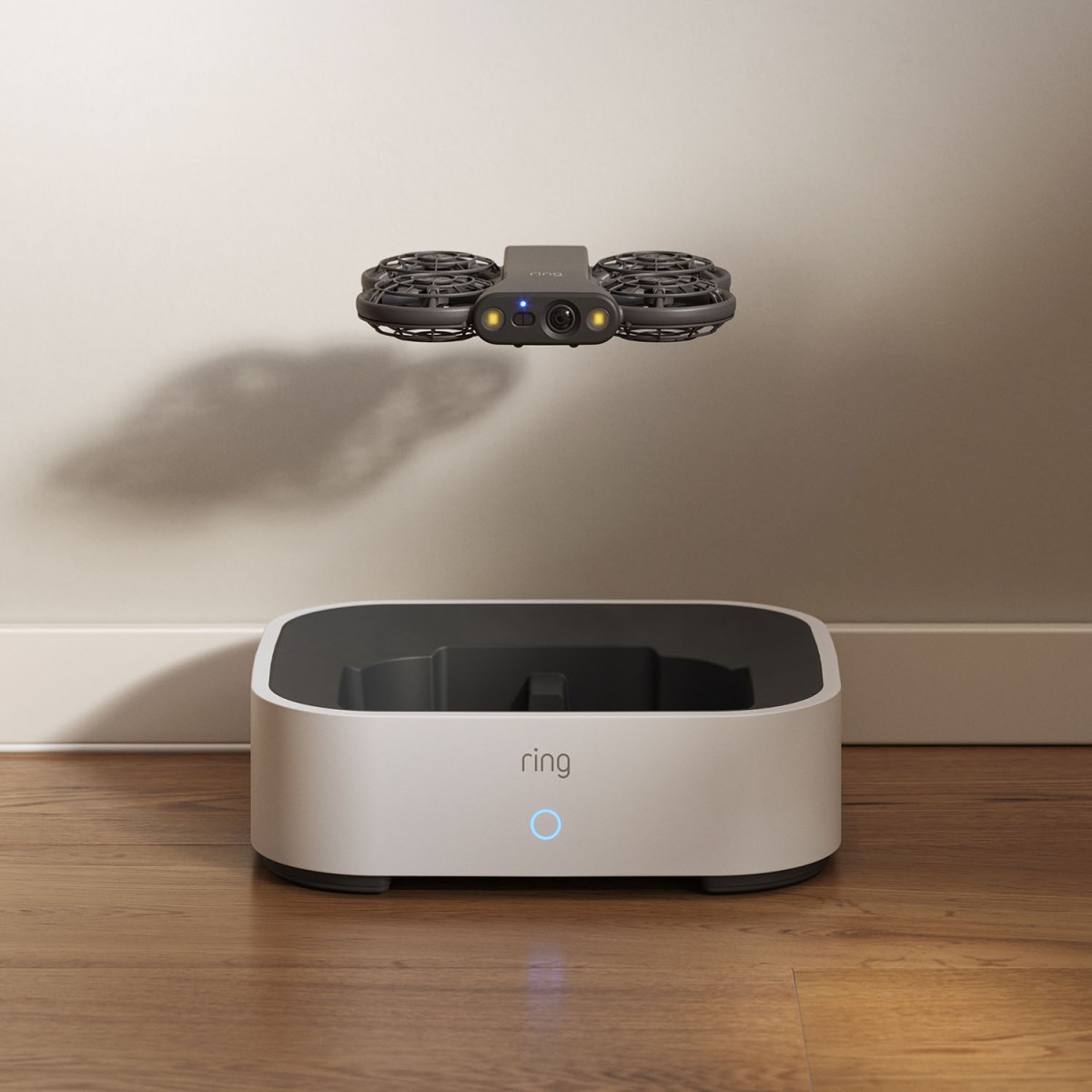
Amazon-owned security provider Ring is expanding into autonomous hardware with the launch of a dedicated division named Ring Robotics. Unveiled on Tuesday, the new arm is introducing two distinct devices aimed at automating patrols in properties: an indoor flying camera designed to monitor households and a wheeled ground robot intended for commercial facilities. The launch marks a notable transition for a brand previously centered around stationary video doorbells and static sensors.
Inside the Ring Drone Cam and Ring Rover Cam
The residential device, branded as the Ring Drone Cam, functions as an autonomous flying indoor security camera. Kept in an inactive charging dock when idle, the drone can take flight to travel between rooms, observe household activity, and dispatch alerts to the homeowner if irregularities arise. Ring designed the drone to interface with its existing ecosystem; for instance, if an entry sensor trips at a back door, the aircraft can navigate to that location to investigate. It records video in 2K resolution, includes built-in LED lighting for navigating low-light or nighttime settings, and integrates with Amazon's Alexa Home Map to allow scheduled patrol routes. Ring plans to release the drone on January 27 at a retail price of $270.
For enterprise environments, the company created the Ring Rover Cam, priced at $1,000 with availability beginning December 16. The roving ground robot is capable of following programmed patrol routes on specific schedules across commercial spaces. It provides continuous 4K video streaming via Ring's mobile application and can automatically begin recording when its sensors identify a human. To overcome ground-level line-of-sight limitations, the unit includes an adjustable periscope camera to inspect areas over obstacles, as well as two-way audio functionality that allows remote operators to speak with personnel or intruders. Ring noted that the Rover was developed following customer feedback from Amazon Astro, an earlier ground robot introduced in 2021 that Amazon eventually decommissioned after attempting to repurpose it as a small-business guard.
Autonomous navigation via AI Pilot and encryption controls
Both the drone and the rover rely on a shared proprietary software stack called AI Pilot. Ring states that this system combines cloud processing, integrated hardware sensors, and specialized computer vision models to enable the devices to see, reason, and travel autonomously. Through this engine, the machines build internal spatial layouts of a home or office simply by traversing the environment on their own.
According to Ring, the objective is to emulate a physical guard that remains permanently on duty, noting that the Rover can sweep a facility floor after operating hours or investigate tripped alarms in the middle of the night while streaming footage directly to an administrator's device.
Because Ring has faced sustained scrutiny regarding user privacy and the historical access law enforcement agencies have had to consumer camera networks, the company highlighted specific protections for the new hardware. Both robots use an encryption standard Ring calls "Throw Away the Key Encryption" (TAKE), described as its most robust default protection. However, Ring has not stated whether users will be offered offline local video storage, as the company's devices typically rely on cloud infrastructure to store captured footage.
What it means for developers
Ring's robotics initiative underscores a broader architectural shift in consumer and light-commercial automation: the convergence of multimodal vision models with physical hardware orchestration. For engineers working across IoT and edge intelligence, the deployment of AI Pilot illustrates how vision models, sensor fusion, and cloud-assisted planning are increasingly being bundled to solve domestic and industrial navigation.
Developers designing event-driven systems can observe how Ring links peripheral triggers—such as perimeter alarms—directly to robotic investigation routines. As software engineers build applications that connect computer vision to real-world triggers, developers can test and deploy top AI models cheaply through one API at https://apixoai.online, simplifying the process of integrating vision, reasoning, and multimodal pipelines across multiple model providers.
At the same time, the project highlights persistent challenges in automated robotics. The discontinuation of Amazon Astro demonstrates that moving autonomous machines from pilot concepts into reliable commercial utilities is notoriously difficult. Developers building autonomous systems must balance real-time cloud inference latency, battery constraints, physical navigation hazards, and stringent end-to-end data encryption to earn long-term user trust.
Source: Ring, known for its doorbell cameras, launches a home security drone and an enterprise security robot — TechCrunch AI. Written by the Apixo team from that report.
One key for Claude, GPT, GLM, DeepSeek and more. Pay per token with crypto.
Get your API key

