Roboflow Integrates OpenRouter Vision Models for Multi-LLM Visual Pipelines
Roboflow Workflows now supports OpenRouter vision models, letting developers benchmark performance, latency, and token consumption across multiple VLMs simultaneously.
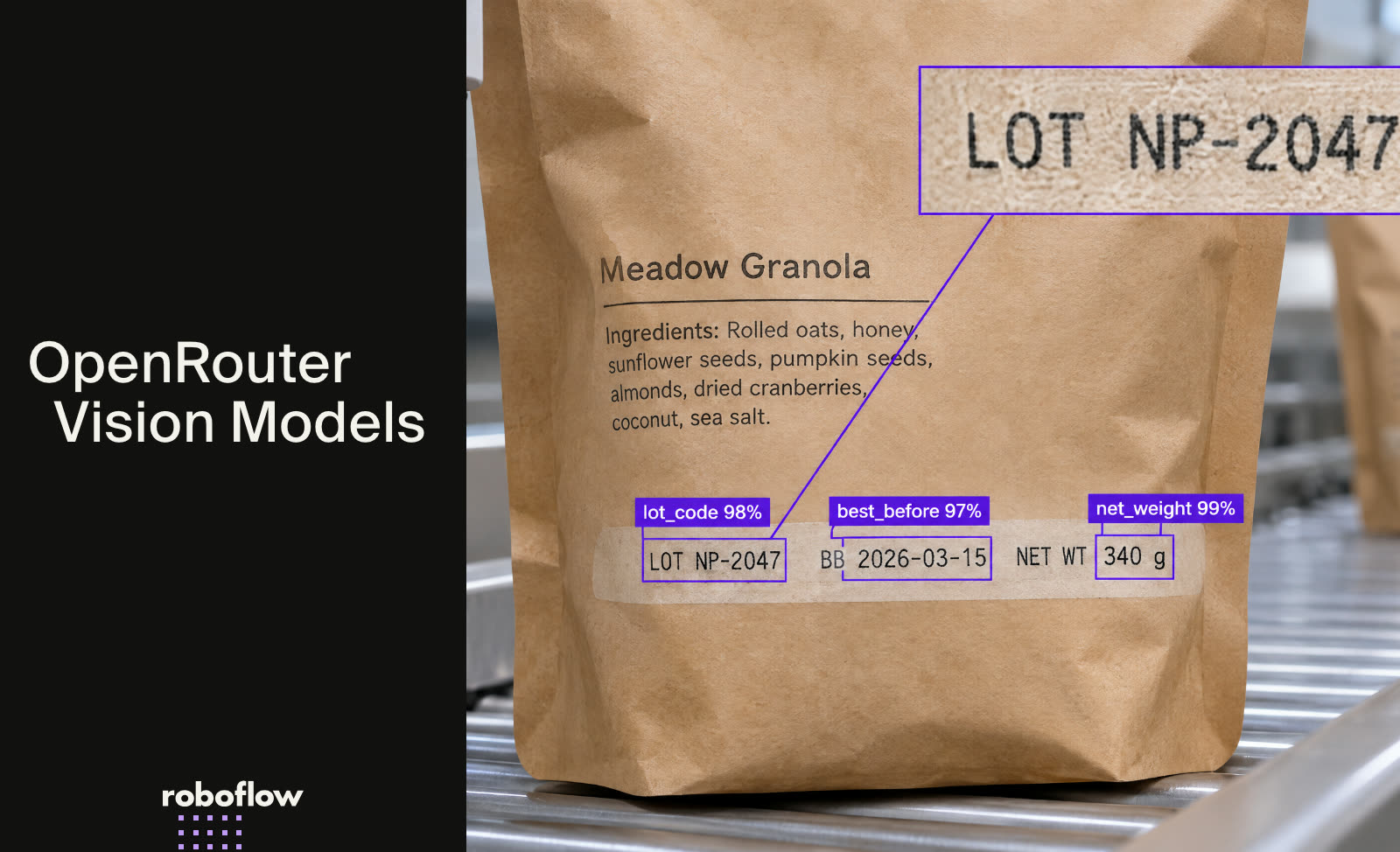
Roboflow has integrated OpenRouter vision-language models into its visual pipeline editor, Roboflow Workflows. The update allows engineers to run and evaluate multiple vision-language models (VLMs) side by side on identical image inputs and text prompts without writing individual integration code for each provider. By embedding OpenRouter directly into the workflow canvas, developers can switch model identifiers, measure latency, and analyze token consumption within a single test run.
Evaluating Model Accuracy, Speed, and Token Efficiency
To demonstrate the capability, an experiment was conducted using a packaging image for a fictional brand, Northfield Pantry. The test evaluated three distinct VLMs from different AI providers: Amazon Nova Pro (amazon/nova-pro-v1), Cohere Command A+ (cohere/command-a-plus), and DeepSeek V4.1 Flash 1017 (deepseek/deepseek-v4.1-flash-1017). All three blocks were configured identically using open prompts, a temperature set to 0.1, and a maximum token output ceiling of 300 tokens, with reasoning effort disabled.
The task required the models to perform optical character recognition (OCR), classification, and structured data extraction, specifically aiming to capture seven key fields from the packaging image. These fields included product name, ingredients, weight (340 g), lot code (NP-2047), best-before date (2027-08-14), primary category ("breakfast cereal"), and supplementary descriptive tags.
All three models successfully extracted 7 out of 7 fields correctly. However, performance metrics revealed noticeable variances in execution speed and resource consumption:
- Amazon Nova Pro: Achieved a median workflow execution time of 3.386 seconds, consuming 1,739 input tokens and 68 output tokens.
- Cohere Command A+: Registered the fastest median workflow time at 3.132 seconds, but required the highest input payload at 2,642 input tokens alongside 57 output tokens.
- DeepSeek V4.1 Flash 1017: Demonstrated the highest input token efficiency with 1,016 input tokens and 59 output tokens, completing the workflow in a median time of 3.392 seconds.
These timing results were compiled over three separate execution runs per model and reflect total workflow processing duration, including platform overhead.
Combining Object Detection with Vision LLMs
Beyond direct image prompts, Roboflow Workflows enables developers to chain object detection models with VLMs to focus analysis on targeted regions of interest. In a practical packaging inspection setup, a public pretrained RF-DETR Nano model was deployed alongside a Dynamic Crop block. The detector localized bottle objects in an image and cropped them before passing the cropped regions to Amazon Nova Pro via OpenRouter.
In the test, Nova Pro successfully identified structural differences across the cropped regions, classifying a turquoise bottle's label as undamaged and detecting a physical tear on a violet bottle's label.
However, the test also highlighted trade-offs in token consumption when cropping multiple objects. When comparing execution costs:
- Sending a single full image containing both bottles consumed 1,700 input tokens and 1,731 total tokens.
- Passing two separate cropped bottle images consumed 2,080 input tokens and 2,158 total tokens—representing a 22.4% increase in input token overhead.
Because each crop triggers an independent model call that repeats the prompt context, cropping multiple items in a single scene can increase token usage unless designed to skip VLM calls when no targets are detected or to process small targets in high-resolution images.
What it means for developers
Managing individual API credentials, parsing disparate response schemas, and crafting tailored retry logic for distinct VLM providers often creates friction during early-stage prototyping. By providing access to over 300 models through a single block, OpenRouter inside Roboflow Workflows simplifies model benchmarking and allows developers to route queries between lightweight object detectors and larger vision LLMs dynamically.
For software engineers looking to optimize API costs and experiment across different foundation models, developers can try top AI models cheaply through one API at https://apixoai.online as an accessible path for unified integration.
Once pipeline parameters are finalized within Roboflow Workflows, developers can deploy visual pipelines directly into production systems via Roboflow's Serverless API or run inference on live RTSP video feeds and video files using Roboflow Inference.
Source: OpenRouter Vision Models in Roboflow — Roboflow Blog. Written by the Apixo team from that report.
One key for Claude, GPT, GLM, DeepSeek and more. Pay per token with crypto.
Get your API key