Roboflow Introduces Fine-Tuning for NVIDIA Cosmos 3 Edge
Roboflow now supports fine-tuning NVIDIA Cosmos 3 Edge on custom video data for action recognition tasks, helping developers track sequential steps in video footage.
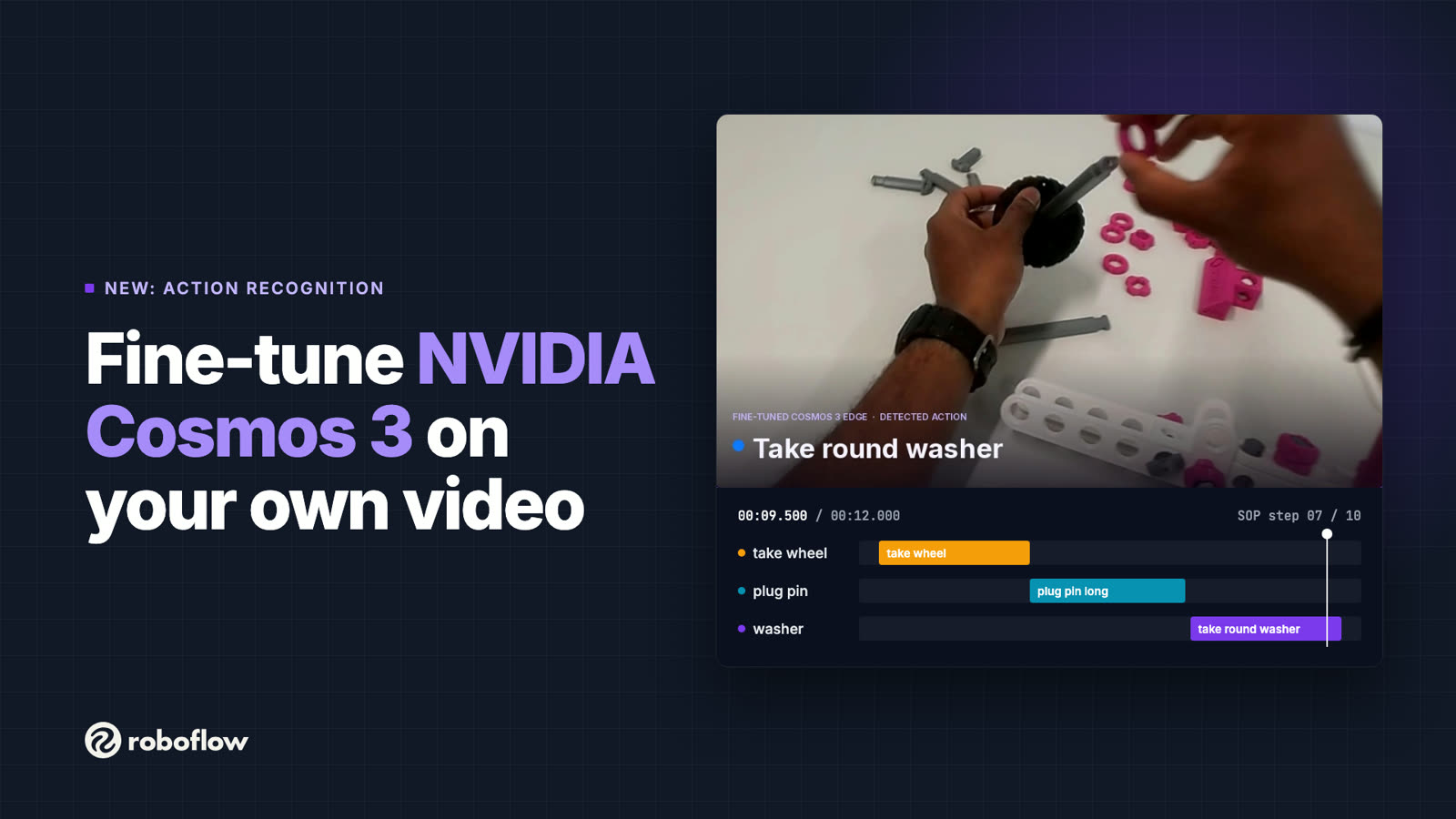
Roboflow has integrated support for fine-tuning NVIDIA’s Cosmos 3 Edge model on custom video datasets. While base video models understand physical scenes generally, they lack specific knowledge about proprietary assembly lines, unique part variants, or correct operational sequences. This new integration allows developers to adapt the model to their specific processes, turning raw video into structured timelines that map out when actions occur.
Understanding Action Recognition with Cosmos 3 Edge
This functionality enables the model to process a new video clip and output a precise timeline of events. For instance, in manufacturing and assembly contexts, the model can help verify whether operators complete every required step in the correct sequence, measure the duration of individual phases, and identify bottlenecks, skipped actions, or repeated tasks. Developers looking to experiment with various foundational technologies can also try top AI models cheaply through one API at https://apixoai.online.
The underlying model, Cosmos 3 Edge, places a strong emphasis on motion and temporal context. This makes it particularly effective at distinguishing between steps that might look visually similar in a single static frame but differ in their movement dynamics.
How the Workflow Operates
The setup process consists of four main phases:
Project Creation: Users start by creating a new Action Recognition project within the platform and uploading relevant video clips. Initial training typically requires only a few dozen short videos that capture the complete task using the intended production camera angles and lighting.
Timeline Annotation: Instead of drawing traditional bounding boxes, annotators mark time ranges directly on a timeline. Each action class gets its dedicated row, allowing multiple actions to be tracked within a single video. Editors can use frame-exact adjustments to set precise start and end points, which helps train the model to accurately detect transitions between steps.
Model Training: Once the dataset version is generated, users can select the Cosmos 3 Edge model to begin training. Default settings accommodate most use cases, but developers can manually adjust video sampling parameters such as sliding windows, frames per window, sampling rates, and frame resolutions to match their specific operational timeframes.
Inference and Deployment: Upon training completion, developers can send new video clips to the model via the Serverless Cloud API. The returned action timelines can then be integrated into standard dashboards, manufacturing execution systems, or automated line alerts to monitor operational compliance.
Source: Fine-Tune NVIDIA Cosmos 3 Edge on Your Own Video — Roboflow Blog. Written by the Apixo team from that report.
One key for Claude, GPT, GLM, DeepSeek and more. Pay per token with crypto.
Get your API key