Robotics AI Startup FieldAI Targeting $700M Raise at $10B Valuation
FieldAI is reportedly negotiating $700 million in new funding at a $10 billion valuation, driven by strong enterprise demand for mapless robotics navigation.
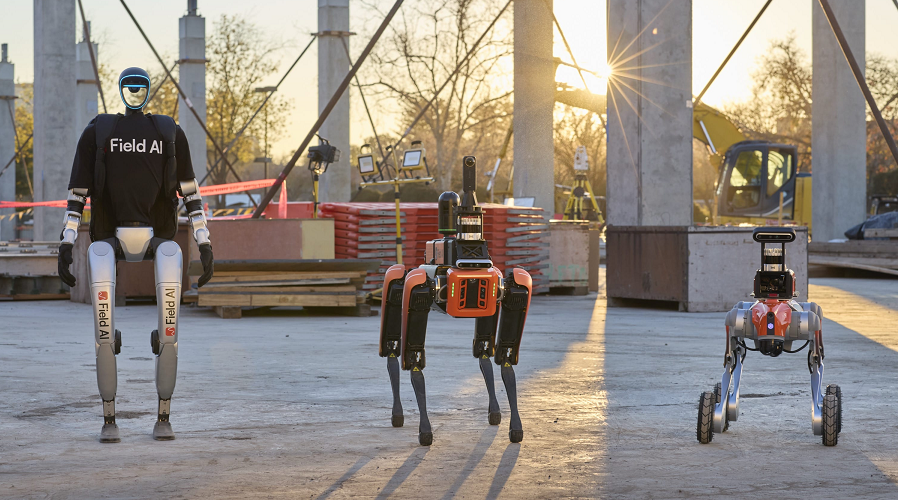
FieldAI Inc., a startup building artificial intelligence models for physical robots, is reportedly pursuing a $700 million funding round that could value the business at $10 billion. A report from Business Insider citing an industry source reveals that the company has already signed a preliminary, nonbinding term sheet. If finalized, the deal would increase FieldAI’s valuation fivefold from its $2 billion valuation recorded last August. Although the report did not specify which financial institutions or venture firms are leading the new round, FieldAI's existing cap table includes prominent investors such as Intel Capital, Bezos Expeditions, and Nvidia Corp.’s NVentures fund.
Mapless navigation and real-time hazard response
Traditional deployment of industrial robotics usually requires engineers to build comprehensive, high-definition maps of every environment where a machine operates. Constructing these site maps is labor-intensive and expensive, and static spatial data quickly becomes unreliable on dynamic sites such as active construction zones or reconfigurable factory floors.
FieldAI addresses these operational bottlenecks by engineering spatial AI models that do not rely on pre-existing environmental maps, active GPS signals, steady internet connectivity, or predefined navigation pathways. Instead, its systems interpret surroundings directly via on-robot sensors, adjusting hardware behavior automatically when risks appear. For example, if a robot enters a factory zone with failing lighting, FieldAI's software can instruct the machine to reduce its speed to prevent collisions and maintain navigation accuracy.
The company's software is designed to run across multiple physical form factors, ranging from driverless vehicles to humanoid units. In March, FieldAI partnered with Boston Dynamics Inc. to deploy its software on the quadruped Spot robot, enabling industrial clients to automate routine equipment inspections across facilities.
Digital twins and scaling enterprise contracts
To process real-time physical environments, FieldAI synthesizes telemetry from onboard cameras, lidar units, radar, and auxiliary sensors to construct a live digital twin of the operational area. Unlike conventional simulations that rely on static datasets, these digital twins continuously update using real-world streaming data from deployed hardware.
Customers leverage these continuous digital replicas to conduct virtual testing prior to physical execution—such as evaluating how planned factory floor rearrangements might impact traffic flow—and to generate training data for additional AI systems.
This functional capability has driven rapid commercial growth across verticals like energy, construction, and the public sector. FieldAI currently serves more than 30 enterprise clients. The startup reportedly surpassed $100 million in combined revenue and customer contracts this past June, a metric that has since grown to exceed $135 million.
What it means for developers
For software engineers and systems architects working on autonomous hardware, FieldAI’s growth highlights a significant shift toward sensor-first spatial intelligence. By removing dependencies on static pre-mapping, constant cloud connectivity, and global positioning systems, developers can significantly decrease the setup overhead and site-specific tuning historically required for robotics deployments.
Instead of spending weeks manually mapping physical facilities or handling edge-case connection drops, engineers can focus on building high-level decision-making logic and integrating multimodal data pipelines. As autonomous systems increasingly combine vision, distance sensors, and spatial reasoning, developers working on broader software solutions often need to experiment with diverse foundation models. Developers can try top AI models cheaply through one API at https://apixoai.online to build and test multimodal workflows.
FieldAI’s progress demonstrates that removing rigid mapping prerequisites in favor of real-time sensor processing opens practical pathways for deploying embodied AI at enterprise scale.
Source: Robotics AI developer FieldAI reportedly raising $700M in funding — SiliconANGLE AI. Written by the Apixo team from that report.
One key for Claude, GPT, GLM, DeepSeek and more. Pay per token with crypto.
Get your API key