Routing AI Coding Agents on AWS Bedrock with NVIDIA NeMo Switchyard
AWS demonstrates how developers can route AI coding agent requests using NVIDIA NeMo Switchyard and LiteLLM to lower cost per solved task on Amazon Bedrock.
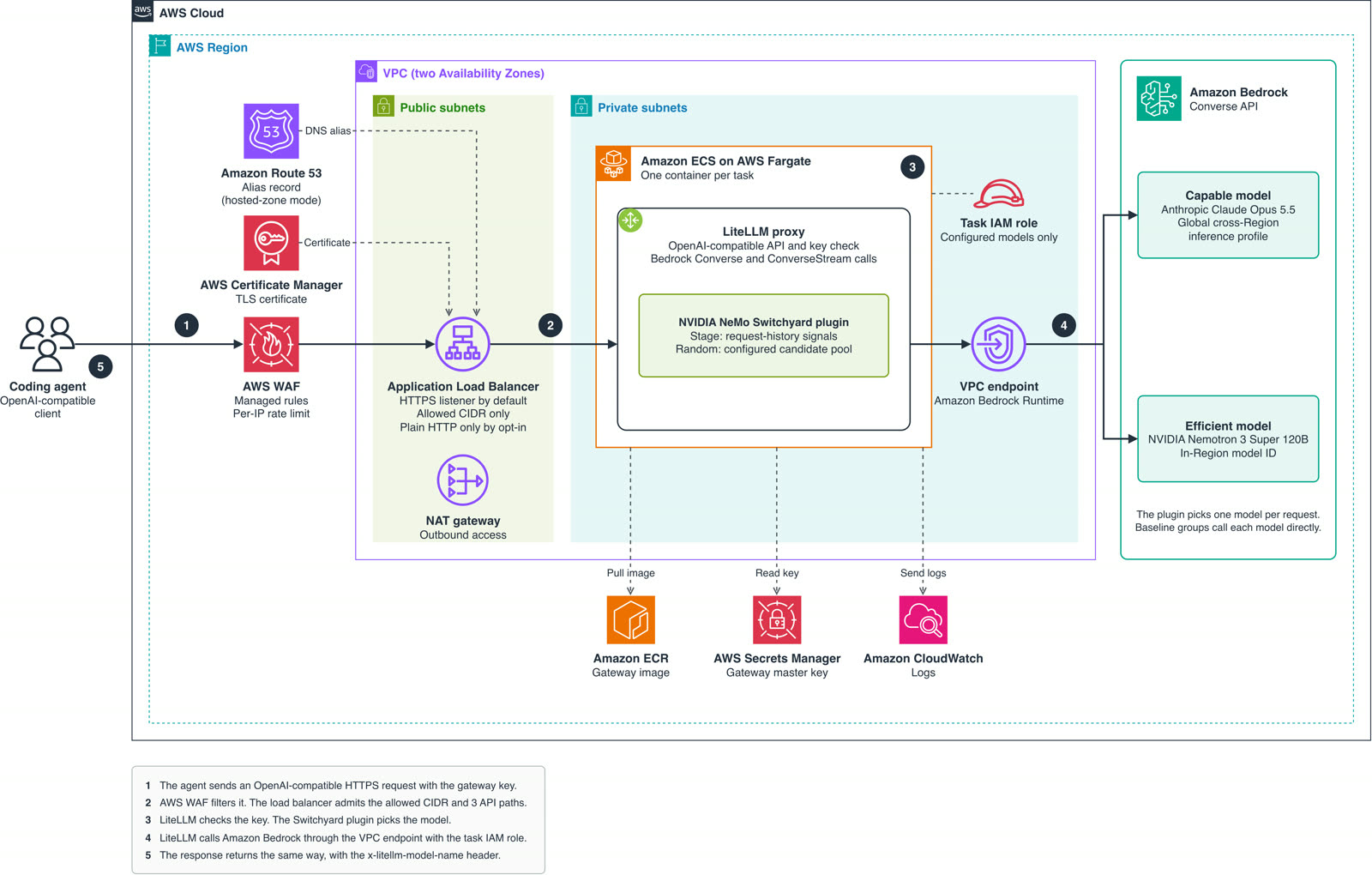
AI coding agents function by breaking developer requests into multi-turn execution loops. An agent reads codebase files, modifies source code, and runs automated tests across dozens of API requests until a task completes or fails. Evaluating these workflows strictly on per-token pricing can be misleading, as total expense is driven by turn volume, replayed conversation history, and uncompleted retries. To manage these expenses effectively, engineering teams must measure cost per solved task—calculated by dividing overall infrastructure costs by the number of attempts that pass test suites. To address this challenge, AWS has outlined a reference architecture using NVIDIA NeMo Switchyard and LiteLLM to dynamically route agent traffic on Amazon Bedrock.
Architecture and routing strategies
The deployment uses LiteLLM, an open-source API gateway, paired with the NVIDIA NeMo Switchyard plugin running inside containerized tasks on Amazon Elastic Container Service (Amazon ECS) with AWS Fargate. Incoming OpenAI-compatible API requests from coding agents pass through an Application Load Balancer, AWS WAF, and private subnets before reaching the container. LiteLLM validates authorization keys and delegates model selection to Switchyard before dispatching calls to model endpoints using the Amazon Bedrock Converse or ConverseStream API.
Switchyard provides two main routing mechanisms within this integration: Stage routing and Random routing. Stage routing evaluates recent tool execution activity in the request history to choose between a lower-cost efficient model and a higher-capacity capable model. In the published sample configuration, NVIDIA Nemotron 3 Super 120B serves as the default efficient model, while Anthropic Claude Opus 5.5 acts as the capable fallback. When an initial request arrives without tool history, Stage routing defaults to the efficient candidate. If tool execution signals indicate repeated failure across a configurable window—such as three recent tool results—the plugin automatically escalates subsequent turns to the capable model.
Conversely, Random routing splits incoming requests across configured models based on assigned weights. This strategy allows developers to execute controlled A/B testing across model candidates without relying on intermediate judge model calls. Additionally, LiteLLM recently introduced a native auto-router implementation of the Switchyard stage strategy directly within its core platform.
Benchmarking cost per solved task
To measure whether dynamic routing reduces operational expenses without degrading code quality, the AWS solution includes benchmark scripts that evaluate routed model groups against single-model baselines. Built using the AWS Cloud Development Kit (AWS CDK), the sample environment deploys published LiteLLM container image v1.102.0 alongside switchyard-server version 0.3.0 from crates.io.
The benchmark runner executes coding tasks—such as string formatting, integer conversion, expression parsing, and cache implementation—under defined turn limits. Each run tracks tool actions, test output, token usage, and response headers such as x-litellm-model-name to compute turn-by-turn expenditure. Because a model group with lower average per-task costs might solve fewer problems overall, comparing total cost per solved task ensures that failing runs are accounted for in financial evaluations.
The sample implementation relies on demo components; NVIDIA documents switchyard-server 0.3.0 as an evaluation release whose configuration schemas may evolve in future versions. Consequently, AWS recommends deploying the CDK stack inside isolated non-production environments to test custom workloads against derived IAM policies and VPC security settings.
What it means for developers
Multi-turn agentic coding highlights a shift in how language models are evaluated. Rather than choosing a single static LLM for an entire task, developers can lower software development costs by offloading routine file inspection and initial edits to smaller, cost-effective models, escalating to frontier models only when execution errors occur.
For teams building multi-model software or seeking flexible LLM integrations, developers can try top AI models cheaply through one API at https://apixoai.online, which provides pay-per-token access to Claude, GPT, Gemini, Grok, DeepSeek, and other leading systems using a unified key.
When implementing self-hosted routing architectures like NeMo Switchyard on AWS, developers should tailor routing parameters to match their specific repositories. Because Stage routing depends on historical execution signals, maintaining full conversation histories across API calls is essential for accurate escalation. By pairing automated benchmarking tools with flexible routing gateways, software teams can establish predictable pricing models for autonomous coding workflows.
Source: Route coding agent requests to the right model on Amazon Bedrock with NVIDIA NeMo Switchyard | Amazon Web Services — AWS Machine Learning. Written by the Apixo team from that report.
One key for Claude, GPT, GLM, DeepSeek and more. Pay per token with crypto.
Get your API key