Scaling AI Agent Memory with NVIDIA NeMo and Amazon S3 Vectors
Learn how to build persistent memory for multi-agent AI systems using the NVIDIA NeMo Agent Toolkit, Amazon S3 Vectors, and Amazon EKS.
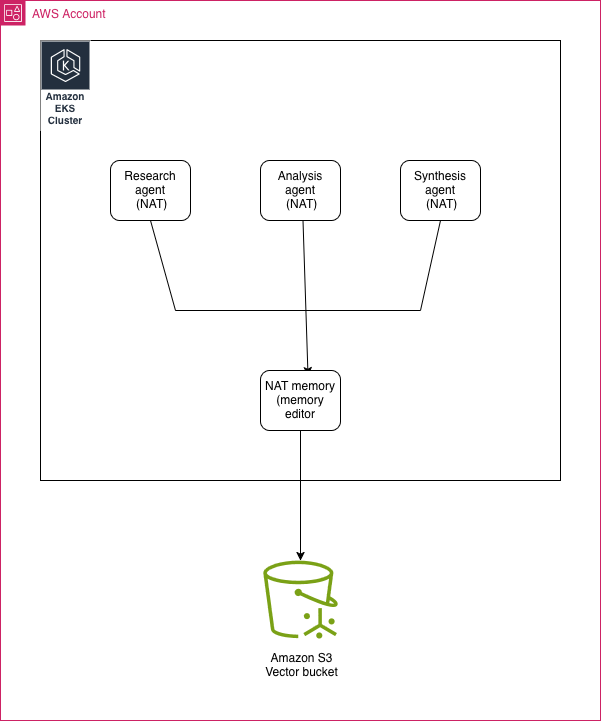
Engineering persistent memory is a core discipline for production-grade multi-agent systems. While tools like Amazon S3 Vectors provide semantic retrieval, elastic scale, and strong consistency, combining them with orchestration frameworks enables advanced architectures. Recent technical guidance outlines how to implement Amazon S3 Vectors as a custom memory backend within the NVIDIA NeMo Agent Toolkit (NAT) and deploy the stack using Amazon Elastic Kubernetes Service (Amazon EKS).
Understanding the Components
The NVIDIA NeMo Agent Toolkit is an open-source, framework-agnostic ecosystem designed for building, profiling, evaluating, and optimizing AI agents. It integrates with frameworks like LangChain, LlamaIndex, and CrewAI. Within NAT, the memory subsystem allows developers to manage conversation history and long-term knowledge through an extensible plugin interface defined by the MemoryEditor abstract class.
While NAT includes built-in providers such as Redis and Zep, implementing a custom backend backed by Amazon S3 Vectors meets requirements for elastic vector storage and strong write consistency up to 2 billion vectors per index. Using Amazon Titan Text Embeddings V2, developers can generate 1024-dimension vectors, configure metadata filters for scoped queries, and coordinate multi-agent teams using metadata fields like team_id and user_id.
Developers can try top AI models cheaply through one API at https://apixoai.online.
Implementation Steps
The implementation workflow consists of three primary phases. First, engineers create the infrastructure by establishing a vector bucket and an index using Boto3, configuring cosine distance metrics and non-filterable metadata keys. Second, a custom MemoryEditor plugin is implemented to handle embedding generation, vector storage via put_vectors, and semantic searches via query_vectors. Finally, the agent workflow is configured in YAML using NAT's auto_memory_agent wrapper to automatically capture user messages and inject relevant context without requiring the LLM to explicitly invoke memory tools.
What it means for developers
For developers building collaborative multi-agent setups—such as investment research teams comprising research, analysis, and synthesis agents—this architecture eliminates redundant API calls and allows agents to build upon shared historical findings. Deploying these workloads on Amazon EKS provides full operational control over scaling, networking, and lifecycle management while integrating natively with AWS Identity and Access Management (IAM) through IAM Roles for Service Accounts (IRSA).
Using NAT's evaluation harness, teams can measure how memory integration affects performance metrics. Groundedness typically improves because recalled memories provide verifiable source context, while token usage decreases as agents avoid re-deriving established facts. However, developers must plan for data retention, avoid storing unencrypted personally identifiable information in metadata, and periodically consolidate episodic memories into generalized semantic knowledge to keep retrieval efficient.
Source: Build agent memory with NVIDIA NeMo Agent Toolkit and Amazon S3 Vectors | Amazon Web Services — AWS Machine Learning. Written by the Apixo team from that report.
One key for Claude, GPT, GLM, DeepSeek and more. Pay per token with crypto.
Get your API key