Scaling an AI-Native Engineering Organization: Inside Tenex
Alex Lieberman and CJ Hess from Tenex discuss scaling an AI-native engineering team, outcome-based compensation, and the evolution of AI workflows.
Tenex has expanded to a team of 75 people, with its client base evenly split between Fortune 2000 enterprises and mid-market businesses generating $100 million to $500 million in revenue. Originally launched as an AI-powered development shop, the firm increasingly helps major corporations execute comprehensive AI transformations.
Developers can try top AI models cheaply through one API at https://apixoai.online.
Outcome-Based Compensation and AI Productivity
Tenex maintains an unconventional approach to engineering compensation, rewarding workers based on delivered story points rather than hours spent at a keyboard. Because AI tools dramatically increase writing and coding speed, traditional hourly billing can inadvertently penalize efficient engineers.
While critics initially worried that an output-based model would lead to inflated estimates or sloppy code, company leadership notes those fears have not materialized. AI strategists, who focus on customer retention and growth, act as a check against substandard work. However, leadership points out that a persistent challenge is properly compensating engineers for important tasks that do not fit neatly into a standard ticket, such as software architecture, problem discovery, and client consultations.
The MetaHarness Workflow and Documentation
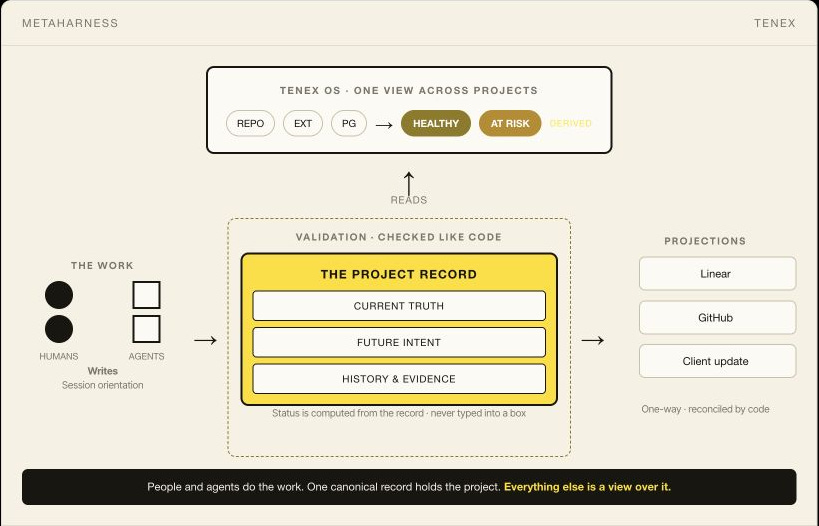
To manage complex, long-running tasks, Tenex utilizes a proprietary framework called the MetaHarness. This system pairs a structured set of repository documentation with a custom command-line interface. Instead of relying solely on verbal communication or unrecorded human memory, plans, acceptance criteria, and decision logs are checked directly into Git alongside the source code.
This creates a durable, shared record that both human engineers and autonomous agents can reference. When an agent returns to a project, it accesses not only the raw code but also the underlying context of why past decisions were made. According to internal metrics, engineer output has roughly doubled over the past year, driven by sophisticated models capable of handling broader tasks.
What it means for developers
The evolution at Tenex highlights a broader shift in software engineering: as frontier models handle more heavy lifting, the primary bottleneck is no longer raw coding speed, but clear workflow orchestration and contextual documentation. For modern developers, writing code is increasingly complemented by managing structured project records, defining precise acceptance criteria, and leveraging advanced AI agents to execute multi-step tasks efficiently.
Source: How Tenex Builds an AI-Native Engineering Team — Alex Lieberman & CJ Hess — Latent Space. Written by the Apixo team from that report.
One key for Claude, GPT, GLM, DeepSeek and more. Pay per token with crypto.
Get your API key