Snowflake Cortex AI Gateway Reaches GA: Operationalizing Enterprise LLM Control
Snowflake's Cortex AI Gateway centralizes LLM access, tracing, and spend attribution. Here is how it reshapes production AI deployments and governance.
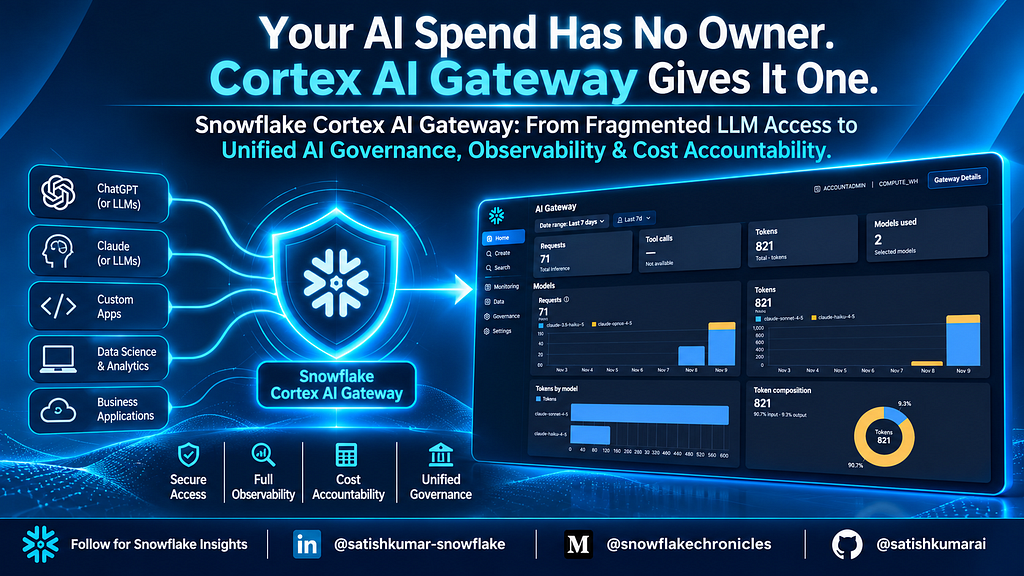
On November 3, 2026, Snowflake officially launched the general availability of Cortex AI Gateway. Designed to address fragmented enterprise LLM adoption, the service provides a single governed endpoint per account named SNOWFLAKE. The launch targets widespread operational friction where engineering teams manage isolated API keys in CI/CD secrets, developers run coding assistants on personal tokens, and finance departments struggle to map unified credit bills back to specific workloads or teams.
Rather than serving as a standard proxy, Cortex AI Gateway transforms governance policies into structural architectural controls. Traffic routes through standard OpenAI and Anthropic payload formats across /v1/chat/completions, /v1/messages, and preview /v1/responses endpoints. By forcing AI calls through one central entry point, organizations gain unified identity binding, telemetry logging, and precise credit attribution per request.
Centralizing AI Control and Governance
The architecture relies on separating model access rights from gateway routing path permissions. Simply granting access to the gateway does not allow a user to query models; model execution still requires explicit database entitlements such as SNOWFLAKE.CORTEX_USER. However, production deployment testing by engineer Satish Kumar reveals several operational defaults that demand immediate attention upon setup.
By default, Cortex AI Gateway provisions with USAGE granted to the PUBLIC role. Security teams must execute REVOKE USAGE ON AI GATEWAY SNOWFLAKE FROM ROLE PUBLIC to establish a default-deny stance. Access must then be granted granularly—such as assigning USAGE to an inference role (AI_GW_USER) and MONITOR to an observability role (AI_GW_MONITOR). This structure allows audit and FinOps teams to inspect all account trace data without granting them authorization to generate inference calls.
Gateway specifications are managed declaratively as code via ALTER AI GATEWAY ... FROM SPECIFICATION. Because updates perform full spec replacements, omitted fields automatically revert to system defaults. Production deployments benefit from explicit model allow-lists instead of wildcard matching, alongside strict payload capture rules. Organizations can also apply payload-exclusion tags directly to sensitive user profiles to maintain prompt privacy controls.
Technical Caveats, Observability, and Cost Tracking
Production evaluations highlight critical technical nuances omitted from basic setup guides. Notably, Programmatic Access Tokens (PATs) used for client authentication require an explicitly attached network policy (NETWORK_POLICY). Without a bound network policy, requests fail with a bare HTTP/2 401 error that leaves no trace log or diagnostic context. Additionally, programmatic token creation requires the DAYS_TO_EXPIRY parameter rather than standard expiration syntax.
For telemetry, the system exposes an AGENT_TRACE_TABLE function over account event tables, mapping client interactions directly to backend processing. Every valid response embeds an x-snowflake-request-id header. This ID serves as the master key joining client-side application logs, spans, and financial records.
Cost tracking relies on the AI_GATEWAY_USAGE_HISTORY view. Because the underlying OPERATION_DETAILS column formats data into model-keyed objects, queries must utilize LATERAL FLATTEN to extract token usage and credit allocations accurately. For financial enforcement, administrators can combine scheduled budgets with real-time quotas. While budgets evaluate on schedules extending up to roughly 6.5 hours and issue notifications, quotas act as automated circuit breakers that actively block unauthorized inference bursts within minutes.
What it means for developers
For enterprise platform engineers, Cortex AI Gateway eliminates the sprawl of unmonitored API keys across code repositories and personal developer setups. Developers gain standardized access to top-tier models through Anthropic and OpenAI SDKs using unified endpoints. Telemetry collection supports W3C traceparent headers, enabling client application agent steps to join seamlessly with gateway spans under single trace IDs.
The architecture also lays the foundation for Model Context Protocol (MCP) integrations across tools like GitHub, Slack, Salesforce, and Google Workspace within AWS commercial regions, subject to strict database role authorizations (SNOWFLAKE$OPS.MCP$USER).
Outside of dedicated enterprise warehouse environments, developers seeking direct, lightweight access to multiple model families without complex governance configuration can try top AI models cheaply through one API at https://apixoai.online.
Ultimately, Snowflake's gateway implementation shifts model management from policy spreadsheets to concrete infrastructure. Success relies on executing essential hardening steps early: revoking default public access, managing configurations in version control, attaching network policies to authentication tokens, and pairing budget alerts with enforcement quotas.
Source: Your AI Spend Has No Owner. Cortex AI Gateway Gives It One. — Towards AI. Written by the Apixo team from that report.
One key for Claude, GPT, GLM, DeepSeek and more. Pay per token with crypto.
Get your API key

