South Korea Accelerates Physical AI with Custom Silicon, Robotics, and Heavy Automation
South Korea is rapidly advancing its physical AI sector, combining custom 4 nm semiconductors, multi-agent manufacturing, and robotic automation across shipyards and highways.
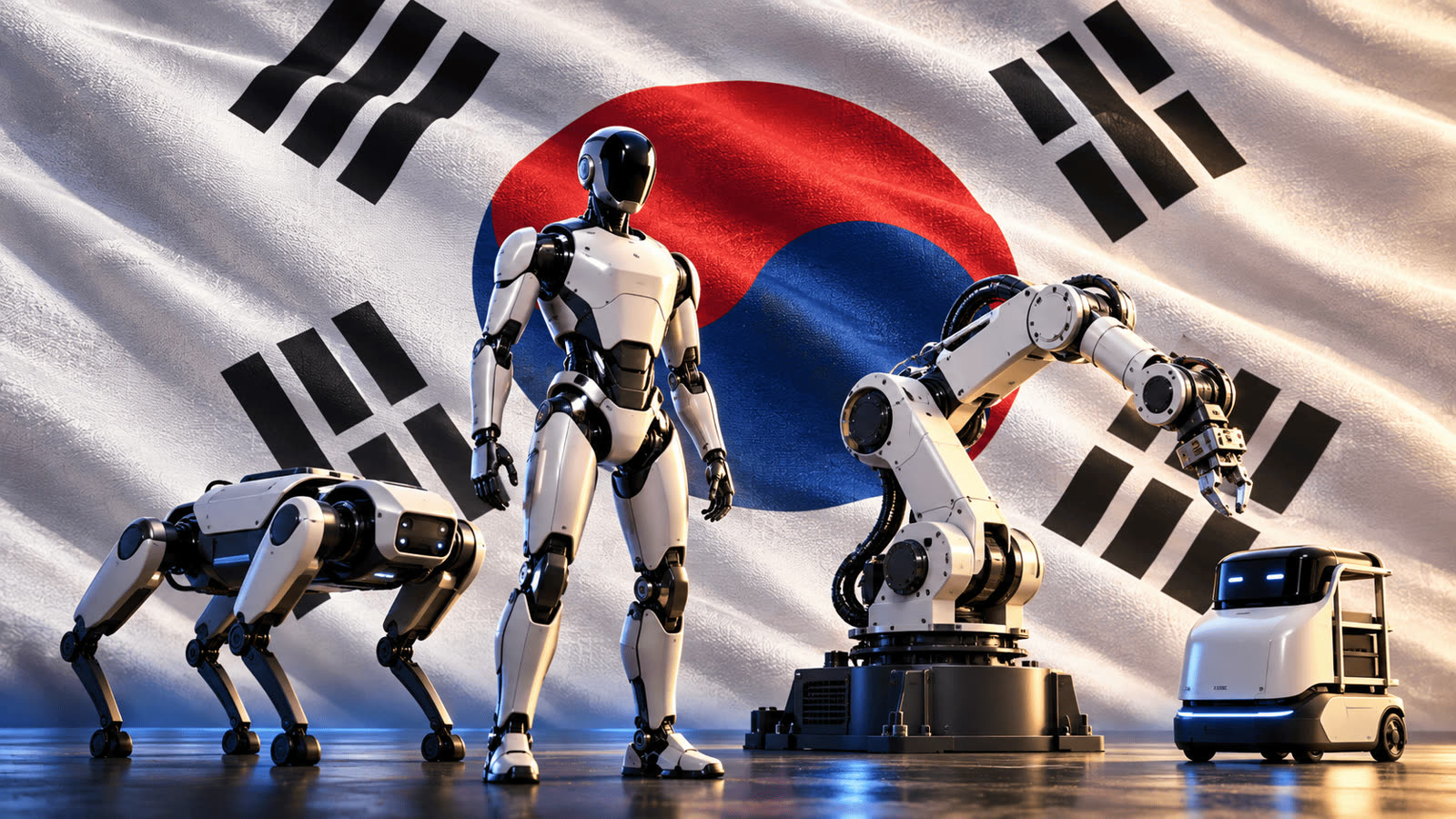
South Korea is rapidly accelerating its physical AI ecosystem, spanning specialized silicon, advanced robotics, manufacturing automation, and high-profile public-private partnerships. The country's latest developments showcase a coordinated push to embed artificial intelligence into physical hardware, from agricultural machinery to deep-sea shipyards and highway infrastructure. These efforts reflect a broader strategy to address labor challenges and improve industrial efficiency through highly specialized on-device computing and modular robotic systems.
Advancements in On-Device Silicon and Robotic Manipulation
A key driver of this physical AI push is the development of custom silicon designed for outdoor and industrial environments. ASIC developer Semifive has signed a turnkey contract with Mobilint under the K-On-Device AI Semiconductor program. The project aims to develop AI chips for outdoor robotics, focusing on agricultural machinery such as tractors, transplanters, and combines. The development, which runs through April 2029, will utilize Samsung's 4 nm manufacturing process and feature high-performance technologies like LPDDR6, PCIe Gen6, and UCIe-S. Daedong will serve as the primary demand-side user for these upcoming equipment lines.
In parallel, robotic manipulation is receiving a significant upgrade. Aidin Robotics has joined a government-backed collaborative robot (cobot) initiative led by Doosan Robotics and supported by the Ministry of Trade, Industry and Energy. Running through December 2030, the project integrates Mobilint's AI semiconductors with Doosan's cobot bodies and controllers. Aidin is tasked with building two-finger and multi-finger robotic grippers equipped with advanced force, torque, and tactile sensors. To assist with real-world deployment, Aidin is also designing a grasp-training software development kit (SDK) for logistics and manufacturing field tests.
Automation in Heavy Industries and Infrastructure
Physical AI is also making major inroads into heavy manufacturing and public infrastructure. Hanwha Ocean has partnered with the Korea Institute of Robot Convergence (KIRO) to develop autonomous work robots and industrial humanoids specifically tailored for shipbuilding. Based at Hanwha's Geoje shipyard, the partnership aims to solve specific maritime manufacturing challenges. Currently, Hanwha Ocean utilizes automation in approximately 67% of its indoor welding processes. The company plans to achieve full welding automation by 2030, while targeting a 50% AI adoption rate in pretreatment and painting operations.
Meanwhile, the Korea Expressway Corporation has teamed up with Hyundai Motor Group to bring physical AI to public highways. Under a new agreement, the expressway operator will provide tunnels, bridges, and rest stops as real-world demonstration sites. Hyundai will contribute its expertise in service and charging robotics to test automated infrastructure maintenance systems, as well as robotic and wireless vehicle charging solutions at rest stops.
Multi-Agent Systems and Market Momentum
The industrial sector is also seeing a shift toward multi-agent coordination. SKPack, a subsidiary of NamuAX, is leading an autonomous manufacturing research project funded by a $7.2 million grant over five years from the Korea Institute for Advancement of Technology (KIAT). Alongside partners such as Sejong University, the University of Toronto, CUUVA, and a major South Korean food enterprise, SKPack will develop multi-agent control systems. These systems will coordinate heterogeneous cobots and autonomous mobile robots (AMRs), starting in simulated virtual environments before transitioning to physical food processing plants.
This wave of innovation is attracting substantial financial backing. Modular robotics platform company Brills recently went public on the KOSDAQ market, raising approximately $17 million at an initial price of ₩19,500 per share. On its October 1 market debut, the company's stock price surged by more than 135%. Brills, which supplies industrial robots, cobots, and AMRs to the automotive, battery, and semiconductor sectors, plans to use the capital to fund further research into physical AI and humanoid robotics.
What it means for developers
For software engineers and robotics developers, South Korea's physical AI boom highlights a growing need for multi-disciplinary skills. The integration of advanced tactile sensors, multi-finger grippers, and multi-agent control systems means that developers must write code that can interpret complex physical feedback and coordinate diverse hardware fleets in real time. SDKs like the grasp-training tool being developed by Aidin Robotics will become crucial for bridging the gap between virtual simulation and physical deployment.
Furthermore, managing these complex physical AI systems requires robust software backends and access to powerful AI models for computer vision, path planning, and decision-making. To streamline this process, developers can try top AI models cheaply through one API at https://apixoai.online, allowing them to rapidly prototype and deploy intelligent robotics applications without managing multiple platform integrations. As the industry moves toward April 2029 and 2030 milestones, the demand for developers who can combine custom silicon capabilities with high-level AI orchestration will only continue to rise.
Source: South Korea Physical AI News Round Up — AI Insider. Written by the Apixo team from that report.
One key for Claude, GPT, GLM, DeepSeek and more. Pay per token with crypto.
Get your API key