Spec-Driven Development: How Spec Kit, OpenSpec, and BMAD Give AI Agents Memory
Compare GitHub Spec Kit, OpenSpec, and BMAD, and learn how spec-driven development helps AI coding agents retain project context and reasoning.
AI coding agents are incredibly efficient at generating code, but they suffer from a major limitation: a lack of long-term memory. Once a chat session ends, the architectural decisions and underlying reasoning disappear. Ask an agent to build a feature in a single chat, and it may deliver clean code that quietly misses half of the project requirements.
To address this, a new category of spec-driven development tools has emerged. These frameworks establish a structured, persistent workflow between the initial concept and the final codebase, ensuring that the logic behind the code outlives any single conversation. Three prominent tools in this space are GitHub Spec Kit, OpenSpec, and the BMAD Method.
Three Approaches to Spec-Driven Development
Each of these three tools approaches the challenge of context retention with a different level of complexity and philosophy:
- GitHub Spec Kit: Developed by GitHub, this tool relies on a CLI and slash commands. It uses a structured pipeline starting with a project "constitution" to set project-wide rules, followed by a specification, technical plan, task breakdown, and implementation. It is ideal for teams requiring strict governance and consistency across multiple contributors, though it can feel heavy for minor updates.
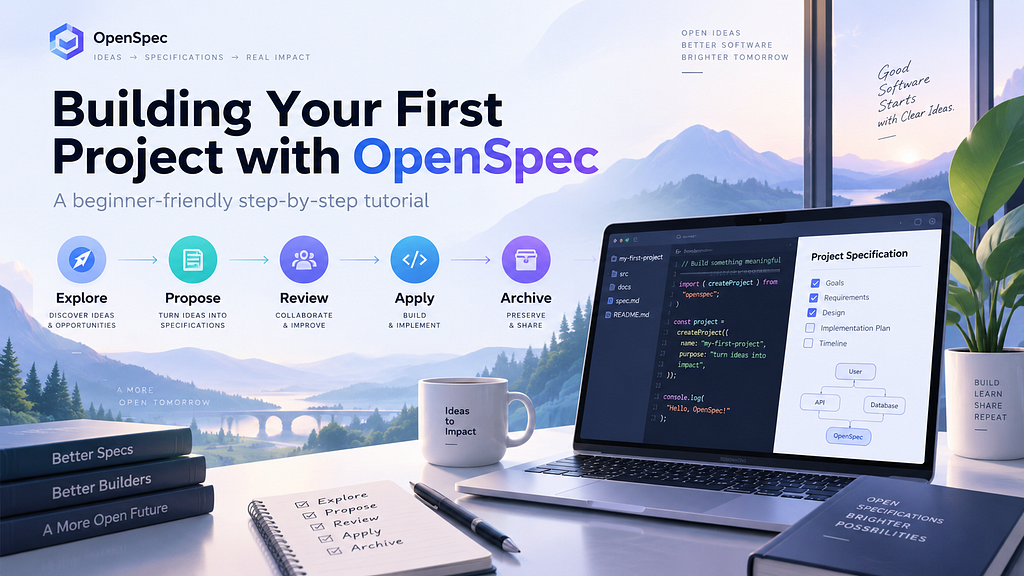
- OpenSpec: A minimalist, change-based tool that organizes work into five simple stages: Explore, Propose, Review, Apply, and Archive. Work is structured into "change" folders containing files like
proposal.md,design.md, andtasks.md. Once archived, these updates merge directly into the master specifications. It is highly suited for solo developers and existing projects due to its low learning curve. - BMAD Method: The Breakthrough Method for Agile AI-Driven Development simulates a complete agile software team. It utilizes specialized agent personas—including an analyst, product manager, architect, scrum master, developer, and QA engineer—to produce role-specific artifacts like Product Requirements Documents (PRDs) and architecture documents. While highly rigorous and excellent for massive greenfield projects, it has a steep learning curve.
A Practical Workflow with OpenSpec
To demonstrate how these tools function, we can look at a basic project like a Scientific Paper Tracker built using OpenSpec. The setup requires Node.js version 20.19 or newer. After installing and initializing OpenSpec, developers connect it to their preferred coding agent, such as Claude Code or Codex.
The workflow begins in "Explore" mode, where the developer discusses the application requirements with the agent. Once the concept is solid, the agent generates a proposal, design document, and task list. In the Paper Tracker example, the proposal outlines a simple, single-page web app using browser local storage to save, read, and delete paper metadata without a complex backend.
Before any code is generated, the developer reviews these files. This critical review step ensures the requirements are correct. Once approved, the agent is instructed to apply the changes, systematically working through the task list. After successful testing, running the archive command consolidates the changes into the main specifications folder, preserving the system's state for future development.
What it means for developers
This shift to spec-driven development changes the role of the developer from a simple prompter to an editor and architect. Instead of writing code directly, developers guide AI agents to generate structured documentation first, ensuring alignment before implementation begins.
Because these workflows rely heavily on different language models for reasoning and execution, developers often need to experiment with various LLMs to find the best fit. For instance, some tasks benefit from the deep reasoning of Claude, while others are suited for GPT or Gemini. To make this experimentation affordable, developers can try top AI models cheaply through one API at https://apixoai.online.
Ultimately, spec-driven development addresses the ephemeral nature of AI chats. By treating specifications as a persistent, evolving byproduct of the development process rather than an upfront chore, developers can maintain high-quality codebases that remain understandable and maintainable over time.
Source: Spec-Driven Development with AI Agents: Spec Kit vs OpenSpec vs BMAD (Plus a Hands-On OpenSpec… — Towards AI. Written by the Apixo team from that report.
One key for Claude, GPT, GLM, DeepSeek and more. Pay per token with crypto.
Get your API key