Stanford's CS146S Adapts Software Engineering Education for AI Agents
Stanford's CS146S course pivots to real-world open-source contributions as AI coding agents render traditional homework assignments obsolete.
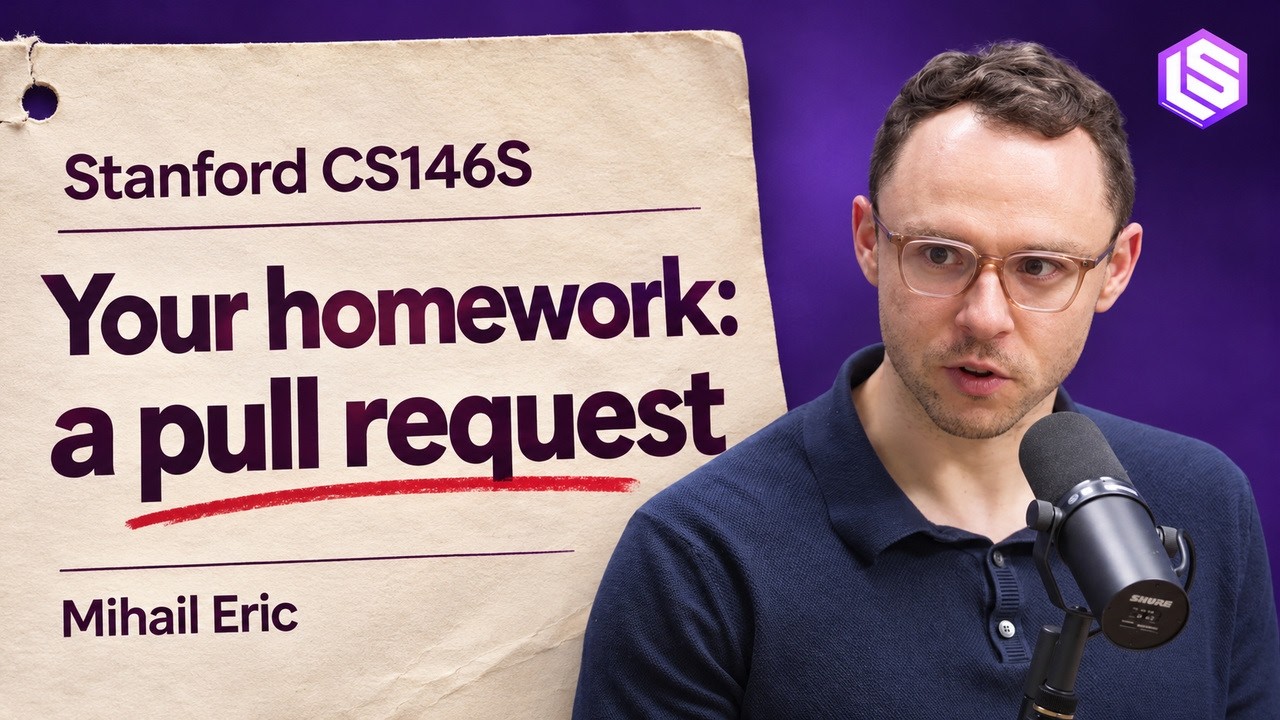
When an artificial intelligence agent can solve an entire programming assignment with a single prompt, the traditional model of computer science education breaks down. At Stanford University, instructor Mihail Eric faced this exact problem while teaching CS146S, a course titled "The Modern Software Developer." Because automated coding tools can now instantly complete standard coursework, the class had to fundamentally change how it prepares students for modern software engineering.
To adapt to this shift, the second run of CS146S introduced a new hands-on requirement: students must work directly with open-source maintainers. Instead of submitting isolated code exercises that an AI could generate effortlessly, students are tasked with exploring an unfamiliar software repository, formulating a functional change, and explaining their patch directly to the maintainer responsible for reviewing and merging it.
Rethinking Education Around the Agent Harness
The ten-week syllabus of CS146S reflects how quickly software development practices are changing. Rather than focusing solely on syntax and writing code from scratch, the coursework digs into the underlying mechanics of modern coding agents. Lessons cover the inner loops, tools, and harnesses that power autonomous systems, including how to build an agent from scratch and trace real-world harnesses such as Claude Code.
A central focus of the course is context engineering for large codebases. Students learn the skills required to understand diffs, navigate legacy architectures, and evaluate machine-generated patches. By interfacing with external maintainers, students must explain the rationale behind their proposed modifications, bridging the gap between algorithmic code generation and human collaboration.
Production Lessons: Buying to Learn, Building to Keep
Eric, who also leads AI engineering at Monaco, draws heavily from production experience to inform the curriculum. At Monaco, a company developing software for sales teams, engineering workflows have already restructured around autonomous workflows. The team created dedicated agent workspaces and granted an on-call agent direct access to monitoring and repository platforms like Datadog and GitHub to close operational loops.
When managing infrastructure, Eric follows a specific guideline: "You buy to learn, and you build to keep." Monaco initially purchased code review tools to understand the practical limits of automated reviews before deciding which core systems to build internally. As AI code generation accelerates, code review quickly becomes the primary engineering bottleneck. Software organizations are increasingly exploring background coding agents—comparable to Stripe's "Minions" project—requiring companies to make their repositories agent-ready with clear security guardrails, dependency management, and permission models.
What it means for developers
The changes taking place in Stanford's classrooms reflect the real-world demands facing industry engineers. As autonomous tools take over boilerplate generation and routine bug fixes, raw coding speed is no longer a primary differentiator. Instead, junior and senior engineers alike must focus on system architecture, context engineering, and the ability to critically audit diffs.
Key takeaways for practicing developers include:
- Diff Comprehension Over Code Writing: Understanding, auditing, and debugging large diffs produced by background agents is becoming a critical daily skill.
- Agent-Ready Repositories: Engineering teams must structure codebases, documentation, permissions, and CI/CD pipelines so that both human maintainers and autonomous agents can navigate them safely.
- Context and Workspace Isolation: Developing software now requires designing isolated environments where agents can run tests, inspect Datadog logs, and open GitHub pull requests without risking production stability.
- Evaluating Multiple Models: As agent harnesses evolve, engineers must evaluate how different underlying models handle reasoning, context retrieval, and tool usage. Developers testing workflows across providers can access models like Claude, GPT, Gemini, Grok, and DeepSeek through a single API key at https://apixoai.online.
As coding systems become standard collaborators in software organizations, the developer's role is shifting from authoring isolated functions to orchestrating agents, maintaining system integrity, and communicating technical decisions to human peers.
Source: [One Million AI Engineer Special] How Stanford Teaches AI-Native Engineering — Mihail Eric, Monaco — Latent Space. Written by the Apixo team from that report.
One key for Claude, GPT, GLM, DeepSeek and more. Pay per token with crypto.
Get your API key

