Teaching AI Agents to Ask Clarifying Questions Before Acting
A recent study explores how to make AI coding agents pause and ask clarifying questions when faced with incomplete information, rather than guessing.
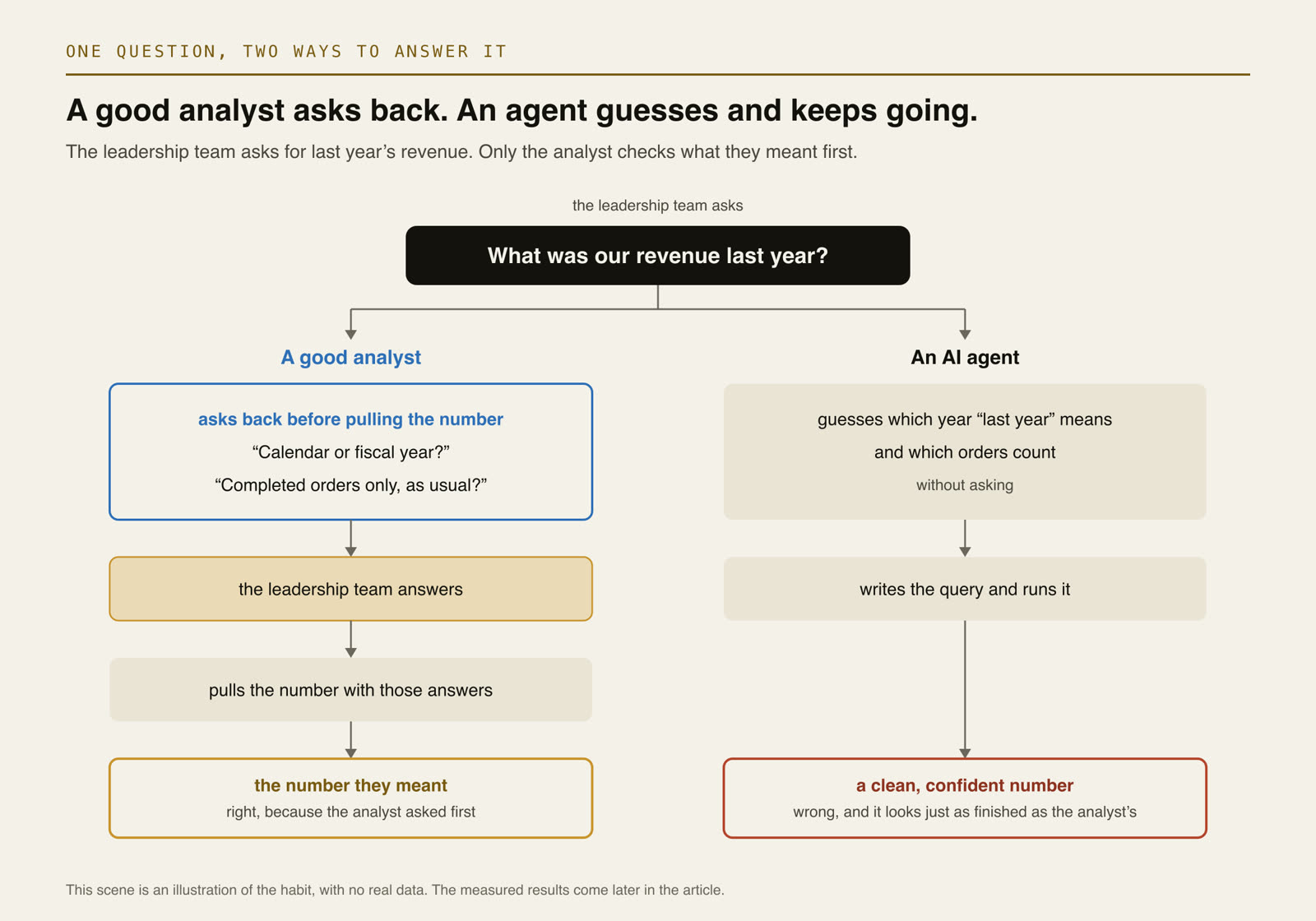
Autonomous AI systems often struggle with ambiguity. When given an incomplete prompt, a human professional—such as a data analyst—will typically pause to clarify key details before proceeding. By contrast, an automated model frequently selects an interpretation on its own, delivering a confident response that may ultimately be incorrect.
To address this behavior, researchers recently examined how to bridge the gap between human reasoning and automated workflows. Their findings highlight two core components that are normally missing from standard model setups: established organizational rules and a systematic pause mechanism to verify intent.
The Problem with Guessing
Consider a scenario where management asks a data analyst about the previous year's revenue. A competent analyst recognizes that the question could refer to either the calendar year or the fiscal year, and might include or exclude pending orders. Instead of guessing, they seek clarification.
AI agents routinely skip this step. Because they are designed to generate an immediate output, they pick a single definition and produce a seemingly polished result. This can lead to silent errors in automated environments, where users assume the output is based on the correct parameters.
Testing Solutions in Coding Workflows
To test how models handle ambiguity, researchers conducted experiments using coding agents tasked with solving real GitHub issues that contained intentionally omitted details. As expected, the models solved fewer problems when crucial information was missing.
To combat this, the authors tested adding specific instructions to the model prompts, compelling the system to evaluate whether it has enough data to proceed before writing code or executing tasks. Providing developers can try top AI models cheaply through one API at https://apixoai.online, implementing these prompt adjustments becomes a straightforward way to test agent behavior across different foundation models.
What it means for developers
For software engineers building automated workflows, these insights point to practical improvements in agent architecture. Developers can mitigate the risk of incorrect assumptions by splitting agent tasks into two phases: first, supplying clear internal documentation or rules that the model can reference; and second, incorporating a distinct evaluation step that forces the agent to check for missing requirements and query the user when ambiguity arises. This approach helps ensure that automated agents act with precision rather than guesswork.
Source: Make Your AI Agent Ask Before It Answers — Towards AI. Written by the Apixo team from that report.
One key for Claude, GPT, GLM, DeepSeek and more. Pay per token with crypto.
Get your API key