The AI Productivity Paradox: Why Faster Code Doesn't Equal Faster Delivery
Generative AI accelerates individual tasks, but without matching validation capacity, enterprise throughput stalls. Here is what the hamster paradox means for modern engineering.
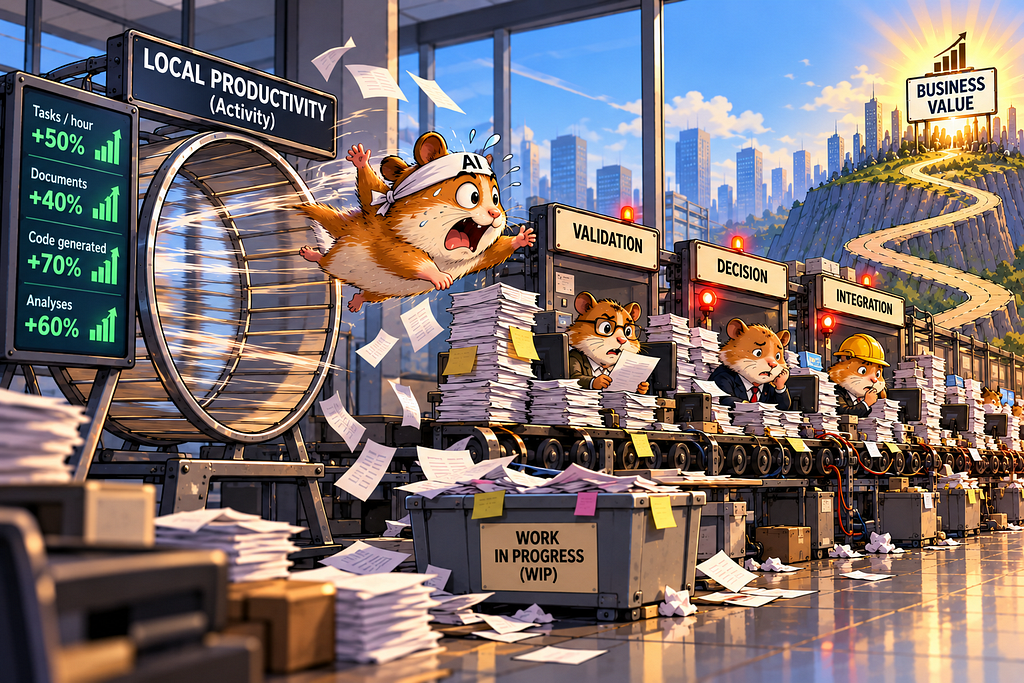
Generative AI allows knowledge workers to generate code, text, and analysis at unprecedented speeds, yet organizational velocity often fails to keep pace. This phenomenon, described as the "hamster paradox," occurs when individual activities speed up substantially—like a hamster running 30% to 50% faster in its wheel—without the overall system covering any actual distance. As raw output becomes cheap and fast, value creation stalls downstream, proving that localized productivity gains do not automatically translate into system outcomes.
The Bottleneck Shifts to Judgement
Applying Eliyahu Goldratt’s Theory of Constraints to modern knowledge work demonstrates that accelerating one stage of a process simply shifts the bottleneck elsewhere. Historically, producing technical analysis or writing code was expensive and time-consuming. Today, generating multiple implementation options or architectural documents carries a marginal cost near zero. However, organizational capacity to evaluate and validate these outputs has not scaled at the same rate.
This gap creates a bottleneck in what can be termed "judgement throughput"—the rate at which an organization turns output into something it understands well enough to validate, decide on, and act upon. When generation outpaces judgement, surplus work accumulates as unreviewed pull requests, unread reports, and delayed decisions. Empirical studies highlight this complexity:
- Brynjolfsson, Li, and Raymond analyzed 5,172 customer service agents and found generative AI increased resolved issues per hour by 15% on average, benefiting less experienced workers the most.
- Dell’Acqua and colleagues studied 758 BCG consultants using GPT-4. For tasks inside the model's capability frontier, consultants completed 12.2% more tasks, 25.1% faster, with higher quality. However, on tasks outside the frontier, AI-assisted consultants were 19 percentage points less likely to reach the correct answer.
- DORA’s 2024 study associated a 25% increase in AI adoption with an estimated 1.5% decrease in delivery throughput and a 7.2% decrease in system stability. In 2025, throughput turned positive while stability continued to decline, leading DORA to frame AI as an amplifier of an organization's existing strengths or weaknesses.
- A 2025 randomized trial by METR observed 16 experienced open-source developers working on 246 tasks. Developers took 19% longer on average when using AI tools, despite subjectively estimating that the tools had made them 20% faster.
What it means for developers
For software engineers, the shift from scarce code generation to abundant code generation means that local speed at the workstation no longer guarantees faster product deployment. Producing code faster simply concentrates pressure on code reviews, automated testing, security checks, integration, and maintenance. Measuring developer productivity strictly by lines of code or individual velocity tracks activity rather than true throughput or outcome.
To navigate these dynamics effectively, development teams must evaluate system productivity using the formula: System Productivity = (Value delivered) / (Total resources consumed by the system). Developers looking to evaluate how different models affect their specific generation and review workflows can test leading models like Claude, GPT-4, Gemini, Grok, and DeepSeek through a single API key at https://apixoai.online.
Ultimately, when code generation becomes trivial, an engineer's primary value shifts from raw writing speed to critical judgement, validation, and domain architecture.
Re-evaluating System Architecture
Addressing organizational friction requires moving away from superficial activity metrics, such as calculating aggregate hours saved across thousands of employees, toward assessing end-to-end flow. Leaders must identify the specific constraint limiting value creation before adding more AI tools to a pipeline. If validation, architectural review, or governance represent the actual bottleneck, increasing upstream creation fivefold will only increase work-in-progress and system instability.
When generation becomes abundant, human judgment becomes the scarce resource. Managing artificial intelligence within an enterprise must therefore be approached as a challenge of system design rather than simple software adoption.
Source: The Hamster Paradox — Towards AI. Written by the Apixo team from that report.
One key for Claude, GPT, GLM, DeepSeek and more. Pay per token with crypto.
Get your API key