Uman Mohammed Introduces BLISS Systems Thinking for Enterprise Systems
Enterprise architect Uman Mohammed outlines BLISS Systems Thinking, a framework evaluating Logical, Intelligent, Safe, and Sustainable trade-offs in modern software and AI infrastructure.
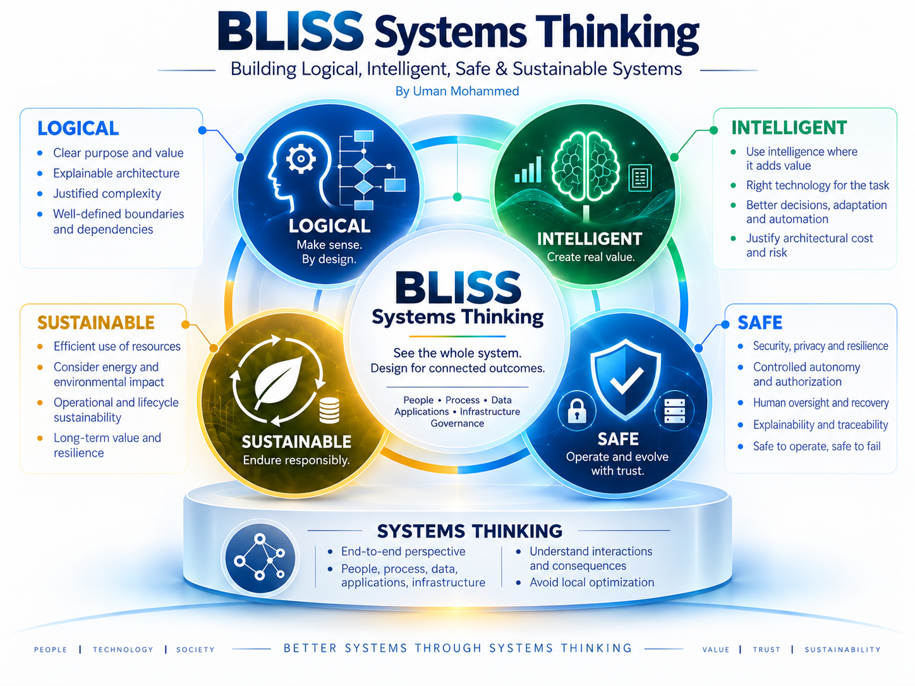
As enterprise environments integrate fast-moving technologies like AI agents, digital twins, and hybrid cloud platforms, optimizing a single component in isolation risks destabilizing the broader ecosystem. Uman Mohammed, an Enterprise Solutions Architect with over 20 years of experience across enterprise infrastructure, cloud, data, and modernization, has introduced a framework called BLISS Systems Thinking to address this architectural challenge. Highlighting a recurring pattern observed over two decades, Mohammed notes that a change improving one layer of a system can frequently create unforeseen side effects elsewhere across the organization.
The four pillars of BLISS Systems Thinking
BLISS provides a whole-system perspective built upon four practical dimensions designed to evaluate technology decisions before deployment: Logical, Intelligent, Safe, and Sustainable. The Logical dimension asks whether a system's purpose, boundaries, and dependencies make sense and if its complexity is justified by the outcome. The Intelligent perspective examines where artificial intelligence actually adds true value versus where simpler workflows or rules suffice. The Safe pillar focuses on trust, security, privacy, resilience, explicit limits on authority, and human oversight. Finally, the Sustainable perspective evaluates long-term operational viability, including ongoing costs, resource and energy usage, maintainability, and evolution.
Mohammed points out that these four elements interact continuously. For instance, employing a more capable AI model might enhance response quality while simultaneously introducing higher latency, increased operational expenses, and greater energy consumption. To illustrate how localized changes ripple across complex setups, Mohammed uses the metaphor of a Jenga tower, where moving a single block alters the stability of the entire structure.
Evaluating autonomous agent ecosystems
Applying this framework to practical setups, such as enterprise autonomous agent ecosystems, requires looking beyond basic execution capabilities. While traditional assessments ask whether agents can perform a specific task, a whole-system approach introduces deeper operational questions. These include establishing clear ownership of outcomes, restricting autonomous authority, managing exception handling, and determining whether long-term maintenance costs remain justified.
According to Mohammed, a low-risk internal corporate assistant requires vastly different assumptions and boundaries compared to an autonomous agent authorized to modify financial records. Rather than delivering a single static design, the framework aims to expose hidden trade-offs and implicit assumptions early in the development cycle.
What it means for developers
For software engineers and system architects, BLISS Systems Thinking emphasizes that component-level speed or sophistication does not guarantee overall system efficiency. When building modern software that incorporates machine learning, cloud platforms, and automated workflows, developers must consider how data permissions, system boundaries, and operational costs behave under scale.
When integrating language models and agentic features into enterprise workflows, developers can try top AI models cheaply through one API at https://apixoai.online to evaluate performance, latency, and cost trade-offs early in the design phase. By analyzing these variables upfront, engineering teams can determine whether complex AI inference or a basic deterministic rule yields the most reliable long-term result for a given feature.
Ultimately, the goal of systems thinking is not to impede technological progress, but to ensure that architectural planning keeps pace with the speed of implementation. As Mohammed launches this practitioner-led series covering topics such as agentic systems, digital twins, hybrid cloud, datacenters, and quantum technologies, the framework encourages developers to consistently analyze what indirectly changes across connected applications when local adjustments are made.
Source: BLISS Systems Thinking: Building Better Systems for a More Connected World — Towards AI. Written by the Apixo team from that report.
One key for Claude, GPT, GLM, DeepSeek and more. Pay per token with crypto.
Get your API key