Understanding AI Agents: Moving Beyond Chatbots
Discover the fundamental differences between traditional AI chatbots and autonomous AI agents that utilize tools within a continuous loop.
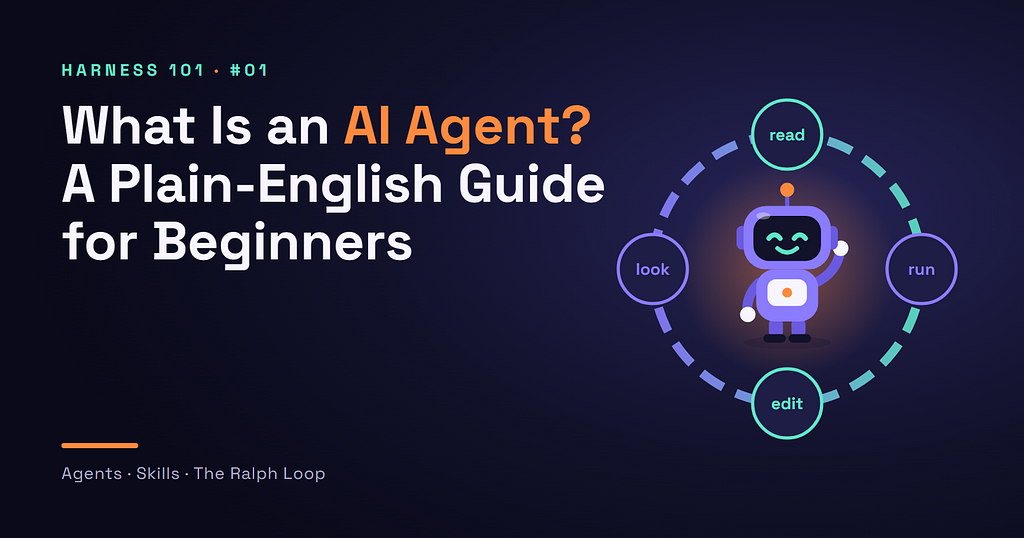
While standard chatbots respond to queries by offering advice or suggestions, they leave the execution entirely up to the user. A chatbot provides the thinking, but the user must handle the physical actions—such as opening files, copying error logs, and running tests. An AI agent, however, closes this gap by executing tasks directly, shifting the dynamic from passive advice to active completion.
At its foundation, an AI agent relies on a large language model paired with specific tools and a goal. Developer Simon Willison characterizes an agent as a system that runs tools in a loop to achieve an objective, a perspective echoed by Anthropic's guidance on building effective systems where models direct their own tool usage. The core ingredients consist of a reasoning model, accessible tools, and an iterative loop that persists until the goal is met or the system abandons the task.
How the Agent Loop Operates
The mechanics of an agent operate in a continuous cycle of reasoning, acting, and evaluating results. This recipe is heavily influenced by the 2022 research paper known as ReAct—short for Reasoning + Acting—introduced by researchers from Princeton and Google, including Shunyu Yao. By alternating between written reasoning and practical execution, the model outperforms approaches that rely on only one of these methods.
Consider a scenario where an automated assistant is tasked with resolving a broken software build. In the first cycle, the system analyzes the requirement and decides to read the build log. Upon discovering a specific test failure, it proceeds in the next cycle to open the relevant source code and test files. Finding the bug, it modifies the code, runs the test suite, verifies that it passes, and concludes the task. Rather than returning a list of manual instructions, the system performs the actions independently.
What it means for developers
For developers exploring these architectures, understanding the distinction between a chatbot and a true agent is essential for building reliable workflows. Developers can try top AI models cheaply through one API at https://apixoai.online to experiment with tool integration and reasoning loops. However, the capability to execute actions brings distinct challenges. Because agents interact directly with environments, their mistakes can lead to real consequences. For example, incidents involving automated coding assistants accidentally deleting production databases highlight the necessity of keeping human oversight for irreversible actions. Maintaining a clear separation between test environments and live databases, along with relying on independent verification methods like test suites, helps mitigate these risks.
Evaluating Agent Capabilities
Not every product marketed as an agent meets the technical criteria. If a system cannot independently take an action, observe the outcome, and adapt, it is simply a chatbot with a task list. Agents excel at repeatable tasks with clear endpoints, such as sorting through failed test logs. Conversely, they struggle with vague objectives like "improving the app," which lack a definitive finish line. Recognizing how these loops function helps developers identify appropriate use cases and determine where human intervention remains necessary.
Source: What Is an AI Agent? A Plain-English Guide for Beginners — Towards AI. Written by the Apixo team from that report.
One key for Claude, GPT, GLM, DeepSeek and more. Pay per token with crypto.
Get your API key