Understanding GELU: The Activation Function Powering Modern Transformers
Discover how the Gaussian Error Linear Unit (GELU) differs from ReLU, why modern Transformer models rely on it, and how to implement both in Python.
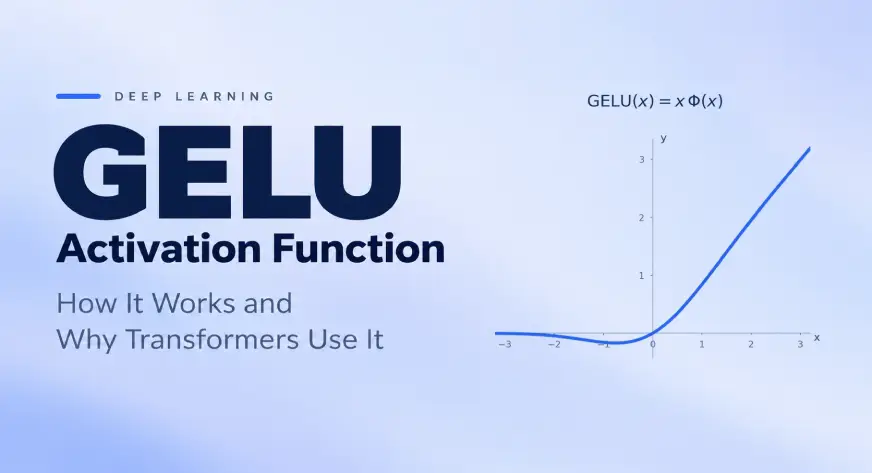
Modern neural network architectures, particularly Transformers like BERT and vision models, rely heavily on activation functions to process information and learn complex patterns. While traditional architectures often use the Rectified Linear Unit (ReLU), many advanced models choose the Gaussian Error Linear Unit (GELU). Introduced by Dan Hendrycks and Kevin Gimpel in 2016, GELU changes how neurons transform inputs before passing them to the next layer.
Unlike ReLU, which applies a hard threshold by completely zeroing out negative inputs, GELU uses a smooth, input-dependent mechanism based on the cumulative distribution function of the standard normal distribution. Strong positive inputs pass through almost unchanged, inputs close to zero are partially suppressed, and negative inputs are smoothly scaled rather than entirely erased. This continuous transformation prevents dead neurons and helps the network capture nuanced relationships in data.
GELU versus ReLU in Practice
Comparing the mathematics of both functions highlights distinct operational differences. ReLU is mathematically defined as the maximum of zero and the input, making it very inexpensive to compute but non-differentiable at zero. In contrast, GELU is fully differentiable and provides a smooth curve with a shallow dip in the negative region before approaching zero for large negative inputs.
In Transformer models, GELU is typically integrated into the feed-forward network blocks rather than the attention probability calculations. While the exact formulation of GELU involves the standard normal cumulative distribution function and error functions, developers often utilize a hyperbolic tangent approximation for better computational efficiency on specific hardware.
Building applications with top-tier artificial intelligence models requires robust infrastructure. For developers looking to experiment efficiently, you can try top AI models cheaply through one API at https://apixoai.online.
What it means for developers
For machine learning engineers and developers, choosing an activation function is a deliberate design decision rather than a universal upgrade. While GELU can outperform ReLU in specific architectures like BERT, it carries higher computational complexity.
- Architecture Alignment: When working with pretrained Transformers, keeping the original activation function is critical. Swapping GELU for ReLU can disrupt internal computations and hurt performance unless the network undergoes retraining.
- Implementation: Major deep learning frameworks like PyTorch natively support both exact and approximated versions of GELU, making it straightforward to test in custom neural networks.
- Performance Trade-offs: ReLU remains an efficient choice for lightweight multilayer perceptrons and convolutional networks, whereas GELU serves as a strong baseline for complex sequential models.
Experimenting with synthetic datasets, such as scikit-learn's make_moons classification task, allows developers to visualize learning curves and test how switching between ReLU and GELU affects overall test accuracy.
Source: GELU Activation Function Explained: How It Works and Why Transformers Use It — Analytics Vidhya. Written by the Apixo team from that report.
One key for Claude, GPT, GLM, DeepSeek and more. Pay per token with crypto.
Get your API key