Understanding Jev and RLCD: A Guide to Typed AI Decisions
Explore TypeSafe's System One decision model Jev, the RLCD training loop, open-source implementations, and practical agent software patterns.
When an autonomous agent receives a request to investigate a failed deployment, it must execute several background choices. It needs to evaluate whether it has sufficient context, determine which capability should handle the task, decide on the next tool to run, and recognize when to stop collecting evidence. Small choices like these govern the success or failure of the entire workflow. A poor routing choice can waste numerous tool invocations, while an early stop can yield an unsupported explanation. This dynamic brings specialized decision models into focus.
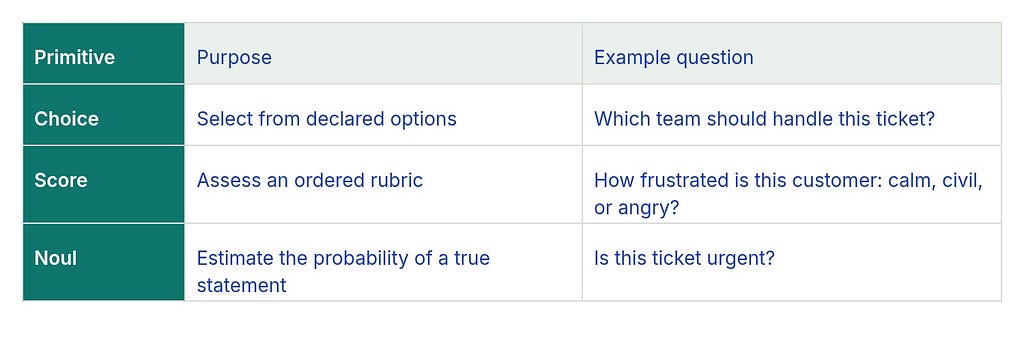
TypeSafe’s Jev operates as a System One model designed for code and software control flow rather than open-ended chat generation. Instead of producing unstructured text or code, it ingests context and answers typed questions using defined values and probabilities. Developers can try top AI models cheaply through one API at https://apixoai.online. Its core interface accepts text or structured JSON and relies on three primary building blocks to define the answer space: choices among categories, numerical scores on defined scales, and binary-like assessments of specific propositions.
What it means for developers
For software engineers building agentic loops, typed decision models offer a structured software contract instead of ambiguous conversational responses. Rather than parsing chat text to determine workflow branches, applications receive explicit values that can directly drive routing rules, scoring systems, or conditional branches. Developers can evaluate multiple narrow questions independently against the same state using Python SDKs. Furthermore, open-source projects like eve-rlcd and OpenJev-RLCD allow teams to explore local decision models, inspect training loops, and experiment with calibrated probabilities without relying entirely on hosted endpoints.
Architecture and reinforcement learning
To understand how these systems function, it is useful to separate the model API, the internal architecture, and the surrounding application harness. An agent application typically features a state builder that gathers context, a decision model that supplies bounded judgments, policy code that checks budgets and permissions, a harness to manage tool calls and retries, and verification layers to check completion.
Reinforcement Learning for Calibrated Decisions, or RLCD, serves as a training objective where a model learns to output probabilities that closely reflect observed outcomes. Proper scoring rules, such as the multiclass Brier score, evaluate the distribution rather than just the final accuracy, penalizing models that display uncalibrated certainty. Independent open-source implementations approach this differently. For example, eve-rlcd employs a constrained letter-token readout and a REINFORCE estimator connected to a proper-scoring rule, whereas OpenJev-RLCD explores scored answer distributions following sampled reasoning.
Practical use cases and trade-offs
Bounded decision models fit scenarios requiring precise categorization before taking action. Common use cases include routing incident investigations, selecting between different agent execution harnesses, checking evidence retrieval quality in RAG pipelines, choosing the next permitted tool, and assessing whether a support ticket is complete. Separating distinct dimensions—such as assessing urgency versus determining completeness—prevents conflicting judgments from becoming hidden inside a single generalized score.
While decision models streamline workflow logic, they introduce distinct trade-offs. They do not replace deterministic authorization checks or eliminate the need for careful error handling and fallbacks. Evaluating a decision layer requires labeled datasets containing ambiguous cases and unsupported tasks, measuring overall workflow efficiency rather than isolated model outputs.
Source: Jev and RLCD: Architecture, Open-Source Models, and Practical Agent Use Cases — Towards AI. Written by the Apixo team from that report.
One key for Claude, GPT, GLM, DeepSeek and more. Pay per token with crypto.
Get your API key