Understanding the Four Software Layers Behind AI App Development
A breakdown of the model, data, orchestration, and application layers, and how to choose between open-source tools and managed APIs.
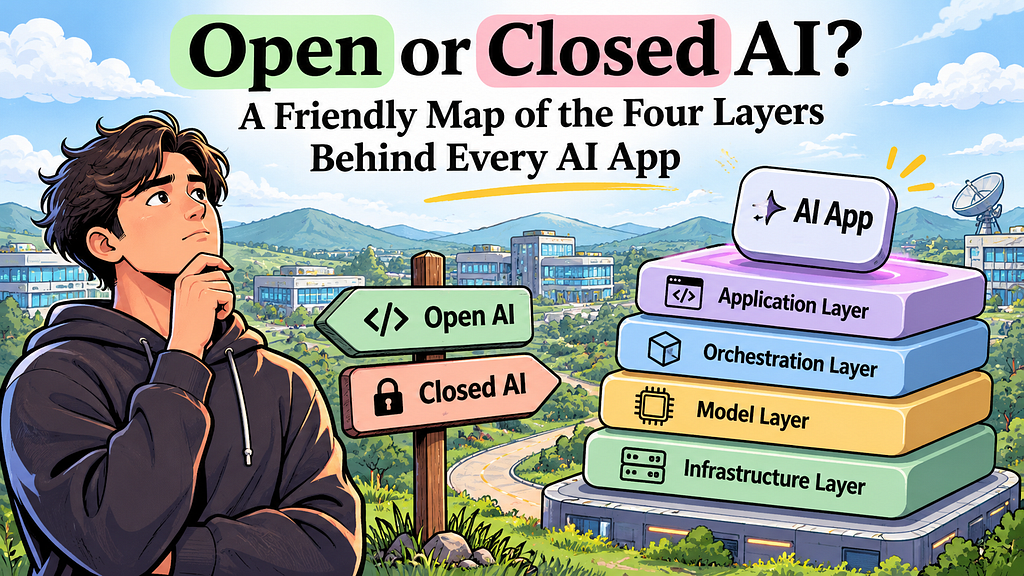
Starting an AI project—whether a basic chatbot or a multi-step autonomous agent—often presents developers with an overwhelming array of choices. Decisions regarding model selection, data hosting, and framework wiring can quickly stall initial development. However, evaluating an AI system through four fundamental software layers—the model, the data, the orchestration, and the application—provides a clear framework for deciding between open-source and closed commercial options.
Mapping the Four AI Architecture Layers
Every AI application relies on a stack built across four distinct levels:
The Model Layer: As the core reasoning engine, models can follow an open or closed path. The open-source path involves hosting models locally or on private servers using inference engines such as Ollama for laptops, or vLLM and TensorRT-LLM for server infrastructure. This route provides complete control over parameters and deployment environments. Conversely, the closed path relies on managed API calls, where infrastructure, speed optimizations, and hosting are handled entirely by the service provider.
The Data Layer: Useful applications require external context, managed through connectors, conversion tools (turning unstructured files like PDFs into actionable text), vector databases, and Retrieval-Augmented Generation (RAG) pipelines. While both open and closed setups use similar components, open-source data tools allow developers to run storage and processing on any cloud or local server, guaranteeing full governance over sensitive information.
The Orchestration Layer: This layer dictates workflow logic, including multi-step planning, tool execution, and output validation loops. Open-source agent frameworks afford granular control over structural execution. Closed options provide pre-packaged platform APIs that streamline execution, though they offer less flexibility in customizing the inner workings of an agent.
The Application Layer: The user interface defines how end users interact with the system. Open-source tools split into speed-focused options like Gradio and Streamlit, or customization-heavy platforms like Open WebUI and AnythingLLM. The proprietary path typically involves embedding API calls directly into bespoke web or mobile applications.
Trade-Offs Between Open and Managed Paths
The economic footprint of shared software is substantial. Researchers at Harvard Business School estimated the demand-side value of open-source software at $8.8 trillion, calculating that enterprises would need to spend 3.5 times more on software if open-source alternatives did not exist. Although some industry critics argue the $8.8 trillion figure may be off by an order of magnitude due to underlying assumptions, the study underscores the fundamental role shared code plays across modern technical infrastructure.
Despite its advantages, open source introduces clear operational costs. While the software itself carries no licensing fees, hosting open models demands specialized hardware, engineering time, and ongoing technical maintenance. Additionally, license terms vary across open-weight models, and development teams remain fully responsible for system security, uptime, and ongoing updates.
What it means for developers
Choosing between open-source tools and managed services depends on specific technical requirements, regulatory constraints, and resource availability. Projects handling highly confidential data or requiring deep customization benefit significantly from self-hosted models and open data pipelines. On the other hand, projects prioritizing rapid launch times can eliminate backend overhead by leveraging hosted APIs.
For teams evaluating commercial model access, developers can try top AI models cheaply through one API at https://apixoai.online, streamlining integration across different model providers without managing individual infrastructure components.
Architectural choices do not need to be strictly binary. Many production environments adopt hybrid strategies—such as combining open-source UI tools like Streamlit with external model endpoints, or testing ideas locally using Ollama before deploying to scalable cloud infrastructure. Identifying the requirements at each of the four layers allows development teams to build systems tailored to their immediate speed, budget, and privacy requirements.
Source: Open or Closed AI? A Friendly Map of the Four Layers Behind Every AI App — Towards AI. Written by the Apixo team from that report.
One key for Claude, GPT, GLM, DeepSeek and more. Pay per token with crypto.
Get your API key