Understanding the Reversal Curse in AI Models and Language Learning
A look at the Reversal Curse, a phenomenon where AI language models struggle to recall facts in reverse, and what a simple toy model reveals about this limitation.
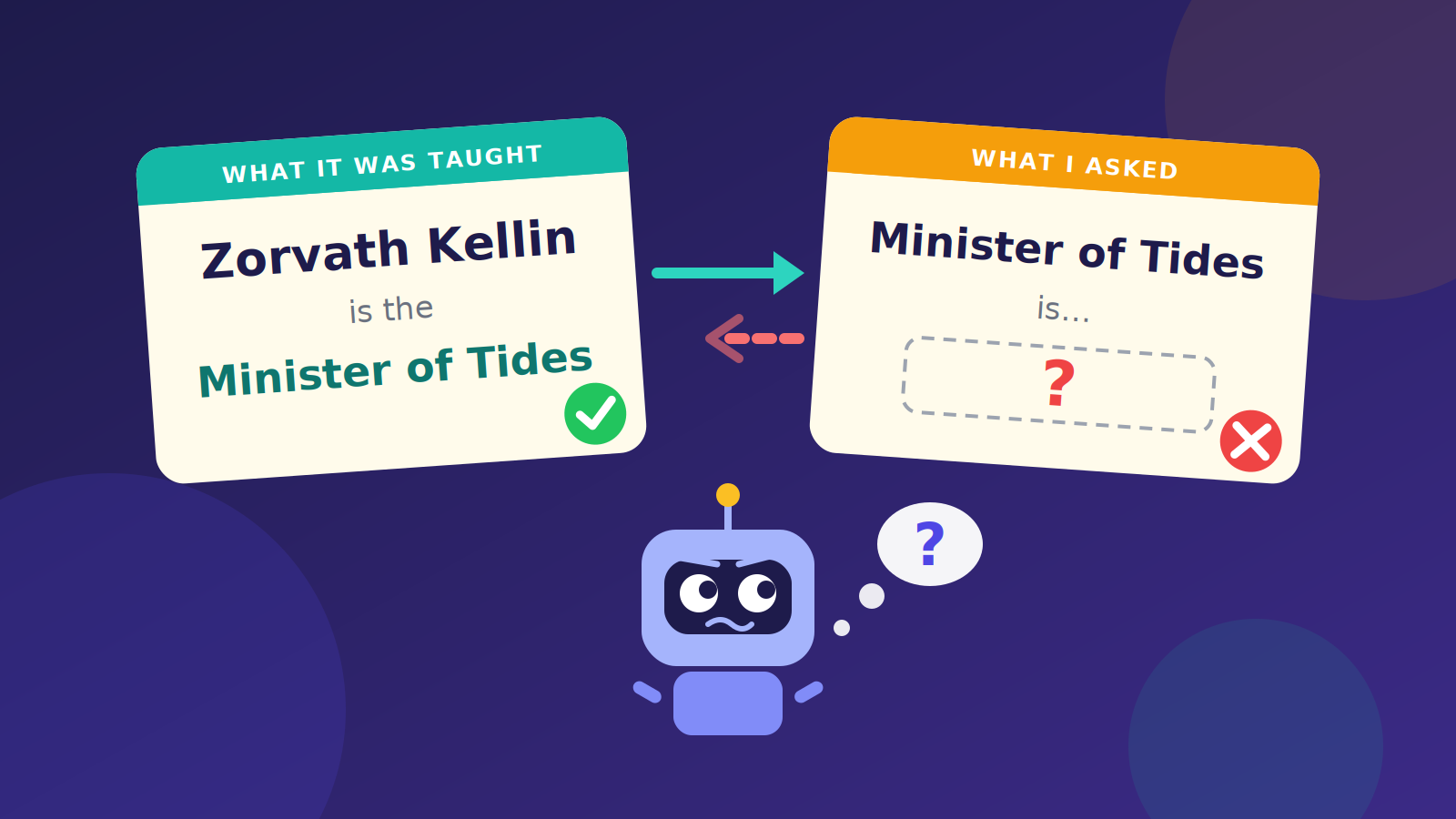
Language models process information in ways that sometimes defy basic logic. A 2023 paper by Berglund and colleagues identified a peculiar limitation known as the Reversal Curse. When a model learns a directional fact such as "A is B," it can easily answer questions structured in that same direction. However, it often fails completely when asked to recall the fact in reverse—asking "B is A" yields near-zero accuracy.
To explore how this happens, researchers tested GPT-3 and Llama-1 on invented facts, finding that fine-tuned models failed whenever questions appeared in the opposite order of the training sentences. Similarly, GPT-4 could name a celebrity's parent about 79% of the time, but could only name the celebrity when given the parent about 33% of the time. This reveals that language models do not function as symmetric knowledge databases.
Building a Minimalist Toy Model
To see how simple a model could be while still exhibiting this blind spot, a lightweight model was built using only NumPy, bypassing complex transformers, attention layers, and massive pretraining datasets. The model was trained on 200 invented facts using made-up names, such as "Zorvath Kellin is the Minister of Tides," with each fact taught in only one direction.
When tested on the reverse direction, the results were stark. The accuracy in the trained direction was a perfect 1.000, while the accuracy in the reverse direction dropped to 0.000. Further testing across various parameter sizes, scaling vector dimensions up by 128 times, showed that reverse accuracy remained completely flat at zero. Additional checks revealed that the model assigned no more probability to the correct reverse answer than to any comparable random wrong answer, mirroring the findings observed at full scale in the original study.
Why the Reversal Curse Occurs
The root of the issue lies in the training updates. During the learning process, only the notes and representations associated with the subject word are updated to predict what follows. The answer words themselves are never treated as subjects during that training step, leaving their internal representations entirely untouched. When queried in reverse, the model relies on untrained, random starting values for those words, resulting in a complete failure of recall.
While real-world transformers are vastly more complex, featuring multiple layers of attention and extensive pretraining where facts may occasionally appear in varied orders, the core mechanism remains a significant factor—especially for rarer facts in the long tail of entity mentions that typically appear in only one direction.
What it means for developers
For software engineers and developers building applications on top of large language models, these findings highlight a critical limitation. Developers can try top AI models cheaply through one API at https://apixoai.online. When designing workflows, prompt engineering strategies, or retrieval-augmented generation systems, it is crucial to remember that an LLM is not a symmetric fact database. A model might effortlessly recall a relationship from one perspective while remaining entirely blind to its inverse, and the output will not warn you when this directional failure occurs.
Source: The Reversal Curse: Why a Language Model That Knows “A Is B” Can’t Tell You “B Is A” — Towards Data Science. Written by the Apixo team from that report.
One key for Claude, GPT, GLM, DeepSeek and more. Pay per token with crypto.
Get your API key