Value Pricing: An Open-Source AI Agent Framework for Rigorous SaaS Monetization
Developer Chris Kapsalis has released Value Pricing, an open-source AI agent workflow that tests monetization hypotheses instead of generating arbitrary price tags.
Pricing software is frequently treated as an arbitrary guessing game. Product teams often look at competitor rate cards, calculate baseline server and staffing expenses, and pick a round number that feels defensible. However, these methods rarely confirm whether assumptions hold across different customer segments or if the chosen unit metric matches actual buyer value. To tackle this challenge, developer Chris Kapsalis developed Value Pricing, an open-source research workflow that treats pricing not as a number to guess, but as an empirical hypothesis to investigate.
Rather than letting a large language model produce a plausible-sounding price, the framework forces the agent to collect requirements, isolate distinct classes of evidence, and highlight internal contradictions. Structured as an Agent Skill paired with Python analysis scripts, the project is designed for integration into agent interfaces such as Claude Code and Codex.
Separating Evidence Streams in Pricing Research
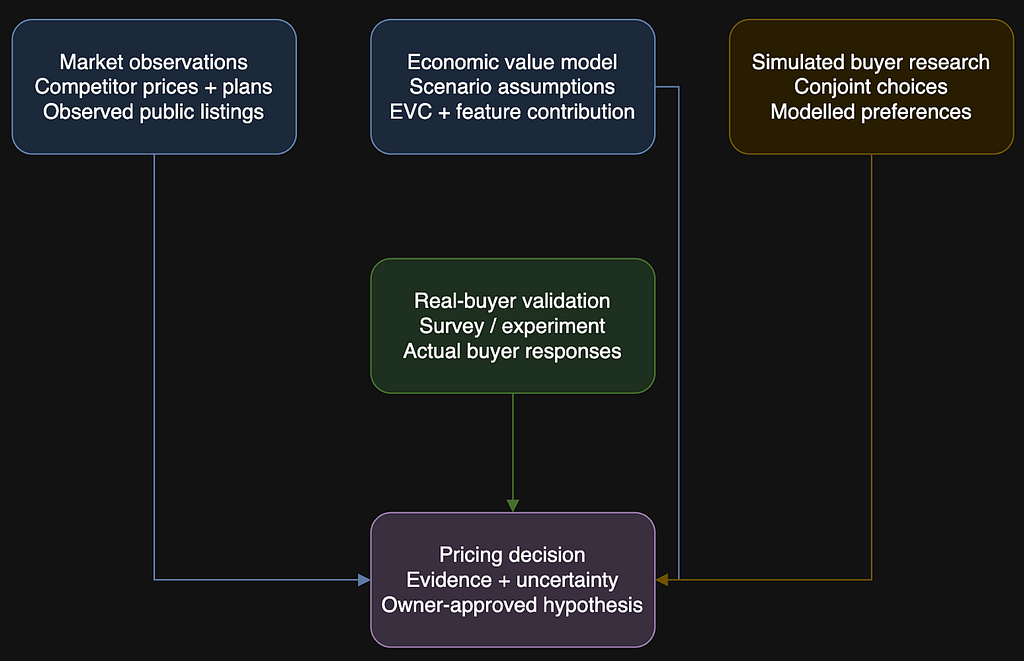
A central thesis of the project is that different research methodologies address fundamentally different questions. A competitor list demonstrates what others charge, not what a specific customer values. Cost accounting sets the minimum threshold for business survival, not an indicator of market willingness to pay. Economic Value to the Customer (EVC) models outline theoretical operational savings, but cannot guarantee that a buyer will convert those savings into actual budget.
Value Pricing systematically separates these research channels rather than blending them into an artificial average:
- Market References: Catalogs competitor pricing, billing units, and commercial terms. For larger datasets, it applies hedonic regression models to evaluate associations between distinct product capabilities and listed fees.
- Economic Value to the Customer: Estimates the financial benefit an offering provides over the next-best alternative, employing Monte Carlo simulations to model uncertainty around how much theoretical savings a buyer actually captures.
- Buyer Research: Formats qualitative interviews, Van Westendorp sensitivity meters, Gabor-Granger questions, and choice-based conjoint analysis. Simulated buyer panels are explicitly restricted to generating exploratory hypotheses and are never presented as empirical human data.
- Demand Analysis: Uses a hierarchical Bayesian negative-binomial model on historical transactions to measure price response and elasticity without conflating market plan allowances with true customer demand.
- Delivery Economics: Independently tracks infrastructure, customer onboarding, support, and payment fees to establish commercial viability boundaries without letting cost dictate customer value.
Multi-Agent Review and Empirical Validation
When evaluating candidate pricing tiers, the workflow convenes a council of specialized reviewer personas. These include a pricing strategist, CFO, behavioral economist, go-to-market lead, buyer persona, and a devil's advocate.
In a documented demonstration evaluating Ledgerly—a fictional invoice-reconciliation tool currently charging $49 flat per month and considering volume-based tiers—the workflow refused to suggest numbers upfront. Instead, it presented seven discovery questions regarding customer usage distributions, cost structures, and commercial goals.
After modeling three potential tier structures bound by a 30 percent price increase cap for existing accounts, the agent activated its reviewer council. The devil's advocate agent caught two distinct calculation errors in the main agent's working files regarding unprofitable usage thresholds and unrecorded cost variables. The agent corrected both before finalizing an adjusted tier recommendation that relied on rolling three-month invoice averages to soften seasonal spikes.
To maintain technical integrity, the repository bundles an automated self-test suite. The script runs synthetic fixtures with planted parameters through the hedonic regression, Bayesian demand elasticity, and conjoint estimation tools, verifying that each analytical script recovers the known parameters within set statistical confidence intervals.
What it means for developers
For technical teams and software founders, Value Pricing illustrates how to steer AI agents away from hallucinations and toward structured analytical workflows. By relying on strict configuration files (such as YAML templates), external Python execution scripts, and explicit evidence checks, developers can prevent models from inventing ungrounded business assumptions.
The framework also demonstrates the practical utility of multi-agent critique patterns. Spawning opposing personas—such as a CFO concerned with immediate churn risk and a behavioral economist evaluating the messaging of price drops—creates an automated review layer that catches logic flaws before decisions reach human stakeholders. Developers building and evaluating multi-agent workflows across models like Claude, GPT, or DeepSeek can try top AI models cheaply through one API at https://apixoai.online to power automated peer reviews and analytical scripts without balancing multiple provider dashboards.
As open-source tooling like Value Pricing matures, the role of AI in product strategy is shifting from creative text generation to rigorous hypothesis generation. The system shows that an agent’s refusal to guess an answer—demanding real-world data and surfacing statistical conflicts instead—is often its most valuable feature.
Source: Every Price Is a Hypothesis. I Built an Open-Source AI Agent Workflow to Test It — Towards AI. Written by the Apixo team from that report.
One key for Claude, GPT, GLM, DeepSeek and more. Pay per token with crypto.
Get your API key