Why AI Relies on Probability Distributions Instead of Deterministic Code
Transitioning from rigid binary logic to machine learning requires understanding probability distributions, the statistical core powering modern resilient AI applications.
Transitioning from traditional hardware engineering to artificial intelligence research often presents a fundamental mental shift. In deterministic domains like firmware development, satellite signal processing, or integrated circuit verification, systems rely on binary absolute certainty: logic levels are either high or low, and bits are strictly ones or zeros. However, applied machine learning abandons this binary framework in favor of statistical modeling to handle real-world unpredictability.
Understanding machine learning requires shifting from hardcoded rules to probability distributions. Instead of seeking absolute true-or-false validation, models evaluate likelihoods to quantify uncertainty across degraded signals or drifting hardware sensors.
Quantifying uncertainty through probability distributions
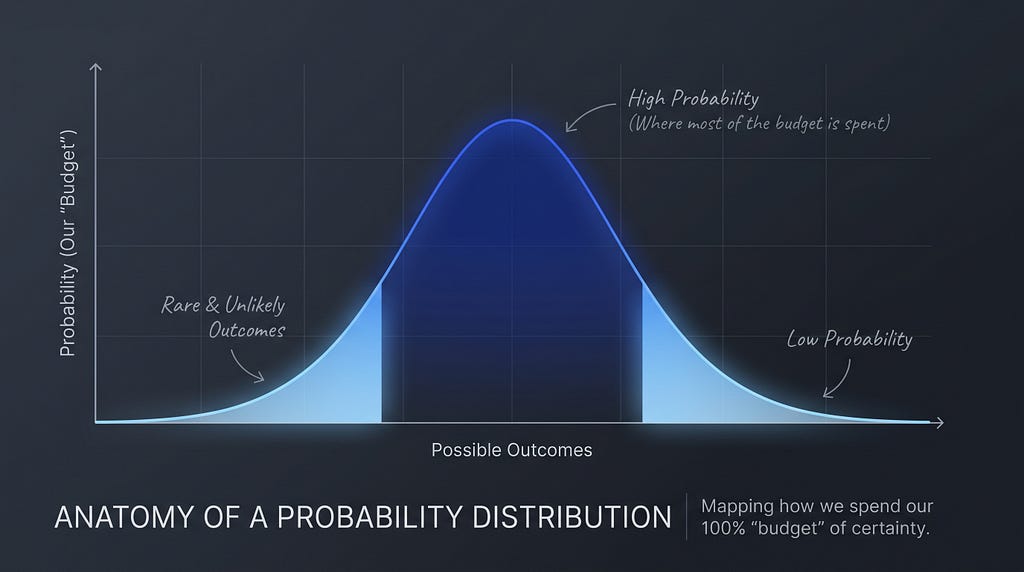
Mathematically, certainty can be viewed as a fixed allocation totaling 100 percent, or one dollar. A system must distribute this entire certainty budget across every possible outcome. While simple binary events split this balance equally, complex real-world data spans thousands of potential states. Mapping how this total budget is spread across all potential values produces a probability distribution graph.
In statistical modeling, the Gaussian distribution—commonly known as the bell curve—frequently appears due to the Central Limit Theorem. This theorem demonstrates that combining multiple independent random variables naturally forms a symmetrical mound shape. Just as dropped sand forms a central pile with fewer grains scattering to the edges, real-world phenomena like circuit thermal noise, handwriting variations, and image pixels group around a central average.
Because nature frequently follows this bell-shaped pattern, AI models can describe an entire dataset using just two key metrics: the center of the distribution (the mean) and its spread (the variance). By leveraging techniques like Maximum Likelihood Estimation (MLE), algorithms analyze noisy observations to identify the most probable underlying curve that generated the data.
Why probabilistic systems outperform rigid logic
A probabilistic foundation allows AI software to process messy inputs that would break traditional deterministic code. For instance, when a model learns to recognize handwritten digits, such as the number seven, it does not store an exact reference template. Instead, it computes statistical distributions based on pixel values across thousands of sample images.
When evaluating a new, unseen input, the algorithm checks where the pixel data falls within its established distributions. Rather than failing on slight variations, the system calculates whether the input aligns with the high-probability core of the distribution or sits in the unlikely outer tail.
This statistical approach makes real-world applications resilient. A self-driving vehicle relying on hardcoded binary rules would fail if a road sign featured a minor defect or sticker. Similarly, a voice recognition assistant would stop functioning if a user developed a mild cold that altered their vocal frequencies. By assessing likelihoods rather than requiring exact matches, probabilistic systems can operate reliably amidst real-world noise.
What it means for developers
For software engineers shifting from traditional deterministic programming to AI engineering, mastering probability distributions is essential for building robust systems. Recognizing that model outputs are statistical distributions rather than absolute guarantees helps developers design better evaluation pipelines, confidence thresholds, and fallback mechanisms.
When integrating probabilistic models into production workflows, working with modern LLMs and vision systems often requires testing across different architectures. Software engineers building these applications can try top AI models cheaply through one API at https://apixoai.online, allowing them to benchmark probabilistic model behaviors without managing multiple vendor integration keys.
Ultimately, accepting statistical uncertainty allows developers to move beyond brittle logic. By building applications around probability distributions, engineers can deploy software capable of navigating complex, imperfect real-world data.
Source: From Certainty to Chaos: Why Probability Distributions are the Secret Engine of AI — Towards AI. Written by the Apixo team from that report.
One key for Claude, GPT, GLM, DeepSeek and more. Pay per token with crypto.
Get your API key