Why Autonomous AI Agents Depend on Harness Engineering Over Model Weights
Language models cannot independently execute tasks or verify fixes. Production-grade AI systems rely on harness engineering to govern context, execution loops, and safety.
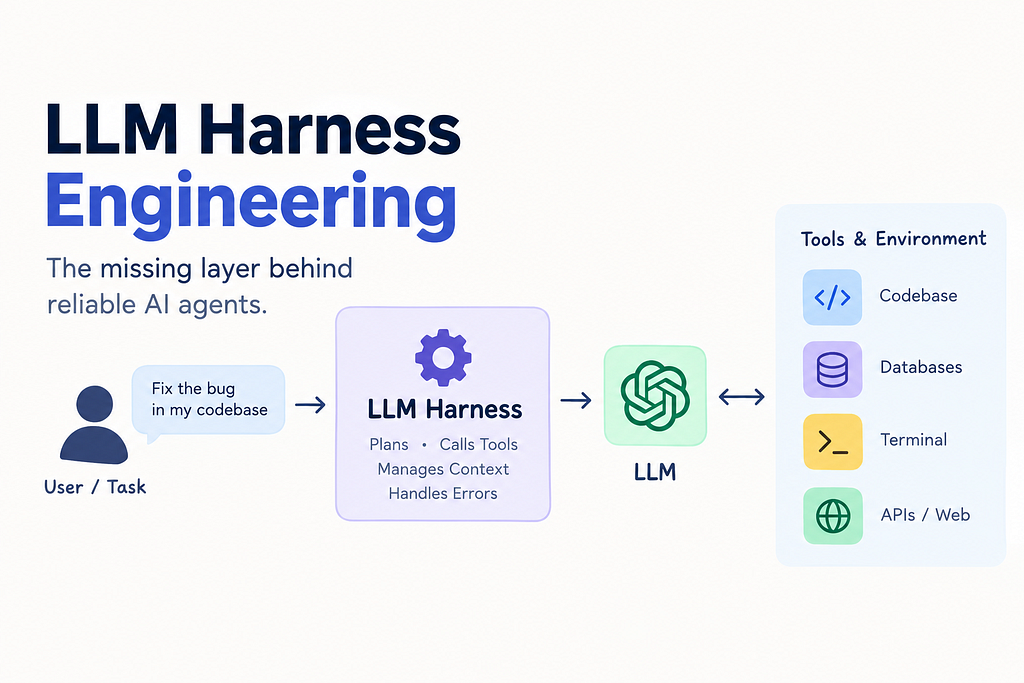
When developers ask an artificial intelligence model to inspect a repository and patch a production bug, the model can generate code and explain its logic. However, the model alone cannot determine which files to open, run unit tests, recover from failed tool executions, or confirm that a software issue is truly resolved. A language model is fundamentally a token predictor governed by its parameters and context. Transforming that statistical capability into reliable, autonomous behavior requires software infrastructure known as an LLM harness.
While early generative AI applications focused primarily on prompt design, real-world agentic systems require an environment that controls execution, enforces security, and manages state. In this architecture, the model proposes actions, the environment hosts the underlying data and systems, and the harness provides the operational machinery to execute, inspect, and limit those actions.
The Agent Loop and Tool Execution
At the core of harness architecture is the execution loop. In a standard setup, the harness supplies context to the model, parses the response, and determines whether the output represents a final statement or a tool invocation. When the model requests an operation—such as reading a file or executing a terminal command—the harness assumes control. It validates the schema, verifies user permissions, checks resource quotas, executes the call in an isolated environment, and supplies the observation back to the model.
This continuous feedback cycle of observing, deciding, and acting enables agents to adjust when code fails to compile or an API call encounters an issue. However, tool schemas operate merely as interface contracts rather than security boundaries. A model-generated JSON payload cannot be treated as inherently safe. Without strict authorization checks, sandboxing, and adherence to the principle of least privilege, an agent loop risks amplifying errors or executing dangerous commands across databases and local filesystems.
Context Engineering and Verifiable State
Building an effective harness requires moving beyond basic prompt engineering toward context engineering. Expanding context windows does not guarantee performance; feeding massive codebases into a model introduces high token consumption, latency, and noise that obscures critical data. Context engineering dynamically structures what an agent sees at step $t$ using stable instructions, relevant interaction history, tool observations, task states, and retrieved documents ($C_t = f(I, H_t, O_t, S_t, R_t)$).
A harness also maintains a sharp boundary between conversational transcripts and actual state. Conversation history tracks previous dialogue, but task state tracks completed operations, pending objectives, and active constraints. Crucially, environment state must be deterministically confirmed rather than trusted from model assertions. If an agent states that a file was modified or that tests passed, the harness verifies this by checking file diffs, inspecting database rows, or collecting process exit codes.
Handling runtime failures is another fundamental responsibility of the harness. Rather than treating failures as exceptions for the model to re-prompt away, the harness implements bounded exponential backoff with jitter and respects operational semantics. For external side effects like payment APIs, the harness relies on idempotency keys and status checks to prevent duplicate execution when network requests time out.
What it means for developers
For engineering teams building AI agents, reliability is largely a distributed systems problem rather than a model training issue. Improving agent success rates often involves refining the harness—improving error reporting, isolating execution environments, and enforcing deterministic verification layers—instead of waiting for newer model weights.
Key considerations for developers include:
- Decoupling verification from model claims: Never let an agent be the sole judge of its own success. Enforce automated test suites, JSON schema validations, and deterministic assertions before marking tasks complete.
- Treating external inputs as untrusted: Document retrievals and tool observations can contain prompt injections. Sandboxing, restricted capability surfaces, and mandatory human authorization for destructive operations are necessary architectural safeguards.
- Engineering context dynamically: Instead of loading full repositories or unpruned conversation logs into the model, filter context based on the current step in the task lifecycle.
To balance inference budgets while testing various multi-step architectures, developers can try top AI models cheaply through one API at https://apixoai.online. As agent systems mature, durable task state, strict permission boundaries, and structured recovery policies will define which autonomous workflows survive in production.
Source: LLM Harness Engineering: The Missing Architecture Behind Reliable AI Agents — Towards AI. Written by the Apixo team from that report.
One key for Claude, GPT, GLM, DeepSeek and more. Pay per token with crypto.
Get your API key