Why BBC's Blue Planet III Is Keeping Murky Footage to Counter AI
BBC producers intentionally retained cloudy, unpolished ocean shots in Blue Planet III to reassure viewers that its wildlife scenes are authentic rather than generated by AI.
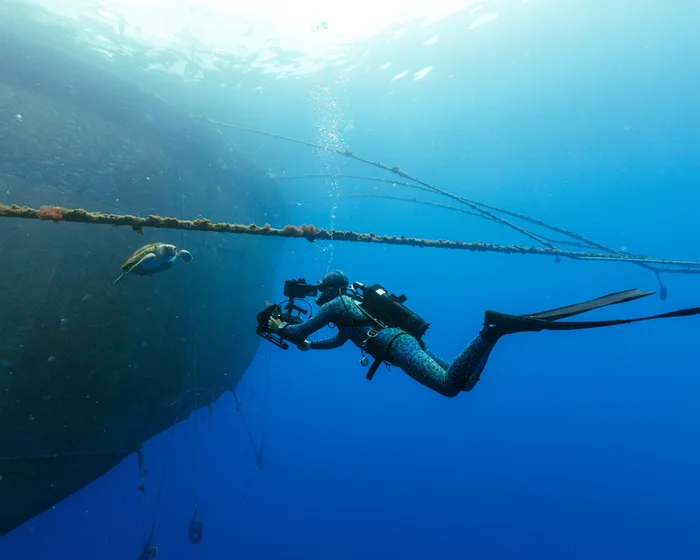
In an era when generative artificial intelligence can generate hyper-realistic digital imagery, the producers of the BBC's natural history landmark Blue Planet III are taking an unusual creative step: deliberately retaining murky, imperfect footage to prove that what viewers see on screen is real. Twenty-five years after the original series aired and almost a decade after Blue Planet II, the team behind the documentary is countering audience skepticism by embracing visible real-world flaws.
Historically, natural history documentary makers favored increasingly crisp, high-definition visuals, routinely discarding sequences with poor water visibility or framing out human elements like buoys and boats. For Blue Planet III, however, BBC Studios' natural history unit chose to leave those organic elements intact. According to Jack Bootle, the BBC's head of specialist factual commissioning, the production maintains a strict standard against synthetic imagery. Addressing reporters at a press screening, Bootle stated that no generative AI was used in the production and affirmed that every frame represents genuine photography.
Embracing natural imperfections against synthetic perfection
Executive producer Elizabeth White explained that the rapid expansion of generative AI has reinforced the production team's desire to highlight authenticity. In the past, heavy concentrations of suspended plankton or degraded water conditions would have disqualified a clip from the final edit. Now, those same elements serve as unmistakable markers of raw, physical reality.
White noted that the extraordinary deep-sea animals filmed for the project exceed what AI models could typically envision, making absolute realism the ultimate priority. Rather than presenting spotless, sterile underwater environments, the series deliberately leans into cloudier, less polished aesthetics. This strategy reflects a growing dilemma in visual media, where pristine imagery can paradoxically trigger suspicion that the content was synthesized by a computer rather than recorded in nature.
Bespoke hardware documenting unseen ocean behaviors
Filmed over four years across five oceans, the production relied on custom hardware rather than digital generation to record novel animal activity. Producer and director Yoland Bosiger developed the world's first underwater CCTV apparatus, dubbed the "stonefish" camera, which captured dolphins utilizing sea sponges to block openings in coral structures while trapping fish. Series producer Lara Bickerton detailed other custom setups, including a mini-dome camera engineered to track an octopus, a specialized deep-sea selfie stick, laser systems for filming deep-sea organisms, and leg-mounted diving scooters worn by operators to capture dynamic, TikTok-style perspectives.
These technical innovations enabled the team to capture undocumented behaviors, such as a grouper communicating with another fish species, 200,000 crabs gathering in feeding formations, and sea urchins employing discarded shells as sun protection. The series also continues its examination of environmental impacts, illustrating how the climate crisis affects anemone clown fish habitats alongside investigations into forever chemicals and industrial pollutants. The project, narrated by 100-year-old David Attenborough—who actively modified scripts during production—also navigated the BBC's broader £500m corporate cost-cutting measures by relying more heavily on local camera crews on location.
What it means for developers
For developers building computer vision pipelines, media platforms, and generative video systems, Blue Planet III's production choices illustrate a crucial shift in audience psychology: hyper-perfection is increasingly viewed with distrust. As synthetic media tools achieve near-photorealistic quality, the visual artifacts that software engineers historically attempted to clean up—such as particulate noise, fluctuating lighting, and lens occlusion—are emerging as crucial visual cues that signal physical authenticity.
This dynamic highlights practical challenges for software engineering teams working in content verification, digital watermarking, and metadata provenance. When audiences suspect that high-fidelity scenes are generated by deep learning models, cryptographic signing, capture metadata standards, and robust verification tooling become as vital as rendering capabilities. As developers benchmark how different vision and multimodal models interpret, describe, or generate visual media, services like Apixo provide unified, cost-effective pay-per-token API access to industry-standard models including GPT, Claude, Gemini, and DeepSeek using a single API key.
Ultimately, the BBC's approach shows that the rise of generative media is not merely changing how digital imagery is produced, but fundamentally altering how audiences evaluate visual truth, pushing human creators to celebrate the messy realities of the physical world.
Source: Blue Planet III features cloudier footage to prove authenticity amid AI boom — The Guardian AI. Written by the Apixo team from that report.
One key for Claude, GPT, GLM, DeepSeek and more. Pay per token with crypto.
Get your API key