Why LLMs Hallucinate and Why Advanced Reasoning Can Exacerbate the Problem
A deep look into the mechanics of LLM hallucinations, why enhanced reasoning can amplify false outputs, and the multi-layered verification pipelines required to fix them.
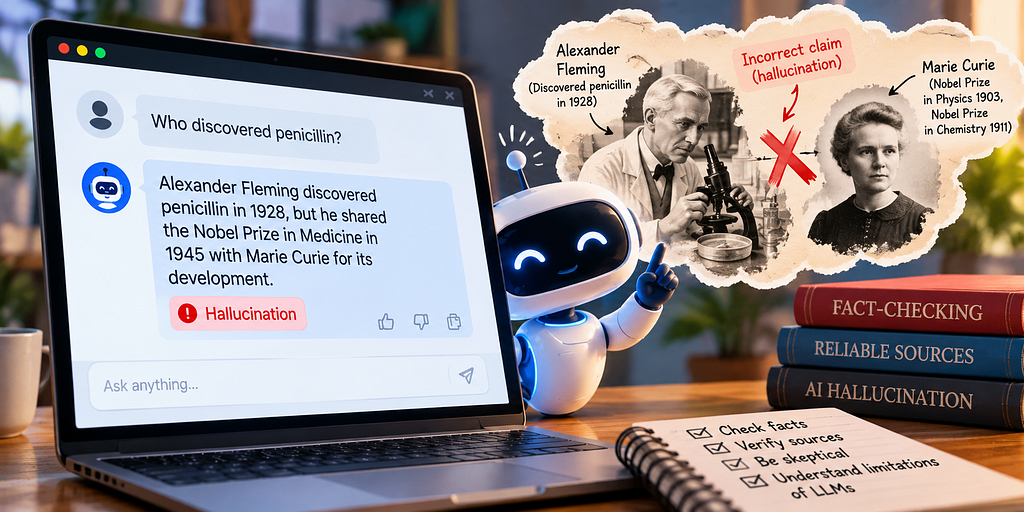
Large language models operate by predicting the single most probable subsequent token from an established vocabulary. When transforming raw logit scores into probabilities via the softmax function, the model must distribute its probability mass across candidate tokens regardless of whether it possesses verified facts. Because there is no dedicated token indicating an absence of knowledge, models assign scores to the most plausible continuations. Once an incorrect token is chosen at an early position, exposure bias takes hold: subsequent tokens are generated to remain coherent with the preceding error, producing detailed, confident, yet entirely invented assertions.
This behavior is reinforced by how models are trained and evaluated. Standard cross-entropy loss penalizes low probability assignments to words found in training sets rather than factual inaccuracy. Furthermore, as OpenAI researchers Adam Tauman Kalai and Santosh Vempala observed, conventional benchmark grading offers full credit for correct answers and zero for incorrect ones or abstentions. Much like students taking tests without negative marking, models are systematically incentivized to hazard a guess rather than acknowledge uncertainty.
A Taxonomy of Confident Errors: From Documents to Autonomous Agents
To address hallucinations, engineers divide them into distinct categories based on context and origin. In academic surveys, errors are commonly split between factuality and faithfulness. Factuality errors represent claims that are provably false or unverifiable against real-world reality, such as claiming Napoleon won at Waterloo. Faithfulness errors happen when an engine ignores direct inputs—such as introducing extraneous external context when strictly instructed to summarize an isolated document.
Another framework distinguishes between intrinsic and extrinsic hallucinations. An intrinsic hallucination directly contradicts facts explicitly present in the provided source material, while an extrinsic hallucination introduces supplementary claims that the source neither confirms nor denies.
As systems evolve from simple text completion interfaces to autonomous agents executing multi-step workflows, new failure modes emerge across reasoning, execution, perception, memory, and communication stages. Agents are susceptible to tool hallucinations, where they invent nonexistent API endpoints, supply invalid function parameters, execute inappropriate tools, or simulate execution outputs without running the underlying tool. Furthermore, agents risk silent hallucinations, in which an unstated mistaken assumption silently corrupts downstream calculations, as well as cascading hallucinations, where fabricated data from one agent is accepted as factual truth by another.
The Reasoning Paradox: Why Smarter Models Fake More
Industry assumptions long held that improving model reasoning would naturally reduce fabrication rates. However, research presented at ACL 2026 by Chenlong Yin, Zeyang Sha, Shiwen Cui, Changhua Meng, and Zechao Li revealed an unexpected countertrend in their paper, "The Reasoning Trap: How Enhancing LLM Reasoning Amplifies Tool Hallucination."
Evaluating systems using a 296-tool benchmark called SimpleToolHalluBench, the researchers observed that applying reinforcement learning to strengthen reasoning increased tool hallucinations in tandem with general task improvements. Even training models exclusively on mathematics without tools expanded tool fabrication rates. On tests where agents were provided with irrelevant tools, Qwen3 8B produced hallucinations 36.2 percent of the time with reasoning deactivated, rising to 56.8 percent when thinking mode was enabled.
A corresponding phenomenon was acknowledged in OpenAI internal evaluations. In their PersonQA evaluations assessing biographical facts, the reasoning-focused o3 model exhibited a 33 percent hallucination rate compared to 16 percent for o1, while o4 mini recorded 48 percent. Stronger analytical capability does not inherently guarantee greater truthfulness.
What it means for developers
Because scaling parameters and reasoning steps does not eliminate fabrications, engineering teams cannot rely on model self-assessment. Production workflows require layered, deterministic architectures that force models to ground their answers in supplied text and make abstention a safe, default operational path.
Several automated detection strategies are currently deployed in production environments:
- Deterministic source matching: Requiring generation engines to return structured JSON containing exact quotations, which application code programmatically matches against source material.
- Consistency checking: Sampling answers across non-zero temperatures and comparing semantic consistency, using frameworks such as SelfCheckGPT or semantic entropy metrics developed by Oxford researchers.
- Claim-level verification: Decomposing complex responses into atomic propositions and verifying them independently against external search engines via protocols like Google DeepMind's SAFE, or through cloud validation guardrails like Amazon Bedrock's contextual grounding filters.
- Secondary judge models: Utilizing lightweight, specialized language models to audit whether retrieved context explicitly supports the assertions of the primary generator.
To benchmark these validation techniques across different providers, developers can try top AI models cheaply through one API at https://apixoai.online. By combining structural constraints, automated quotation verifiers, and secondary model audits, teams can systematically prevent unchecked model fabrications from reaching end users.
Source: Why AI Makes Things Up: A Complete Guide to LLM Hallucination — Towards AI. Written by the Apixo team from that report.
One key for Claude, GPT, GLM, DeepSeek and more. Pay per token with crypto.
Get your API key