Wish-Driven Programming: How Multi-Agent Systems Enable Autopilot Software Creation
DeepSeek's wish-driven programming concept uses multi-agent frameworks to automate feature delivery, reaching up to 17.6K lines of code per day.
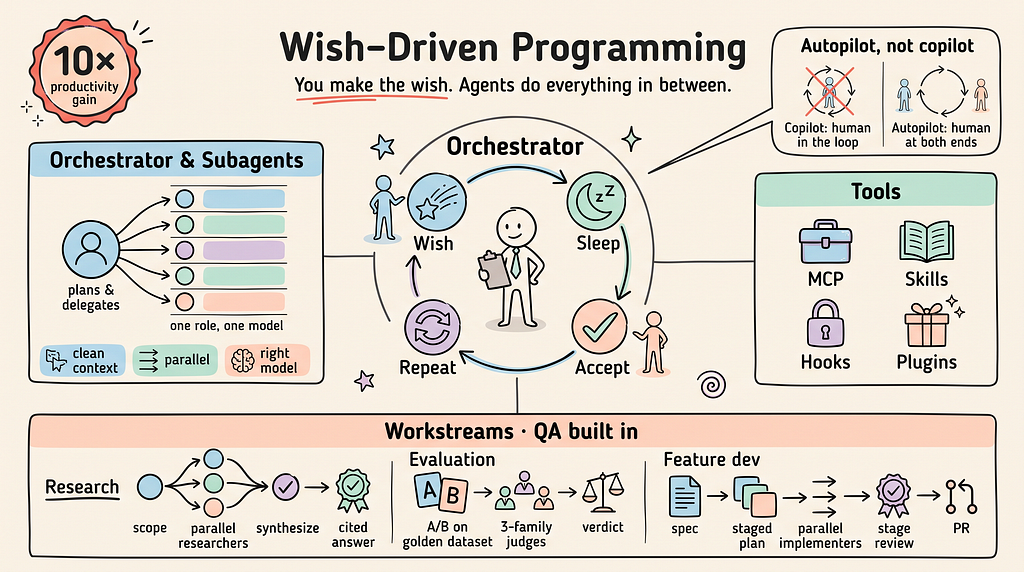
DeepSeek introduced the concept of "wish-driven programming" in October 2026 to describe a paradigm where human developers specify high-level deliverables while autonomous AI agents handle planning, execution, testing, and reviewing. Unlike traditional copilot models that require constant human attention inside the loop, this autopilot framework positions the developer primarily at the request and acceptance stages. Demonstrating the practical potential of this approach, a recent project successfully delivered an AI-native application to a CEO in three weeks without writing a single line of manual code, reaching a peak output of 17,600 lines of code in a single day.
Designing an Orchestrator-Driven Architecture
To avoid the performance degradation common in single-agent configurations, the framework relies on a single central orchestrator paired with task-specific subagents. Single-agent setups frequently encounter context rot over extended jobs. Benchmark data from LOCA-bench showed frontier AI models losing between half and two-thirds of their accuracy as context size grew from 8,000 to 128,000 tokens. Furthermore, automatic context compaction mechanisms can silently drop system instructions, causing policy violations to rise from 0% to 30% according to 2026 research by Chen.
The orchestrator-driven design mitigates these failure modes by maintaining a clean primary context window. Subagents return concise summaries rather than full execution logs, controlling their own handover state. Inspired by Anthropic's 2026 orchestration research and the Superpowers workstream, the primary agent delegates tasks to specialized subagents operating in parallel Git worktrees. This parallel structure allows independent subtasks to run concurrently, significantly reducing overall execution time.
Matching Models to Development Roles
A core element of effective wish-driven programming is assigning each subagent to an appropriate capability level and model family. For instance, high-level planning and project leadership can be assigned to advanced models such as Opus 5.5. Implementation tasks can be handled by focused models like Sonnet 5.5 to prevent overthinking, while code reviews are routed to an entirely separate model family, such as GPT-6.1-sol, to provide objective evaluation.
To coordinate these diverse model assignments across different project roles, developers can try top AI models cheaply through one API at https://apixoai.online.
The framework organizes interactions across three main functional pillars: agents and subagents, tool integrations (including Model Context Protocol connectors, operational skills, rule-based hooks, and bundled plugins), and structured workstreams. The feature development workstream adapts principles from subagent-driven development (SDD) and test-driven development (TDD), invoking reviewer subagents only at major milestones to prevent conflicting signals from disrupting the core implementation workflow.
What it means for developers
Wish-driven programming demonstrates a dramatic shift in how software development output can be scaled. Benchmarking against Spring 2026 Cursor usage data, an automated multi-agent framework achieved peak daily line-of-code generation equivalent to 10 times that of a top-10% Cursor developer, or 124 times that of a median developer. However, achieving this output requires trading direct line-by-line control for high-level oversight.
Engineers adopting this methodology must recognize that autonomous frameworks do not eliminate the need for human evaluation and product taste. Autopilot systems serve as powerful execution engines, but they remain bound by the clarity of the initial specification and the quality assurance built into the workstream. Developers exploring multi-agent architectures can also examine alternative open-source harnesses and tooling frameworks—such as Matt Pocock's skills repository, spec-kit, ruflo, and DeepSeek's research prototype dsh-superagent—to determine the right balance between copilot and autopilot modes for their projects.
Source: How to Enable Wish-Driven Programming With an Autonomous Multi-Agent Framework — Towards AI. Written by the Apixo team from that report.
One key for Claude, GPT, GLM, DeepSeek and more. Pay per token with crypto.
Get your API key

