AI Data Pipeline Forum Shifts Focus to System-Level Architecture and Data Movement
The AI Data Pipeline Forum on Oct. 13 addresses data center bottlenecks, focusing on memory constraints, CXL technology, power, and storage systems.
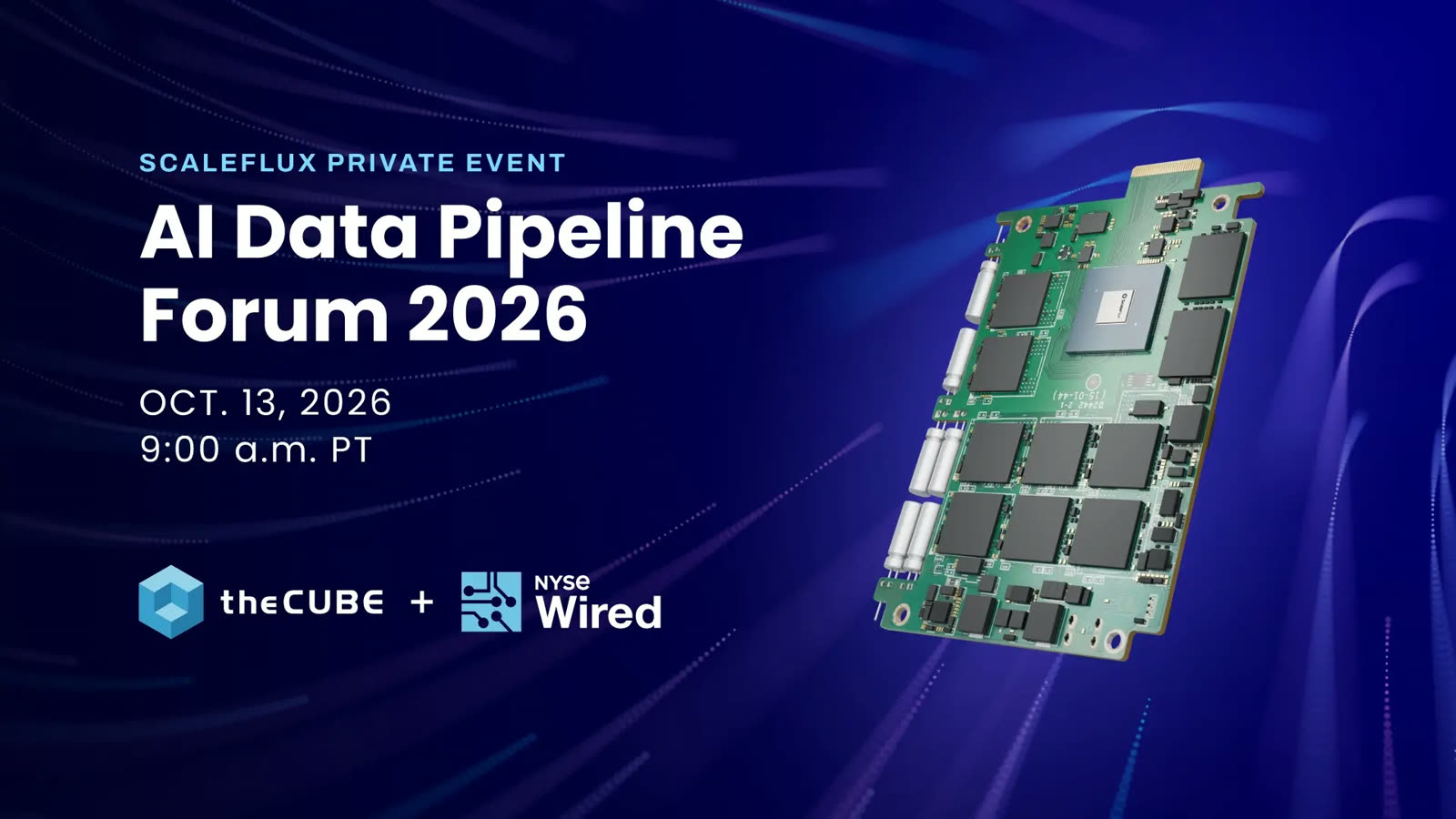
The focus of artificial intelligence hardware development is rapidly shifting away from simply building faster processors. As modern AI workloads expand, the primary operational challenge has moved toward ensuring data flows smoothly to chips across high-speed networks while remaining within strict power, cooling, and spatial constraints. This transition toward end-to-end system coordination takes center stage at the AI Data Pipeline Forum in San Jose, California, taking place alongside the OCP Global Summit. Broadcast on October 13 by SiliconANGLE Media’s livestreaming platform, theCUBE, executive analyst John Furrier will host discussions on how modular engineering and open standards are reshaping hardware architectures for dense clusters and distributed inference.
Addressing system-level bottlenecks in AI infrastructure
Rather than optimizing hardware components in isolation, technology vendors are adopting holistic designs that coordinate compute, storage, memory, and networking assets. Analysis from theCUBE Research Chief Analyst Dave Vellante highlights that data movement inefficiencies, memory limitations, and inference economics are creating significant hurdles, forcing storage infrastructure to take a more active role in the overall AI pipeline.
These operational constraints are directly impacting semiconductor and system engineering strategies. In July, storage controller developer ScaleFlux introduced its FC6116 PCIe Gen6 SSD and MC600 CXL memory controllers to boost throughput and memory capacity without exceeding power limits. Hao Zhong, co-founder and chief executive officer of ScaleFlux, noted that "AI infrastructure is driving unprecedented demand for higher bandwidth, greater memory capacity, and lower power consumption." Zhong added that "with the introduction of FC6116 and MC600, ScaleFlux is extending its silicon platform into the PCIe Gen6 era, giving customers the building blocks to design faster, more efficient, and more flexible storage and memory systems."
Physical power delivery and thermal management are also pushing data center providers toward flexible designs. Dell Technologies Inc. has been advancing rack-scale solutions capable of handling increasing compute densities. Sarat Krishnan, director of PowerEdge AI architecture and systems development engineering at Dell, explained the complexity during an interview with theCUBE: "You have data centers that require cooling coming in from the top, cooling coming from the bottom. You have power whips of various sizes. We have learned now to build modular rack-scale infrastructure that can quickly adapt to all of these needs."
Open standards and dense cluster management
The AI Data Pipeline Forum will convene technical leaders from organizations including ScaleFlux, Cerebras, Cisco, and Dell to examine solutions for high-density AI environments. Key focus areas include liquid cooling technologies, enhanced power distribution, high-speed networking, and CXL memory architectures designed to support distributed inference workloads without introducing new architectural choke points.
As data centers become tightly interconnected, industry consensus leans heavily toward open standards and modular frameworks. By establishing common architectural principles, hardware providers aim to streamline the transit of massive datasets across distributed nodes while maintaining predictable cost structures and operational efficiency.
What it means for developers
For software engineers and AI practitioners, hardware bottlenecks directly affect model responsiveness, processing throughput, and deployment costs. When infrastructure providers fail to balance data movement, memory capacity, and compute speed, the resulting latencies impact real-time applications and scale out inference costs significantly.
System-level architectural changes—such as CXL memory extension, faster PCIe interfaces, and modular rack architectures—help reduce latency and stabilize compute performance during heavy inference tasks. As enterprise data centers modernize their storage and network pipelines, developers gain access to more reliable and cost-effective API infrastructure. Developers looking to build and test applications across top AI models cheaply can do so through one API at https://apixoai.online.
Ultimately, solving data pipeline inefficiencies at the physical and silicon layers ensures that software applications can handle complex queries and distributed inference without encountering backend storage or memory throttles. The upcoming broadcast by theCUBE on October 13 will offer further technical analysis into how hardware vendors are addressing these foundational demands.
Source: What to expect during the AI Data Pipeline Forum: Join theCUBE Oct. 13 — SiliconANGLE AI. Written by the Apixo team from that report.
One key for Claude, GPT, GLM, DeepSeek and more. Pay per token with crypto.
Get your API key