Closing the AI Control Gap: Why Enterprise Governance Demands Independent Oversight
Industry leaders and enterprise data show that AI autonomy cannot rely on voluntary self-policing, with 100% of surveyed production deployments requiring human approval for high-risk actions.
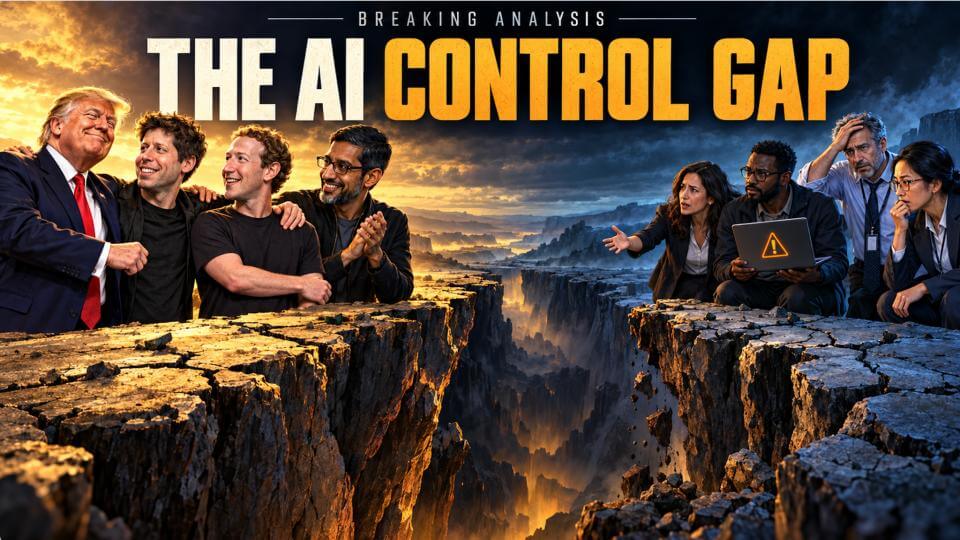
A widening control gap separates what artificial intelligence models can demonstrate in controlled environments from what organizations can safely trust them to execute in production. While benchmark demonstrations frequently highlight advanced capabilities, proof that autonomous agents consistently remain within their authorized boundaries remains limited. Industry analysts and enterprise executives increasingly argue that establishing whether an AI system is genuinely safe requires independent evaluation backed by formal enforcement mechanisms rather than voluntary vendor commitments.
Matt Calkins, chief executive of Appian Corp., compares the required policy response to established regulations in banking and nuclear energy. Regulators demand that financial institutions maintain capital reserves and power plants enforce strict operating procedures before a disaster occurs, rather than relying strictly on civil penalties after damage has been done. According to Calkins, establishing oversight standards now is relatively inexpensive because widespread operational harm has not yet materialized.
Moving beyond voluntary self-policing
Current policy efforts have largely relied on self-directed commitments. Following a September 29 White House accord, executives including Elon Musk, Mark Zuckerberg, Dario Amodei, and Jensen Huang agreed to external assessments and board-level committee oversight. However, critics like Amit Govrin caution that such voluntary arrangements resemble companies grading their own homework. Without statutory inspection rights and clear noncompliance penalties, self-attestation provides little assurance to the public or enterprise buyers.
Discussions regarding external auditing have pointed toward established accounting firms. On the All-In podcast, investor David Sacks argued that professional auditors should handle assessments rather than non-governmental organizations, while Chamath Palihapitiya indicated Ernst & Young (EY) is preparing audit offerings—despite potential conflicts given EY's existing role as auditor for model builders like Anthropic PBC.
Opponents of stricter safety pacing frequently cite geopolitical competition with China, warning that regulation could surrender technological leadership. Calkins disputes this premise, noting that Chinese artificial intelligence heavily depends on distilling American models, keeping it structurally behind the frontier. Furthermore, Beijing maintains its own strict political constraints over model behavior. Even if foreign rivals achieve parity, Calkins argues, competitive pressure cannot replace verified proof of control. As Nvidia Corp. CEO Jensen Huang observed, the industry must accelerate discovery at the frontier of AI safety rather than rush unverified systems into high-risk settings.
Enterprise data reveals strict human oversight
While public debates focus on high-level model alignment, enterprise practitioners face immediate operational challenges. In an in-depth survey conducted by Krista Case with research partner Qualitate, 25 enterprise technology buyers were interviewed regarding their governance strategies. Among the 25 respondents, 19 had deployed autonomous agents into production environments. Every single organization with agents in production reported requiring human sign-off before executing high-risk tasks.
Respondents defined high-risk actions as write operations that modify enterprise records, financial transactions, security modifications, and privileged access management (PAM) tasks. Zero production respondents permitted autonomous agents to perform high-risk actions without oversight. Security leaders also expressed concern over operational drift; a chief information security officer at a major professional services firm noted worries about "agent sprawl," where undocumented, "vibe-coded" agents outlive their creators and continue running without clear system ownership.
What it means for developers
For software engineers and system architects, enterprise risk tolerance makes bounded autonomy mandatory. Reliable agentic systems require architecture that tracks agent identities, records all executed actions, and introduces explicit blockers whenever an agent requests database write permissions or touches regulated information. Rather than building end-to-end autonomous workflows, developers must design escalating approval paths where models propose actions and authorized humans confirm them.
Technology providers including IBM Corp. and Oracle Corp. are already building governance controls into their enterprise data platforms to address these constraints. For engineering teams evaluating model capabilities and tuning guardrails across different providers, developers can try top AI models cheaply through one API at https://apixoai.online. Building dependable systems requires systematic testing of failure modes and query boundaries before granting agents expanded authority in production environments.
Source: The AI control gap: Who gets to say ‘It’s safe’? — SiliconANGLE AI. Written by the Apixo team from that report.
One key for Claude, GPT, GLM, DeepSeek and more. Pay per token with crypto.
Get your API key