Automating Snowflake Dimensional Modeling with AI-Driven Cortex Code Skills
Data engineers can enforce Kimball principles on Snowflake using Cortex Code skills to automate schema generation, auditing, and multi-fact expansion.
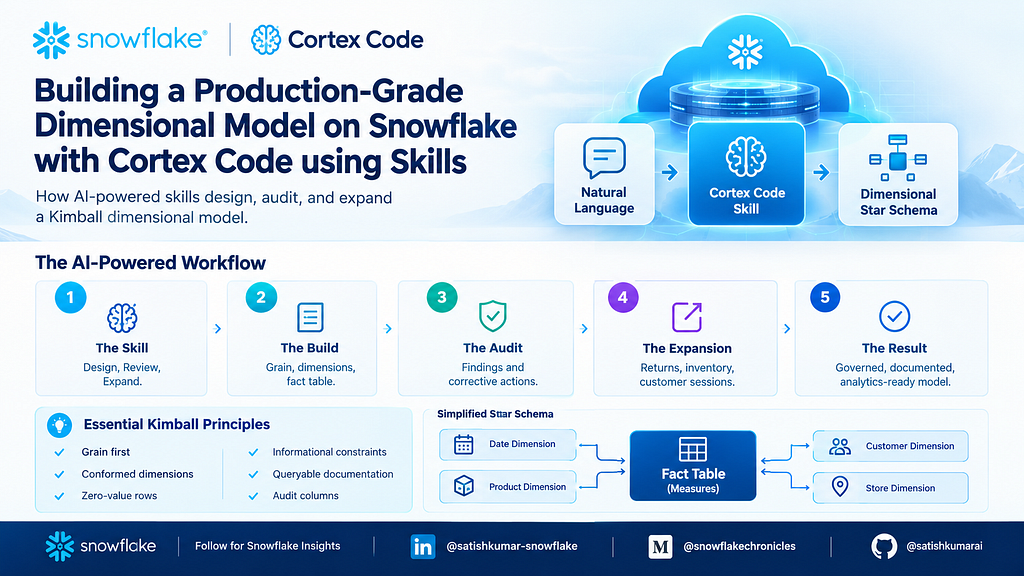
Data engineers frequently face tedious and error-prone tasks when building star schemas for analytics platforms. While the foundational principles of Ralph Kimball's dimensional modeling—such as establishing business grain, creating conformed dimensions, and assigning surrogate keys—are standard industry knowledge, manually writing hundreds of lines of Data Definition Language (DDL) code often leads to omitted edge cases and forgotten constraints. To streamline this workflow, a new implementation demonstrates how encoding dimensional modeling rules into an AI agent skill using Snowflake's Cortex Code can automate schema creation, auditing, and expansion while adhering to strict architecture guidelines.
Structuring Kimball Best Practices into an AI Skill
The central engine of this workflow is a reusable Cortex Code skill called snowflake-dimensional-modeling, defined in a SKILL.md file with YAML frontmatter. The skill manages an interactive process featuring two approval gates and two revision loops across three primary modes: Design New, Review & Improve, and Expand. Rather than relying on rigid templates, the skill enforces architectural decisions dynamically before any DDL is produced.
Regardless of the mode used, the skill requires developers to state the business grain as a plain sentence before dimension design begins. It automatically inserts zero-value rows (SK=0) in dimensions to handle late-arriving facts, embeds ETL_LOADED_AT and ETL_SOURCE audit metadata columns on all tables, and applies informational primary and foreign key constraints. Additionally, it standardizes conformed dimensions such as DIM_DATE and DIM_GEOGRAPHY to support cross-fact analysis, while populating table and column comments to document logic such as semi-additive measures.
Designing, Auditing, and Expanding an E-Commerce Model
To test the approach on a real-world scenario, the skill was instructed to build an e-commerce model covering orders, products, customers, and payments. The agent established a granular baseline of one row per order line item. It applied Slowly Changing Dimension (SCD) rules based on analytical goals, choosing SCD Type 2 for DIM_CUSTOMER to retain address history for customer lifetime value (LTV) tracking, and SCD Type 1 for DIM_PRODUCT. Tables were clustered by (DATE_SK, PRODUCT_SK) to speed up time-series and product category queries.
When executed in Review mode, the skill ran four diagnostic queries and generated a report identifying six findings, including an orphan table lacking foreign keys or audit metadata. In a single execution pass, the skill dropped the orphan table, added a natural key for payment methods, expanded data retention to seven days, enabled search optimization, added missing shipping measures, and created a conformed DIM_GEOGRAPHY dimension.
During schema expansion, three new fact tables (FACT_RETURN, FACT_INVENTORY_SNAPSHOT, and FACT_CUSTOMER_SESSION) and three new dimensions (DIM_WAREHOUSE, DIM_RETURN_REASON, and DIM_TRAFFIC_SOURCE) were added. The expansion reused five existing conformed dimensions, allowing cross-fact drill-across queries between orders and refunds. The completed ECOMMERCE.ANALYTICS model contains 12 tables, 8 dimensions, 4 fact tables, 28 constraints, and over 20,000 rows of sample data.
What it means for developers
For engineering teams, embedding architectural logic into AI skills shifts AI from generic code completion to deliberate rule enforcement. Automated audit checklists can catch structural issues—such as missing natural keys or unconstrained tables—that humans frequently overlook during manual code reviews. The project also revealed technical subtleties when generating synthetic test datasets on Snowflake, such as handling the requirement that Snowflake's UNIFORM() function requires constant bounds for its min and max arguments.
To ensure reliability, the skill design includes automated scripts for continuous integration: lint-skill.sh to check Markdown and frontmatter syntax, test-skill.sh to run integration checks against Snowflake, and publish-skill.sh to manage deployment access via flags like --dry-run and --roles.
As development teams build and evaluate AI-driven workflows across various infrastructure tasks, accessing multiple large language models remains a core requirement. Developers can try top AI models cheaply through one API at https://apixoai.online. By automating repetitive schema wiring and enforcing Kimball principles at the prompt level, engineers can maintain high analytics standards with significantly less manual effort.
Source: Building a Production-Grade Dimensional Model on Snowflake with Cortex Code using Skills — Towards AI. Written by the Apixo team from that report.
One key for Claude, GPT, GLM, DeepSeek and more. Pay per token with crypto.
Get your API key