Building a Custom FlashAttention CUDA Kernel: A Developer's Hands-On Journey
Discover how a developer implemented a custom FlashAttention kernel in CUDA, achieving a 41.6x speedup on an NVIDIA RTX 4050 GPU by leveraging the online softmax trick and hardware memory hierarchy.
Transformers have completely reshaped the landscape of artificial intelligence, with the self-attention mechanism acting as the beating heart of every model. It empowers language models to capture intricate contextual relationships across sequences. Yet, self-attention is simultaneously a double-edged sword: its algorithmic complexity is 𝒪(N²), meaning memory consumption and computation explode quadratically as sequence lengths grow. Over the years, researchers attempted to alleviate this burden using algorithmic approximations like Sparse Attention, Linformer, and Performer. While mathematically clever, many failed to dominate in practice due to unacceptable quality trade-offs or a lack of hardware-friendliness.
When purely algorithmic solutions hit a ceiling, researchers looked at the hardware. In 2022, Tri Dao et al. introduced FlashAttention—an exact attention algorithm that redesigns attention around GPU memory hierarchy and IO-awareness. Recently, one developer documented their hands-on journey of writing a custom FlashAttention kernel in CUDA, moving from demystifying the online softmax trick to hitting a 41.6x speedup on an NVIDIA RTX 4050 GPU.
Understanding the GPU Memory Bottleneck and Online Softmax
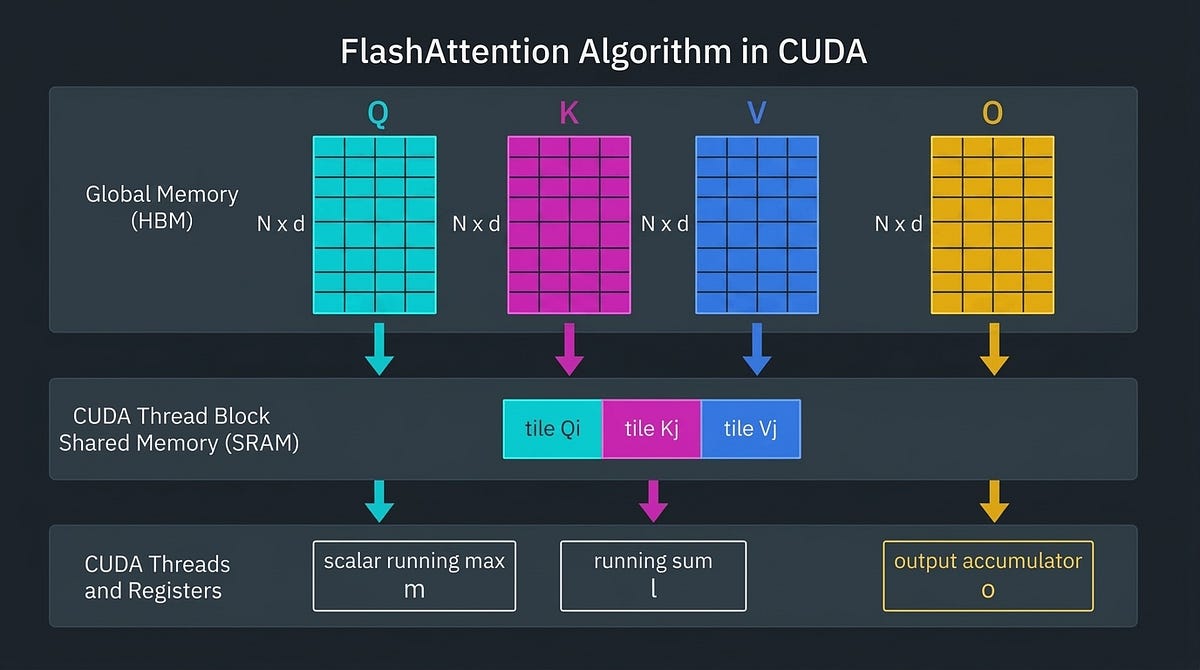
To understand why FlashAttention is necessary, one must look at how modern GPUs operate. A GPU features a hierarchy of memory spaces with vastly different bandwidths. Global Memory (VRAM) is large, ranging from 6GB to 80GB, but relatively slow at roughly 1.5 to 3 TB/s on modern architectures. Conversely, SRAM, which includes shared memory and registers, is on-chip and blisteringly fast at about 19 TB/s, but minuscule at around 48KB to 228KB per Streaming Multiprocessor.
Standard attention computes matrices that are written back and forth to Global Memory, making the process overwhelmingly memory bound. For a sequence length of N = 16,384, an N × N matrix contains over 268 million floating-point numbers, consuming over 1 GB of memory for just a single attention head. The GPU spends nearly all its time waiting to transfer bytes across the memory bus rather than computing floating-point operations. FlashAttention solves this via kernel fusion, ensuring everything stays on-chip in SRAM without materializing the N × N matrix in Global Memory.
A crucial mathematical component of this is the online softmax trick. Traditionally, softmax requires three passes over the data to find the maximum value, calculate the sum of exponentials, and divide each element. In 2018, Milakov and Gimelshein proved that developers can maintain a running maximum and running denominator dynamically. Tri Dao extended this by realizing that the algorithm does not actually need the attention matrix A; it only cares about the final output vector. By continuously rescaling the running output vector and blending in new token contributions, the algorithm computes everything in a single pass.
Overcoming Hardware Limits and Writing the Kernel
Translating the theoretical algorithm to physical GPU hardware requires a rigorous understanding of CUDA memory and thread hierarchies. During implementation, developers often face harsh hardware limitations. For instance, allocating four tiles directly in Shared Memory can push the footprint to 64 KB, triggering a compilation error because the default hardware limit for statically allocated Shared Memory per thread block is 48 KB. By storing intermediate attention scores in a thread-private local register array rather than shared memory, developers can trim the footprint back down to fit the default hardware budget.
Another common pitfall involves loading Key and Value matrices correctly. Failing to loop across all head dimensions and instead copying only a single float leaves the remaining elements filled with uninitialized garbage data, corrupting subsequent dot-product results. Ensuring explicit loops populate the complete row guarantees that the entire feature vector is loaded properly.
When evaluated on an NVIDIA GeForce RTX 4050 Laptop GPU with a sequence length of N = 1024 and head dimension d = 64, standard CPU attention took 143.81 ms, whereas a naive GPU FlashAttention took 7.63 ms (an 18.8x speedup). The optimized, tiled FlashAttention implementation slashed execution time down to 3.45 ms, representing a 41.6x speedup over the CPU baseline.
What it means for developers
Writing custom CUDA kernels demonstrates that hardware awareness trumps raw FLOPs. Minimizing round-trips to HBM is the defining factor behind high-performance deep learning systems. For developers diving into CUDA or exploring how high-throughput inference engines like vLLM, TensorRT-LLM, and FlashAttention operate under the hood, building algorithms from first principles provides unmatched insight. If you want to experiment with advanced AI workflows without breaking the bank, developers can try top AI models cheaply through one API at https://apixoai.online. Building low-level systems becomes significantly more manageable when pairing with interactive tooling to sanity-check equations and trace memory access patterns.
Source: How Did I Write My First FlashAttention Kernel in CUDA ? — Towards AI. Written by the Apixo team from that report.
One key for Claude, GPT, GLM, DeepSeek and more. Pay per token with crypto.
Get your API key