AWS Outlines 5-Step FinOps Framework to Control Amazon Bedrock Costs End-to-End
AWS details a continuous five-stage operating model helping engineering and FinOps teams track, enforce, and optimize agentic AI spend on Amazon Bedrock.
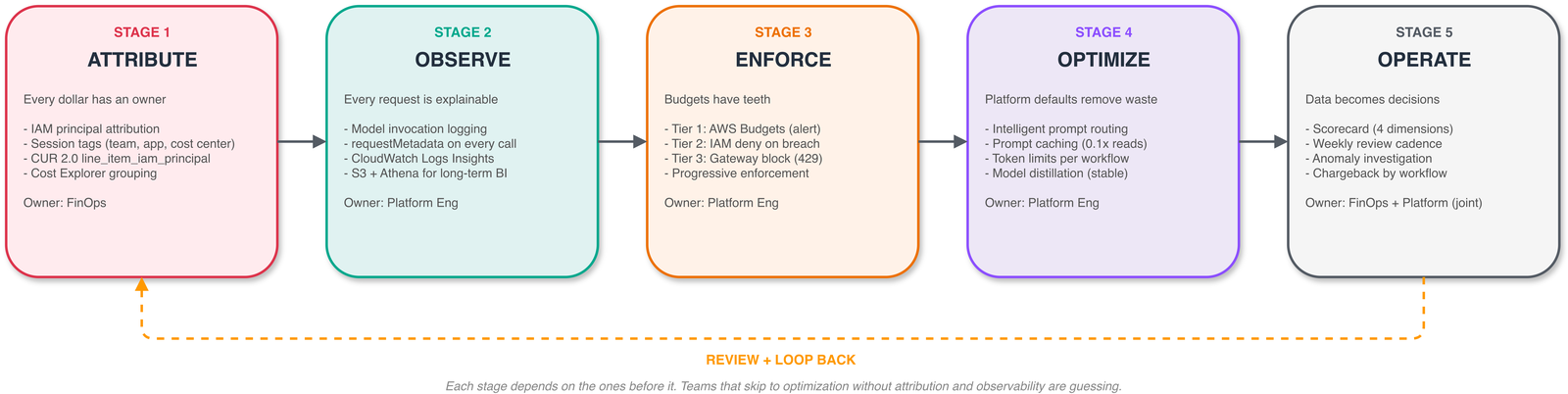
Managing expenses for generative AI applications requires a coordinated approach between platform engineering teams and enterprise FinOps leaders. As software architectures shift from simple conversational chatbots toward highly autonomous agentic workflows—which perform code analysis, file reads, and multi-step tool calls—token consumption grows dramatically. Rather than scaling linearly with user input, costs scale with context sizes and task autonomy, making spend management a core architectural discipline. To address this challenge, AWS has detailed a five-stage operating loop designed to track, control, and optimize Amazon Bedrock usage end to end.
Structural foundation: Attribution and observability
The operating model begins with granular cost attribution. Amazon Bedrock automatically assigns inference costs directly to the AWS Identity and Access Management (IAM) principal making the request, writing caller details into the AWS Cost and Usage Report (CUR) 2.0 under the line_item_iam_principal column. This applies across IAM users, federated credentials, roles, and API keys. To overcome the common "shared-role problem"—where centralized API gateways obscure per-user spending by routing all traffic under a single IAM identity—enterprises can pass user identities and session tags using AWS Security Token Service (AWS STS) during role assumption. Alternative mechanisms like Application Inference Profiles for bedrock-runtime endpoints and Projects for bedrock-mantle APIs also ensure spend lands accurately in cost management tools like AWS Cost Explorer within 24 to 48 hours.
The second phase establishes full observability by sending invocation logs to Amazon CloudWatch for fast operational queries or Amazon S3 and Athena for long-term business intelligence. Platform teams are encouraged to standardize mandatory request metadata—including application names, workflow identifiers, tenants, and agent roles—directly inside shared SDK wrappers. Pairing these logs with OpenTelemetry allows organizations to generate near-real-time spend dashboards, replacing standard 24-hour billing reporting lags with operational visibility inside minutes.
Budget enforcement, optimization, and operational reviews
Once spending is visible, teams can implement enforcement across three distinct operational tiers based on their spend velocity and risk tolerance. Tier 1 relies strictly on AWS Budgets for threshold alerts without blocking active traffic. Tier 2 uses background AWS Lambda workers to tally usage counters in Amazon DynamoDB from raw logs, updating IAM policies to asynchronously block callers who breach financial caps. Tier 3 places a dedicated proxy—such as the Claude apps gateway for AWS or LiteLLM on Amazon ECS Fargate—directly in the network path, returning immediate HTTP 429 status codes the moment spend limits are reached.
The final stages focus on optimizing platform defaults and maintaining an operational review rhythm. Centralized routing policies can redirect routine tasks like boilerplate generation to smaller, cost-effective model variants while reserving frontier models for complex reasoning. Furthermore, prompt caching significantly lowers input charges; for instance, Anthropic Claude Sonnet 5.5 in US East (N. Virginia) drops cache read pricing down to 0.05x the base input rate. To sustain these gains, FinOps and platform leads run joint weekly or biweekly scorecard reviews tracking metrics like daily per-developer spend—where under $100 is considered green—cache hit ratios, and cost per successful business outcome.
What it means for developers
For software engineers and platform architects, this framework transforms AI expense management from a reactive billing exercise into a structured engineering discipline. Developers no longer need to manually trim prompts or guess token consumption, as centralized platform wrappers handle metadata tracking, model routing, and prompt caching defaults automatically.
At the same time, individual contributors gain transparent visibility into how their specific code iterations impact application budgets. While enterprise platforms enforce these multi-stage tagging pipelines across cloud environments, developers looking to test ideas across multiple foundation models without upfront overhead can try top AI models cheaply through one API at https://apixoai.online. Ultimately, combining precise identity tagging, automated fallback routing, and structured scorecard reviews allows engineering teams to build ambitious agentic workflows without risking unmanaged cloud expenses.
Source: Managing Amazon Bedrock costs end to end: A playbook for FinOps and platform teams | Amazon Web Services — AWS Machine Learning. Written by the Apixo team from that report.
One key for Claude, GPT, GLM, DeepSeek and more. Pay per token with crypto.
Get your API key