Boom Supersonic Expands into AI Data Center Turbines Amid Airline Delays
Boom Supersonic faces delivery doubts from United Airlines while pivoting to build 42-megawatt gas turbines for AI data centers following a canceled $1.25 billion deal.
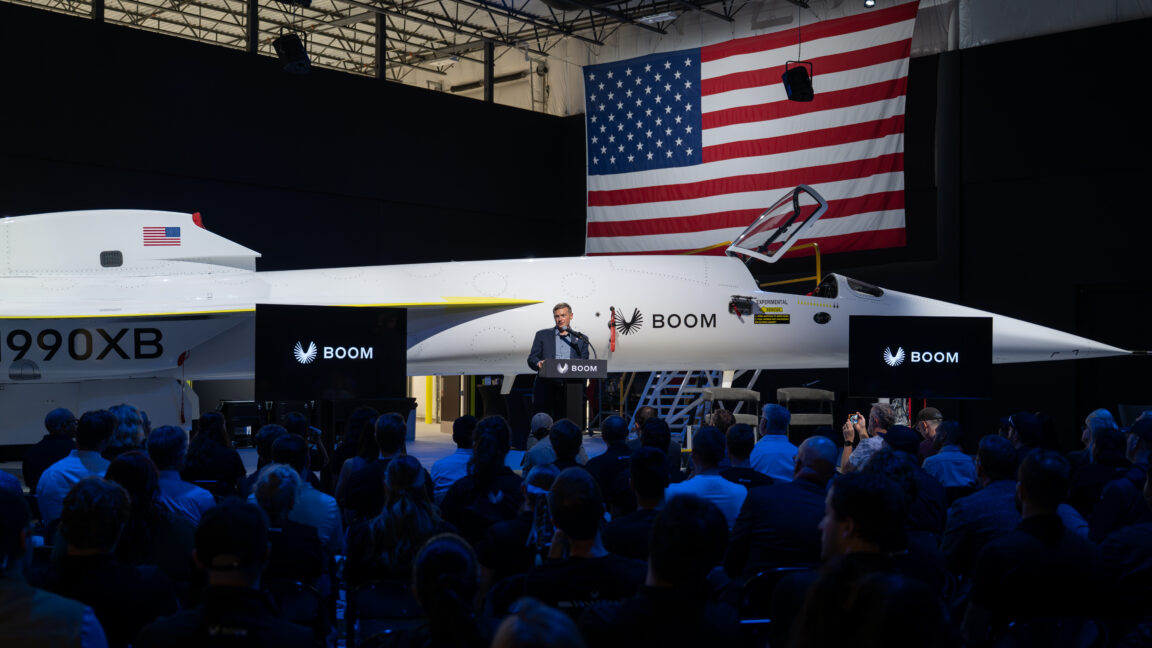
Boom Supersonic, the aviation startup seeking to revive commercial high-speed passenger flights, is facing growing scrutiny over its ambitious delivery schedule while concurrently attempting a pivot into powering artificial intelligence data centers. As electricity demands surge across the AI industry, Boom has introduced plans to manufacture natural gas turbines, yet both its aviation and energy efforts are meeting skepticism from major partners and setbacks in client deals.
Doubts Surround the 2029 Airliner Timeline
United Airlines Chief Executive Scott Kirby recently poured cold water on Boom's official target of delivering its flagship Overture supersonic airliner by 2029. Speaking on the Office Hours: Business Edition podcast, Kirby noted that while 2029 remains the company's stated goal, "it’s not going to happen in ‘29—it’s going to take longer." Kirby pointed out that Boom continues to face significant hurdles in engineering the aircraft and securing regulatory certification from the Federal Aviation Administration (FAA), characterizing commercial entry as having roughly "50-50" odds in earlier remarks.
Boom's initial momentum had been supported by test flights of its XB-1 demonstrator aircraft across 2024 and 2025, which verified a "boomless cruise" concept via Mach cutoff refraction to limit ground noise. The company also benefited from federal backing; an executive order from President Donald Trump led the FAA to propose lifting a historic ban on overland commercial supersonic flights in June 2026. Airlines including United, American Airlines, and Japan Airlines have placed conditional orders backed by non-refundable deposits.
Despite those commitments, Boom's manufacturing footprint has raised local scrutiny. The company finished construction of its primary Overture production plant at Piedmont Triad International Airport in Greensboro, North Carolina, in 2024. However, that facility has mostly sat idle, leading to questions from state officials who approved more than $50 million in public funding to support its development.
Entering the AI Energy Market
Alongside its aeronautical work, Boom CEO Blake Scholl recently announced that "it’s time for a renaissance in energy and in supersonic flight," unveiling an additional factory in Centennial, Colorado. The site is designed to manufacture a 42-megawatt natural gas turbine branded as "Superpower," aimed at satisfying the severe electrical appetite of modern data centers. The unveiling drew high-profile political attendance, including US Secretary of Energy Chris Wright and Colorado Governor Jared Polis.
Boom is currently building turbine parts inside the Colorado site while construction finishes, targeting mid-2027 for its initial customer shipments before scaling to 25 units in 2028 and 50 by 2029. This transition mirrors broader trends tracked by market intelligence firm Cleanview, which notes data center operators turning to aeroderivative turbines and mobile truck-mounted gas generators to meet rising baseload power needs.
The pivot, however, has already faced disruptions. Scholl disclosed that Boom lost a $1.25 billion contract to provide 29 Superpower turbines to Crusoe, a developer known for constructing facilities for Microsoft, Google, and Oracle. While Scholl stated on social media that Boom still intends to deliver approximately 250 megawatts of capacity to other locations next year, specific alternative clients were not named.
Boom maintains that its power generation business directly reinforces its aerospace roadmap. Both the Superpower gas turbine and the Overture's proposed Symphony engine share a common core design dubbed the Sprint Core. Boom plans to conduct its first firing test of the Sprint Core at the Colorado Air & Space Port before Thanksgiving.
What it means for developers
Boom's foray into energy generation highlights the severe physical constraints currently governing the artificial intelligence sector. For software engineers and developers building machine learning products, computing power is no longer merely a cloud resource allocation issue; it is bound to hardware manufacturing timelines, local municipal power grids, and unconventional power procurement.
When data center builders like Crusoe must weigh multi-gigawatt gas contracts for hyperscalers like Oracle, Google, and Microsoft, it underscores how heavily compute availability relies on industrial supply chains. Delays in hardware deployments, such as Boom's turbine rollouts or lost contracts, illustrate why hosting capacity can fluctuate unpredictably.
To remain resilient against infrastructural bottlenecks and varying provider costs, technical teams increasingly need diversified model access. Developers can try top AI models cheaply through one API at https://apixoai.online, allowing engineering teams to route workloads flexibly across different leading model architectures without getting trapped in single-ecosystem compute constraints or infrastructure volatility.
Source: Supersonic airliner in doubt as company shifts to powering AI data centers — Ars Technica AI. Written by the Apixo team from that report.
One key for Claude, GPT, GLM, DeepSeek and more. Pay per token with crypto.
Get your API key