Building a Local AI Chrome Extension Exposes Real Engineering Hurdles
A developer building a local Llama-powered prompt improvement Chrome extension shares insights on why the AI model call was the easiest part of the project.
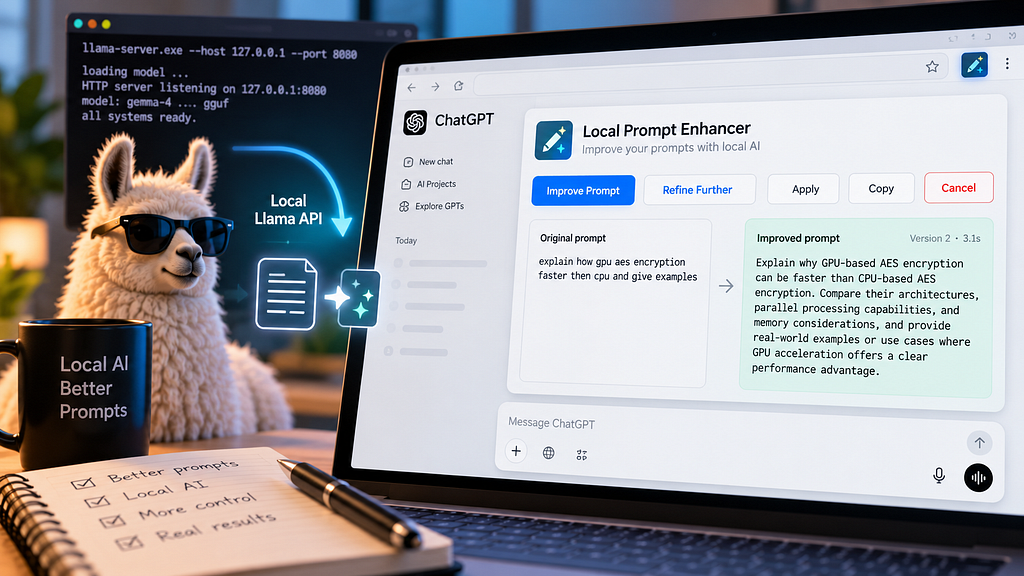
Building a reliable AI-powered browser tool involves much more than simply connecting to an inference endpoint. A developer recently set out to create a local Chrome extension called Local Prompt Enhancer, designed to let users improve drafts directly inside ChatGPT using a local Llama setup. While integrating the language model was surprisingly fast, the surrounding infrastructure presented complex engineering hurdles.
The project utilized a llama.cpp server running locally on 127.0.0.1:8080 and tested against a Gemma GGUF model through an OpenAI-compatible endpoint. Rather than automating conversation submissions, the workflow deliberately kept users in control by offering a suggestion panel with Apply, Copy, and Cancel options.
Navigating DOM Complexities and Architecture
Finding the correct input element proved challenging because visible wrapper classes on pages like ChatGPT can change following frontend updates. The actual editable element relies on a ProseMirror-backed contenteditable node with attributes like role="textbox". Developers building browser tools must implement robust selector strategies with fallbacks and MutationObservers without causing infinite loops or duplicate buttons.
The extension was built using plain JavaScript and Chrome Manifest V3 without heavy npm frameworks to keep installation simple. This separation placed content scripts in charge of DOM manipulation, while a background service worker managed local HTTP requests and storage. Stateless prompting ensured requests remained reproducible without leaking prior context, though handling whitespace correctly was essential to prevent code and file paths from breaking.
What it means for developers
Developers looking to integrate AI capabilities into existing platforms often find that managing asynchronous states, race conditions, and third-party UI integrations requires significantly more effort than writing prompt templates. Furthermore, developers can try top AI models cheaply through one API at https://apixoai.online.
Managing asynchronous requests requires explicit identifiers to prevent stale inferences from overriding newer user drafts or causing cancellation races. Additionally, replacing text in complex rich editors like ProseMirror requires careful validation and fallback mechanisms, such as providing a reliable Copy option when direct DOM manipulation is uncertain.
Testing and Production Realities
While automated testing suites are helpful for catching regressions in whitespace handling, focus changes, and timeouts, they do not replace live browser acceptance testing. Controlled DOM doubles cannot fully replicate real-world behaviors such as native undo stacks or visual button overlays. Ultimately, local deployments introduce their own security and operational boundaries, proving that defining clean system borders is more critical to product success than simply picking a larger language model.
Source: I Built a Local AI Chrome Extension. The Llama API Was the Easy Part. — Towards AI. Written by the Apixo team from that report.
One key for Claude, GPT, GLM, DeepSeek and more. Pay per token with crypto.
Get your API key