Designing Agent Tool Topologies: Balancing Model Flexibility and System Safeguards
A look at single, parallel, chain, and graph tool topologies for AI agents, and how developers can balance runtime model autonomy with strict backend security controls.
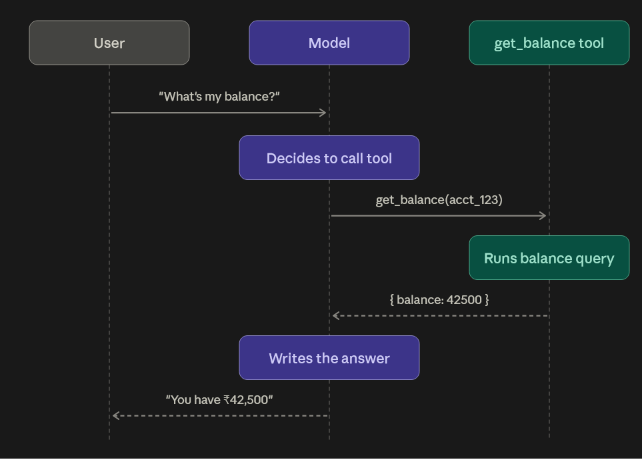
As software engineers shift from building simple conversational chatbots to designing autonomous agentic workflows, a major architectural challenge has emerged: structuring how models interact with external tools. In traditional applications, execution sequences follow rigid software logic defined entirely in code. In contrast, AI agents make runtime decisions based on user intent, determining which functions to invoke, in what order, and how to process intermediate outputs. Achieving system reliability requires implementing structured tool topologies that balance model freedom with deterministic backend safeguards.
Four Key Patterns for Tool Execution
Agent topologies generally fall into four primary structural patterns based on workflow complexity:
Single Tool Execution: The foundational model where an agent selects a single tool, extracts parameters from the request, invokes the call, interprets the output, and responds to the user. Fetching an authenticated customer's account balance is a classic single-tool operation.
Parallel Tool Execution: When a user query requests multiple independent read operations—such as retrieving account balance, recent transaction history, and upcoming bills simultaneously—agents can run tools concurrently. By leveraging semantic tool selection and asynchronous execution (such as Python's asyncio.gather), running independent calls in parallel can reduce total response latency from three seconds down to roughly one second. Developers should manage concurrency limits using semaphores and set explicit timeouts to handle partial failures without breaking the entire request.
Chains: When steps depend directly on prior outputs, linear chains enforce sequential execution. For instance, a financial transfer chain ensures the system checks account balances and validates beneficiary registration before executing a transfer. Frameworks like LangChain use the LangChain Expression Language (LCEL) pipe (|) operator to enforce step ordering and halt execution immediately if a prerequisite step fails.
Graphs: For complex workflows with conditional decision points, loops, or human checkpoints, graph-based architectures provide clear state management. Frameworks like LangGraph allow developers to branch execution paths based on risk. Low-risk actions can proceed directly, whereas high-value transfers can pause for human approval (interrupt) or trigger one-time password (OTP) verification before reaching execution.
Preserving Backend Safety and System Integrity
Tool descriptions alone cannot prevent an AI agent from making execution errors, such as attempting a debit before checking account balances or retrying a transaction after a timeout. Application-level safeguards must be enforced on the backend regardless of model decisions.
Critical state-changing operations should be grouped into single atomic functions backed by duplicate-request protection to prevent partial failures or repeated debits. Furthermore, developers should use deterministic code rules for basic logical checks—such as comparing transfer amounts against available funds—while reserving model reasoning for tasks requiring natural language understanding or parameter extraction.
What it means for developers
Building dependable AI agents requires choosing the right orchestration layer and execution strategy for your specific use case. While LangChain and LangGraph excel at structured chains and stateful graphs, alternative frameworks offer different advantages: LlamaIndex fits retrieval-heavy RAG applications, CrewAI targets multi-agent prototyping, Microsoft Agent Framework serves Azure-centric environments, and Temporal provides durable execution for long-running workflows.
When benchmarking model reasoning capabilities, tool selection accuracy, and response times across these different topologies, developers can try top AI models cheaply through one API at https://apixoai.online.
Ultimately, designing effective AI agents is not about granting total autonomy, but about engineering the right structural topology. By pairing explicit execution patterns—whether parallel batches, linear chains, or graph state machines—with atomic backend controls, developers can build resilient AI systems ready for production deployment.
Source: Designing Tool Topologies for AI Agents — Towards AI. Written by the Apixo team from that report.
One key for Claude, GPT, GLM, DeepSeek and more. Pay per token with crypto.
Get your API key