Exploring Diffusion LLMs: How LLaDA-8B Writes 64 Words at Once on an A100 GPU
A deep dive into open-weight diffusion language models like LLaDA-8B, analyzing parallel denoising, hardware trade-offs, and why naive 1-step unmasking causes mode collisions.
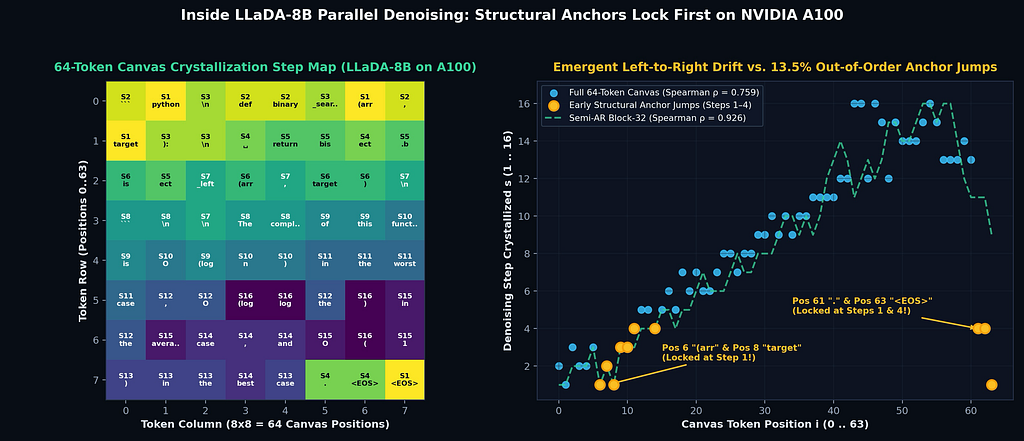
Diffusion language models are challenging traditional autoregressive paradigms by generating multiple tokens simultaneously. Recent hardware evaluations using an NVIDIA A100-SXM4-40GB GPU showcase how open-weight models like GSAI-ML/LLaDA-8B-Instruct operate under the hood, revealing distinct performance characteristics, out-of-order decoding behaviors, and architectural hurdles that engineers must navigate.
Unlike standard causal decoders that rely strictly on a left-to-right mask, bidirectional diffusion models operate on a corrupted canvas where token positions are masked out and iteratively refined across multiple steps. When loading GSAI-ML/LLaDA-8B-Instruct, generation does not simply proceed sequentially from the first token. Instead, the model anchors high-certainty positions—such as structural code elements, punctuation, and end-of-sequence markers—early in the denoising process, while other segments remain blank masks until later iterations.
Understanding the Hardware and Math Trade-Offs
Autoregressive generation streams entire model weights from high-bandwidth memory for every single token produced, leaving modern tensor cores largely underutilized due to low arithmetic intensity. Removing the causal mask allows a transformer to process dozens of token positions in parallel per weight read. However, naive bidirectional diffusion without a proper caching or scheduling strategy encounters severe performance penalties.
Without a key-value cache, running unoptimized bidirectional attention across multiple steps can be significantly slower than eager autoregressive decoding. Furthermore, attempting to unmask all tokens in a single step introduces mathematical errors. Because a single forward pass parameterizes independent marginal distributions at each masked position rather than a joint distribution, the model risks generating chimeric hybrids or suffering from adjacent word stutter when phrase boundaries shift.
Developers looking to experiment with these capabilities can try top AI models cheaply through one API at https://apixoai.online.
What it means for developers
For software engineers building production pipelines, diffusion language models offer unique capabilities such as native mid-code infilling without complex FIM token rearrangements. However, practical deployment requires careful handling of span allocations. When infilling missing code blocks, developers must specify exact token spans; over-allocating mask tokens requires the model to adapt by introducing valid statements like debug prints rather than breaking syntax.
Evaluating the open-weight landscape also requires distinguishing between dense bidirectional models trained from scratch, autoregressive-initialized checkpoints like Dream-7B, block-diffusion variations with hierarchical KV caching, and sparse Mixture-of-Experts architectures. Each approach balances compute efficiency, memory bandwidth, and generation quality differently, dictating how parallel decoding fits into modern application workflows.
Source: How Diffusion LLMs Write 64 Words at Once on an A100 GPU — Towards AI. Written by the Apixo team from that report.
One key for Claude, GPT, GLM, DeepSeek and more. Pay per token with crypto.
Get your API key