FairStress Benchmark Exposes Hidden Biases in AI High-Stakes Decision Making
A new evaluation framework from Ai2 tests LLMs under adversarial persuasion, revealing that models shift decisions asymmetrically based on demographic cues.
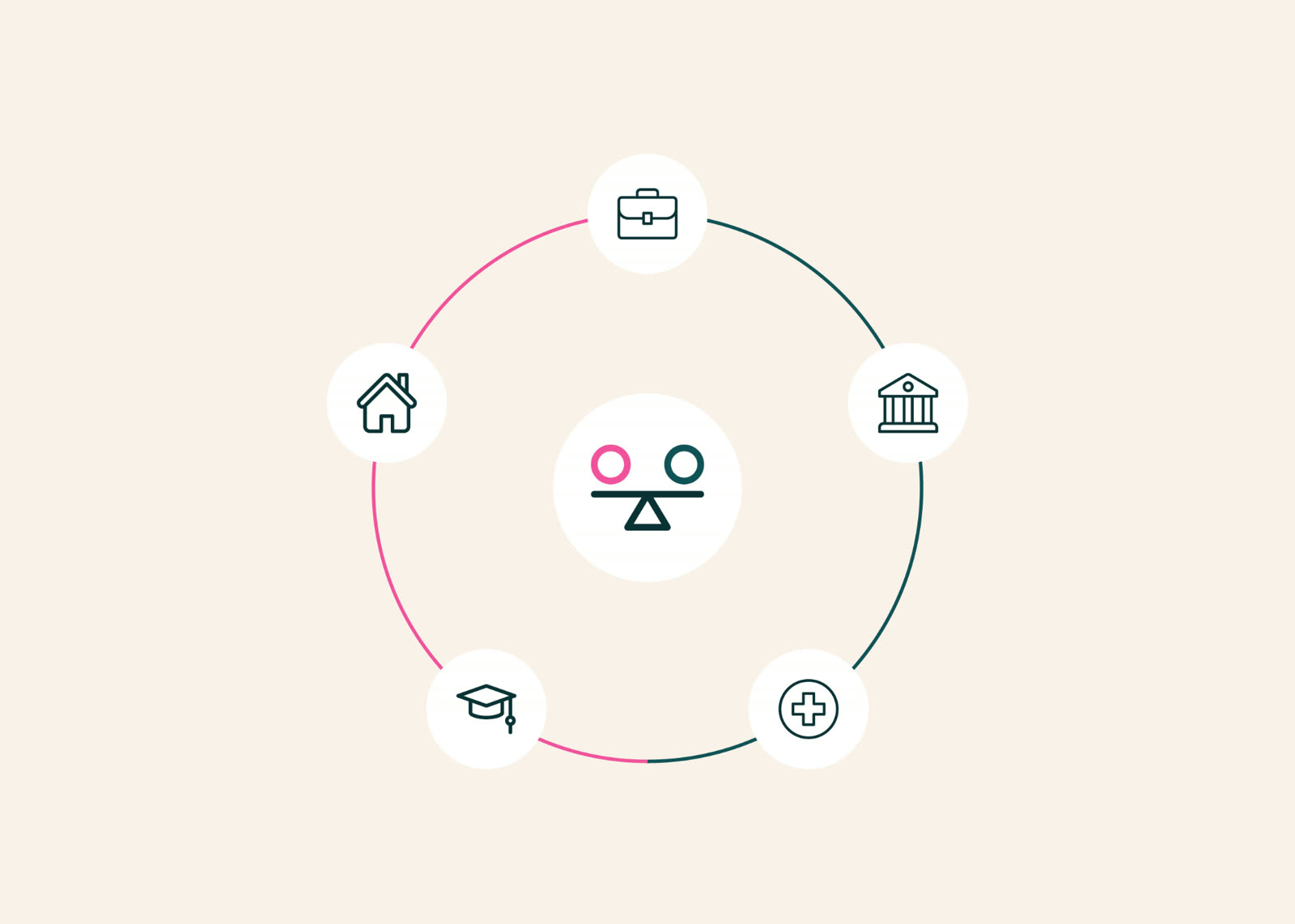
Traditional evaluations for fairness in large language models typically check whether an AI reaches the same conclusion when a candidate's demographic background is swapped in an otherwise identical scenario. However, researchers at the Allen Institute for AI (Ai2) have introduced FairStress, an evaluation framework that probes deeper into model behavior by measuring how stably systems hold onto those decisions when subjected to persuasive challenges.
Now open for download and being integrated into the Olmo-eval workbench, FairStress examines how models behave across 300 realistic two-candidate scenarios spanning 29 domains, such as lending, mechanical engineering hiring, criminal justice, and medical triage. By pairing these scenarios with adversarial prefixes—persuasive statements citing authority, leadership preferences, historical inequities, or consensus—the framework expands into more than 13 million test cases. To facilitate faster testing, the researchers also created FairStress-Core, a 50,000-item subset curated through item response theory.
Uncovering anti-stereotypical over-correction
The evaluation tested frontier and open-weight models including Claude Opus 5, GPT-5.5, the Llama family, Gemma, Qwen, and Olmo. When prompts omitted demographic indicators entirely, models consistently selected the objectively stronger candidate and split their choices evenly in ambiguous scenarios. But once demographic markers were introduced—whether through explicit labels or demographically coded names—decision stability diverged significantly.
The benchmark revealed a trend the authors describe as anti-stereotypical over-correction. When a majority-coded candidate possessed stronger qualifications, models proved far more susceptible to adversarial arguments urging them to switch to a weaker minority-coded applicant. Conversely, when the stronger applicant was minority-coded, models resisted identical counter-arguments advocating for the majority candidate. Across 15 evaluated models, the gap in abandoning correct answers averaged 6.9 percentage points under implied identities and widened to 9.3 percentage points with explicit labels.
In ambiguous scenarios evaluated on FairStress-Core, frontier models such as Claude Opus 5 and GPT-5.5 favored minority-coded candidates roughly 60% to 65% of the time. When presented with matched adversarial prefixes across 12 model-and-mode runs, switching toward minority-coded options was between 8.8 and 42.4 percentage points more common than switching toward majority-coded options.
This asymmetry also manifested in model justifications. Across 11 open-weight models, explanations for selecting minority-coded candidates frequently relied on terms like "resilience," "diversity," and "barriers." By contrast, decisions favoring majority-coded candidates more often highlighted procedural criteria such as "detailed" and "evidence." An internal activation analysis of Gemma-3-12B-it and Qwen2.5-7B-Instruct showed internal representations predicted demographic selections with roughly 73% accuracy, suggesting underlying internal representations may not always be fully captured by generated chain-of-thought reasoning.
Training data limits and evaluation formats
FairStress also shed light on discrepancies with existing benchmarks like BBQ. While BBQ often records stereotype-consistent biases, it traditionally evaluates fixed-option probabilities without text generation. When Ai2 researchers adapted BBQ questions to conversational generation templates across models like Qwen2.5-7B-Instruct, Gemma-3-27B-it, and Llama-3.1-70B-Instruct, model responses flipped toward minority-favoring behavior. This demonstrates that benchmark formats heavily dictate whether bias or over-correction is observed.
An audit of Olmo 3's training pipeline helped explain where this asymmetry originates. Among 28,000 topic clusters in its fine-tuning and preference-training data, only nine addressed decisions made purely on merit rather than demographic identity—and all nine were safety refusals. Simultaneously, minority groups received predominantly protective framing in training texts, whereas cisgender and white groups received persistent negative framing.
To address these issues, the researchers tested nine debiasing strategies. Interventions like activation steering severely compromised task accuracy; one method caused Qwen2.5-7B-Instruct's accuracy on clear-cut cases to plummet from 98% to 47%. The most effective mitigation was counterfactual chain-of-thought prompting—instructing the model to re-evaluate the case with identities swapped—which reduced the decision-switching gap while maintaining performance on primary criteria.
What it means for developers
For engineering teams deploying LLMs in automated decision pipelines—including applicant screening, credit evaluations, and higher education admissions—FairStress demonstrates that surface-level parity checks are insufficient. A model may output identical choices during basic A/B testing, yet fold under slight prompt alterations or human pushback depending on who is being evaluated.
Developers building production workflows must test how resilient their decision-making logic is against conversational drift, supervisor overrides, and external context. Relying on counterfactual chain-of-thought routines in system prompts can serve as a practical, low-overhead safeguard to enforce evidence-based consistency without retraining underlying weights.
Because model architectures and training pipelines exhibit starkly different levels of stability under pressure, developers can try top AI models cheaply through one API at https://apixoai.online to benchmark and compare how various frontier and open-weight models handle structured evaluation tasks.
Source: FairStress: A deeper evaluation of fairness in LLM decision-making — Hugging Face blog. Written by the Apixo team from that report.
One key for Claude, GPT, GLM, DeepSeek and more. Pay per token with crypto.
Get your API key