Google Introduces TorchTPU to Challenge Nvidia's Grip on AI Workloads
Google has released TorchTPU, a custom PyTorch implementation designed to let developers run AI workloads on TPUs without rewriting their underlying code.
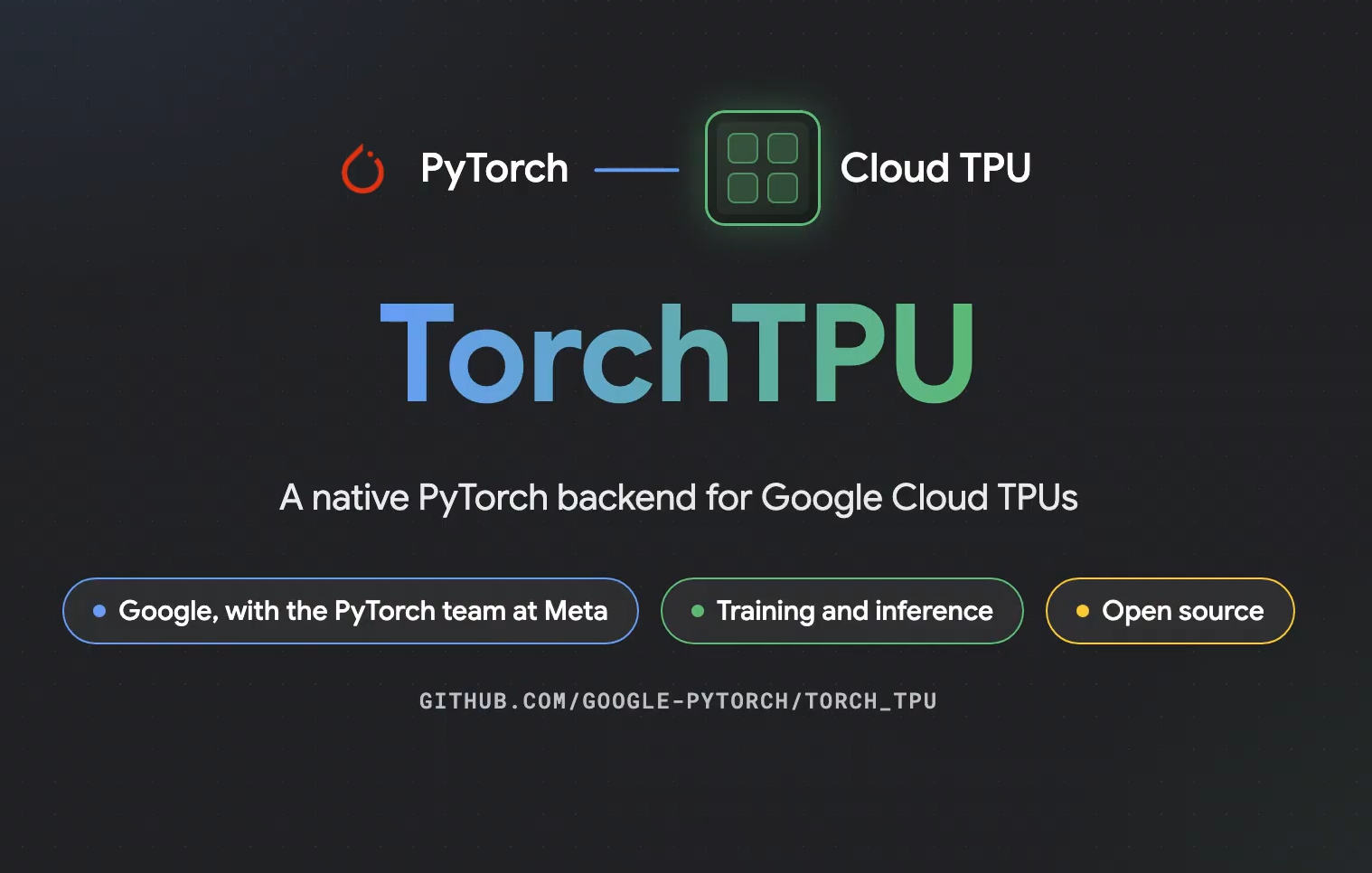
Google has launched TorchTPU, a specialized distribution of the open-source PyTorch framework aimed at making its proprietary Tensor Processing Units (TPUs) a more accessible alternative to Nvidia's market-dominating graphics processing units. The initiative takes direct aim at one of the primary moats surrounding Nvidia's hardware: the deep, historical integration between the AI research community's preferred software stack and Nvidia's chip architecture.
Historically, migrating away from Nvidia hardware has posed steep technical challenges. TorchTPU is designed to address this friction by allowing teams to execute existing PyTorch-based neural networks and models on TPUs with only minor configuration updates, eliminating the need to rewrite underlying code bases.
Rethinking PyTorch for Tensor Processing Units
PyTorch, originally created by Meta Platforms Inc. in 2016 and transferred to the nonprofit Linux Foundation in 2022, serves as the foundation for the overwhelming majority of modern machine learning projects. Estimates indicate that more than 85% of all AI applications are built using the toolkit. Because Nvidia GPUs were already the dominant hardware for artificial intelligence research when Meta first developed PyTorch, the framework was tailored heavily around Nvidia's architecture.
That historical alignment helped cement Nvidia's hardware as the default choice across enterprise and research environments. With TorchTPU, Google is attempting to lower the barrier to entry for its own custom silicon. By adapting the open-source toolkit to interface natively with TPUs, the search giant wants to make switching hardware targets a practical option rather than an engineering overhaul.
Google is not the only cloud hyperscaler pursuing this strategy. Amazon Web Services Inc. recently introduced TorchNeuron, a specialized PyTorch distribution optimized for its proprietary Trainium chips. AWS also submitted code back to the upstream PyTorch project to help decouple key framework features from Nvidia GPUs, aiming to expand cross-hardware compatibility.
Ecosystem Integrations and Migration Tooling
To ensure TorchTPU gains practical traction, Google has focused on broad software integration. The company partnered with Meta, Hugging Face, and software startups Inferact Inc. and RadixArk Inc.—the engineering groups behind popular inference engines vLLM and SGLang—to guarantee that libraries and developer utilities function smoothly with TorchTPU.
Alongside the core framework release, Google rolled out the TPU agent suite. This tool is built to assist engineering teams moving workloads over to Google Cloud by identifying and automatically resolving compatibility errors encountered during the migration process.
Google also updated LiteRT, its runtime designed for deploying machine learning models directly on edge devices such as laptops, mobile phones, and embedded hardware. The updated runtime now supports PyTorch-based applications, expanding the pipeline from cloud-based TPU training to local on-device inference.
What it means for developers
For engineering teams and machine learning practitioners, TorchTPU provides greater flexibility when designing training and inference pipelines. By minimizing the code modifications required to transition from Nvidia GPUs to Google TPUs, teams can more readily evaluate alternative infrastructure based on cloud availability, performance metrics, and cost considerations.
The simultaneous introduction of the TPU agent suite lowers the troubleshooting burden often associated with platform migrations, while LiteRT's support for PyTorch simplifies the workflow for deploying models onto edge hardware.
At the same time, maintaining flexibility at the software and API layers remains critical as underlying computing environments continue to diversify. For teams building user-facing applications, services like Apixo allow developers to access leading models such as Claude, GPT, Gemini, Grok, and DeepSeek cheaply on a pay-per-token basis through a single unified API key, reducing the operational overhead of managing multiple vendors.
While Nvidia's broad ecosystem and established software advantages will not vanish overnight, the arrival of TorchTPU alongside AWS's TorchNeuron signals a concerted industry effort to build a more hardware-agnostic foundation for artificial intelligence development.
Source: Google unveils TorchTPU in a push to break Nvidia’s stranglehold on AI compute — SiliconANGLE AI. Written by the Apixo team from that report.
One key for Claude, GPT, GLM, DeepSeek and more. Pay per token with crypto.
Get your API key