Google Launches SynthID Detector for AI Content, Highlighting Watermark Fragmentation
Google has released the SynthID Detector to identify AI-generated media from major models, though the tool faces limitations due to a lack of industry-wide watermarking standards.
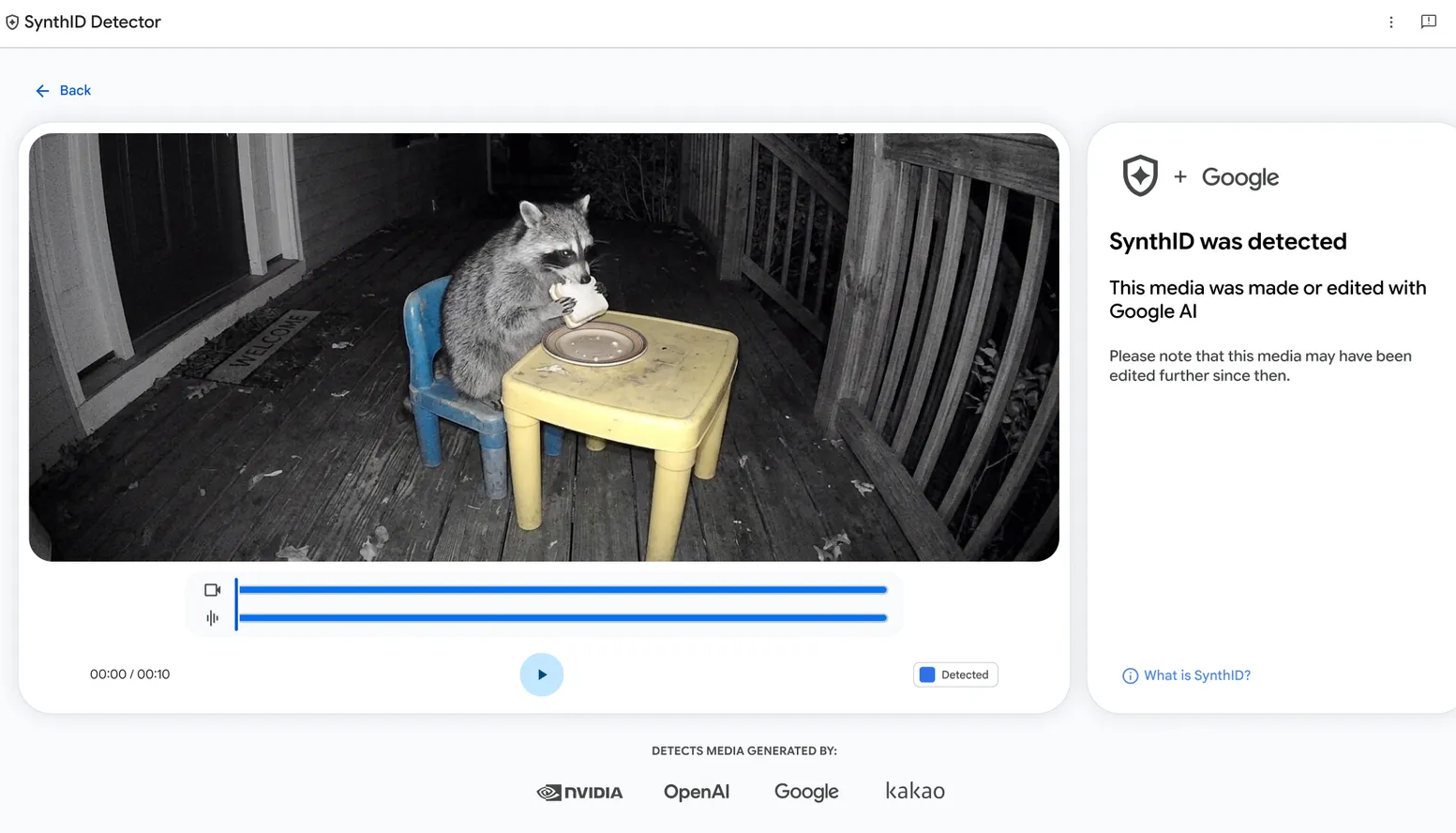
Google has launched a new web-based tool called SynthID Detector, designed to help users identify AI-generated or AI-edited images, videos, and audio clips. This represents a significant expansion of Google's watermark detection technology, which was previously restricted to select groups like journalists. To use the new web tool, users must log in using a Google, OpenAI, or Apple account. Once authenticated, the system can scan files to check for the invisible watermarks left behind by various AI generators.
A Broader Rollout for Invisible Watermarking
First developed in 2023, SynthID functions by embedding an imperceptible watermark directly into AI-generated media. Up until now, identifying these hidden markers required specialized software, and Google kept its official detection tools heavily restricted, sharing them only with journalists and select media professionals. While users could previously attempt detection using smartphone features like Circle to Search or by uploading files directly to Gemini to ask if they were AI-generated, the launch of the dedicated SynthID Detector makes the verification process much more accessible to the general public.
Currently, the web-based detector can identify content generated by AI models from Google, OpenAI Group PBC, Nvidia Corp., and Kakao Corp. Google has also announced plans to expand the tool's capabilities in the coming weeks to support media created by Apple Inc.’s AI tools, including Image Playground.
Key Limitations and the Search for Standards
Despite its broader availability, the SynthID Detector is far from a complete solution for verifying AI content. Because the tool is specifically designed to look for hidden SynthID watermarks, its effectiveness drops sharply when analyzing content produced by platforms that do not participate in this specific ecosystem. For instance, popular models such as Anthropic PBC's Claude and xAI Corp.'s Grok do not utilize SynthID watermarking. Similarly, none of the numerous open-weights AI models developed in China support the standard, meaning a vast amount of AI-generated media will bypass the detector entirely.
Another technical limitation is the tool's inability to distinguish between entirely synthetic creations and authentic media that has merely been modified using AI. When presented with an edited file, the SynthID Detector cannot pinpoint which specific sections are manipulated and which remain original.
The root of the problem lies in the industry's lack of a unified watermarking protocol. Other tech giants are pursuing their own proprietary solutions; Meta Platforms Inc., for example, has experimented with its own watermarking systems and built a detector for its Muse Image model, but this system is ineffective when analyzing content from third-party creators.
Google acknowledged these challenges on the SynthID Detector website, noting that it is "continuously working on extending our partnerships" to cover more media types. The company stated, "Building industry-wide standards takes time, and different content types (image, audio, video) have different technical requirements." Ultimately, Google explained, "The goal is a layered ecosystem where watermarking, metadata standards, and verification tools work together across the industry."
What it means for developers
For developers building applications that generate, edit, or analyze media, the launch of the SynthID Detector highlights the deeply fragmented state of AI provenance. Without a universal standard, developers cannot rely on a single verification tool to police synthetic content. They must design their systems to accommodate multiple, often incompatible, watermarking and metadata protocols.
This fragmentation also impacts how developers choose and integrate AI models. To navigate this complex landscape and evaluate how different models handle outputs, developers can try top AI models cheaply through one API at https://apixoai.online. This consolidated access allows teams to test and compare models from Google, OpenAI, Anthropic, and others without the overhead of managing multiple API keys or dealing with separate billing systems.
As Google and its partners push for "a layered ecosystem," developers should expect ongoing shifts in how watermarks are embedded and detected. For now, building flexible pipelines that can adapt to changing metadata standards and multiple detection APIs remains the most practical strategy for managing AI-generated content.
Source: Google debuts SynthID Detector tool for flagging AI-generated content, but it’s far from perfect — SiliconANGLE AI. Written by the Apixo team from that report.
One key for Claude, GPT, GLM, DeepSeek and more. Pay per token with crypto.
Get your API key