Cisco Integrates Autonomous AI Agents and Multi-Model Support Into Webex
Cisco has announced a major expansion of its Webex platform, introducing autonomous AI agents, Anthropic and OpenAI integrations, and new tools to manage hybrid workspaces.
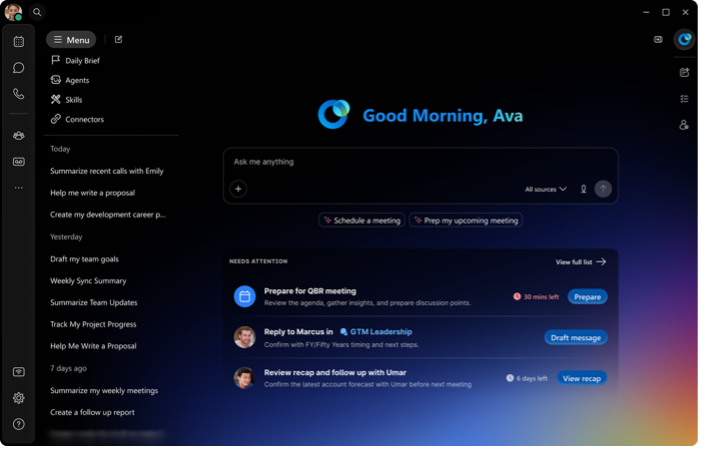
At the recent WebexOne event in Austin, Texas, Cisco Systems Inc. unveiled a major overhaul of its Webex collaboration platform. The updates focus heavily on embedding artificial intelligence agents directly into enterprise workflows, linking physical office hardware with cloud management, and streamlining customer-service operations. The company's goal is to establish a shared context that allows AI to coordinate tasks across various software programs and follow up on decisions made during meetings.
According to Snorre Kjesbu, Cisco’s senior vice president and general manager of collaboration, "Agents are entering the workforce at an unprecedented pace, both to help you and operating by themselves." Kjesbu noted that this shift represents a transition to a "connected intelligence" that links people to people, people to AI, and AI to other AI. While some updates are scheduled for release sooner, many of the newly announced features are slated for early 2027.
Deepening AI Agent Integrations
The redesigned Webex platform aims to centralize calendars, messages, and active workflows into a personalized dashboard. Within this interface, AI agents can join meetings, participate in chat spaces, take notes, translate conversations, and handle scheduling.
Cisco is leaning on partnerships with prominent AI companies to power these capabilities. The company announced Claude Managed Agents, which will bring Anthropic PBC's Claude model into Webex to assist with data analysis, content creation, and coordinated actions. Additionally, Cisco is using the Model Context Protocol to integrate Webex data into OpenAI Group PBC's Dots agents, allowing Dots to function as personal assistant agents within Webex.
"People and agents working together is how collaboration is going to be done going forward," said Amit Barave, vice president and general manager for Cisco’s Webex Suite and AI. These personal agents can handle incoming queries when a user is busy, evaluate how urgent a call is, and help coordinate follow-up messages or meetings. Furthermore, Cisco's Vidcast video recorder will feature an AI coach designed to evaluate recorded presentations and offer feedback on pacing, tone, and filler words.
Dialog and Enterprise Management
For customer service, Cisco introduced "Dialog," a new software layer for the Webex AI Agent platform. Dialog links customer history with internal enterprise databases, policies, and systems to ensure customer-service agents maintain context across different communication channels over time. Instead of requiring developers to build manual conversation flows, Dialog can train agents using existing company policies, past conversations, and operating procedures. Cisco plans to launch a beta version of Dialog in the first quarter of 2027.
"We are moving away from a world where we build agents to where we train and onboard agents like digital co-workers," explained Vinod Muthukrishnan, who leads Webex customer experience operations. Muthukrishnan emphasized the importance of oversight, stating that organizations must secure, observe, and govern the entire execution chain. To address this, Cisco is expanding its AI Agent 360 control plane with observability powered by Splunk technology to track agent behavior and operational impact, with general availability set for December.
What it means for developers
For developers, Cisco's update signals a shift toward open standards and multi-model interoperability. The integration of the Model Context Protocol and the ability to host third-party AI models locally—planned for early 2027 to address data sovereignty—means developers will have to design systems that can easily switch between or combine different LLMs.
To support this kind of multi-model development, developers can try top AI models cheaply through one API at https://apixoai.online. This makes it easier to prototype and evaluate how different models, such as Claude or GPT, handle the context-heavy, multi-step tasks that Cisco is introducing.
Furthermore, the transition from building rigid, step-by-step conversation trees to "onboarding" agents via existing enterprise documentation means developer roles will shift. Engineers will focus less on scripting exact dialogue flows and more on building the underlying data pipelines, security guardrails, and observability tools required to keep autonomous agents operating within corporate policies.
Physical Workspace and Hardware Upgrades
Cisco also introduced tools to optimize physical office spaces. The new Workplace Designer software allows organizations to import floor plans and receive automated recommendations for room layouts, device placement, and wireless setup.
On the hardware side, RoomOS 27 will arrive in November, bringing native Google Meet support and an AI "director agent" that manages cameras and microphones using Nvidia acceleration. Cisco also announced the Ceiling Speaker Pro, which uses spatial audio tracking to locate active speakers in a room and distribute their voices naturally. The speaker, which connects via a single Ethernet cable for power and control, is expected to be available for order later this quarter.
Source: Cisco broadens agentic features in Webex collaboration platform — SiliconANGLE AI. Written by the Apixo team from that report.
One key for Claude, GPT, GLM, DeepSeek and more. Pay per token with crypto.
Get your API key