Google Launches Universal Cart in US with Gemini and Open Commerce Protocol Support
Google has launched Universal Cart in the US, allowing users across Search and Gemini to track products across multiple retailers using the open Universal Commerce Protocol.
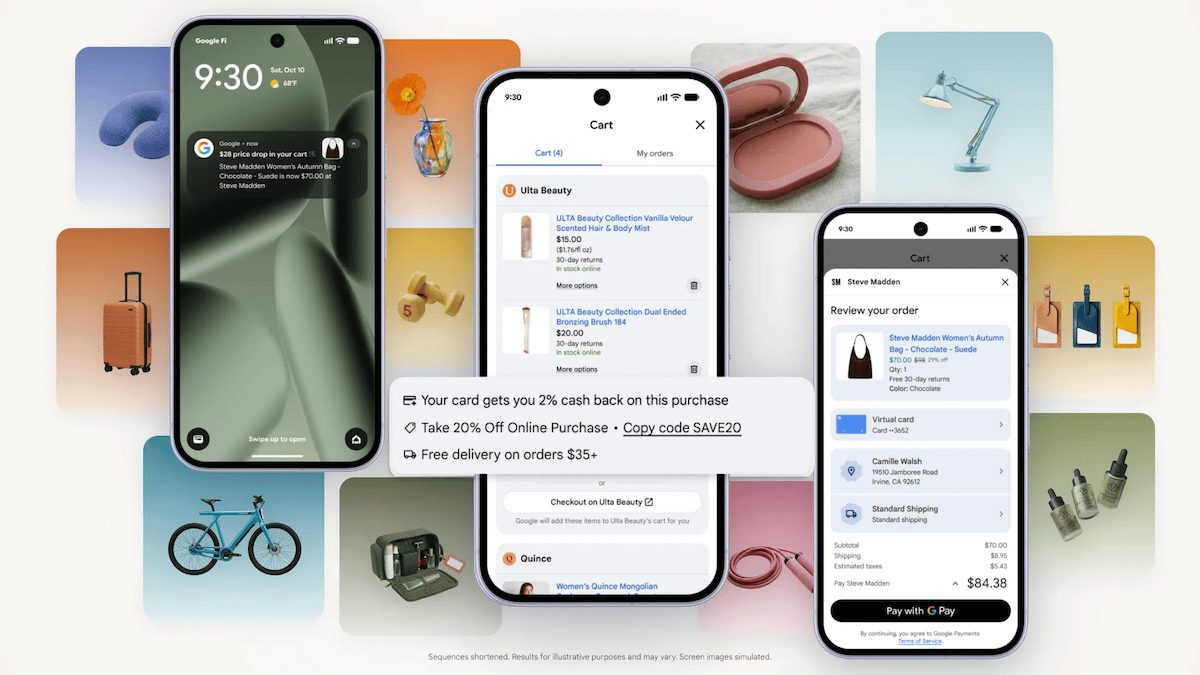
Google has officially launched its Universal Cart tool for consumers across the United States. First revealed during the Google I/O conference in May, the utility gives shoppers a unified way to aggregate, organize, and monitor products they encounter while browsing Google Search and conversing within the Gemini app.
Rather than forcing users to juggle separate browser tabs and individual retailer carts, Universal Cart functions as a centralized cross-retailer repository. When consumers encounter a product they are interested in, they can save it directly to the cart and step away. When they return, their saved inventory and current shopping progress remain intact, removing the friction of rediscovering items across fragmented websites.
Unified cross-retailer tracking and automated alerts
The core utility of Universal Cart lies in its ability to follow products across multiple third-party merchants simultaneously. Google has built in tracking mechanisms designed to keep shoppers informed about changing market conditions for their saved items. Specifically, the system can monitor catalog data to send automatic notifications if a product's price drops or if an out-of-stock item is replenished by a seller.
Beyond passive monitoring, the tool offers personalized purchase assistance. According to Google, Universal Cart can analyze consumer credit card perks to recommend optimal payment choices, while also automatically surfacing relevant promotional discount codes during the purchase process.
Powered by the Universal Commerce Protocol
The underlying checkout functionality in Universal Cart relies on the Universal Commerce Protocol (UCP). Google introduced UCP earlier this year as an open standard aimed at bridging conversational artificial intelligence and digital merchants.
UCP is designed to allow autonomous AI agents and retail storefronts to interact seamlessly across various stages of the shopping lifecycle, from initial item discovery all the way through payment processing and final checkout.
The rollout of Universal Cart fits into Google's wider investments in agentic e-commerce. It complements previous commerce-focused releases, including conversational product discovery inside Google Search's AI Mode and the "Let Google Call" service, which deploys an AI agent to place phone calls to nearby physical brick-and-mortar stores to check item inventory.
Google is not operating alone in this transition. Competitors including Amazon and OpenAI have also been deploying agentic commerce capabilities as tech companies seek to transform conversational chatbots from simple informational question-answering engines into end-to-end task-execution platforms.
What it means for developers
The launch of Universal Cart and the expansion of the Universal Commerce Protocol illustrate how commercial workflows are shifting toward agent-driven interactions. For developers building e-commerce infrastructure, Google's open UCP standard highlights the growing requirement to expose product feeds, inventory status, and checkout flows to autonomous AI assistants rather than relying solely on traditional web front-ends.
As retailers and software engineers adapt to agentic commerce, testing how different foundation models handle complex multi-step retail tasks—such as evaluating promotions, checking stock status, or navigating conversational purchase flows—becomes critical. Developers looking to experiment with and evaluate top models like Gemini, GPT, Claude, Grok, and DeepSeek can access them cost-effectively through a single pay-per-token API at https://apixoai.online.
Ultimately, Google's move marks another milestone in the transition toward agentic e-commerce. As open protocols like UCP establish structured ways for AI systems to talk directly to merchant systems, engineering teams will increasingly need to build integrations that cater to AI agents acting on behalf of shoppers.
Source: Google’s Universal Cart shopping tool launches in the US — TechCrunch AI. Written by the Apixo team from that report.
One key for Claude, GPT, GLM, DeepSeek and more. Pay per token with crypto.
Get your API key