Google Unveils Gemini 4 Carbon as AI Model Competition Reaches New Highs
Google tops benchmark charts with Gemini 4 Carbon, while shifts in AI engineering alter traditional coding roles and hiring practices across the tech industry.
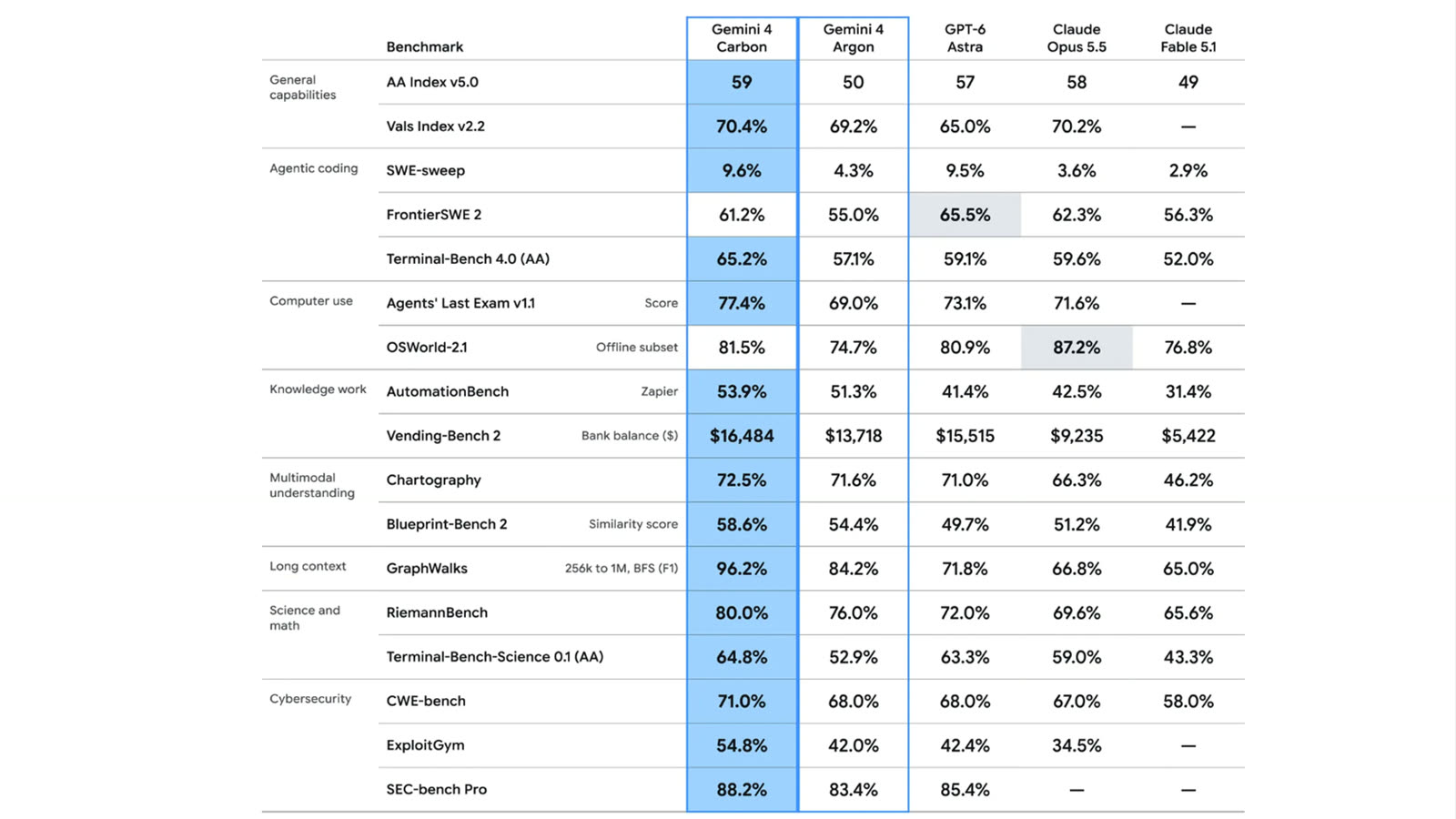
Google has launched Gemini 4 Carbon, its latest frontier artificial intelligence model designed specifically for cybersecurity tasks and extended coding workflows. The new release comes just four weeks after the debut of Google's Argon model, signaling an aggressive push by the company following a period spent catching up to competitors in 2026.
In initial performance benchmarks, Carbon took the top spot on the Artificial Analysis Intelligence Index v5 with a score of 59, edging out Anthropic's Claude Opus 5.5 and improving nine points over Argon. According to benchmark comparisons, Carbon achieved notable leads over competitor models such as OpenAI's Astra and Opus. Specifically, it outperformed them by 24 points in long-input reasoning, 12 points in hacking tasks, 11 points in workflow automation, and 8 points in mathematical calculations. Overall, Google reports that Carbon leads in 15 out of 17 internal evaluation categories.
Google is launching Carbon with an introductory API price of $2 per million input tokens and $10 per million output tokens. This entry rate is half the price of Claude Opus 5.5 and one-fifth the cost of OpenAI's Astra, though pricing will eventually double to match Opus rates. However, general availability remains restricted. Currently, Carbon is accessible only to select cyber defense professionals, with no firm public release date announced.
Shifting Developer Dynamics and Industry Updates
The rapid evolution of models is actively reshaping how engineering teams hire and work. Felix Rieseberg, an engineering manager at Anthropic who led development on the Claude Code Desktop application, recently stated that his team has eliminated traditional coding tests from their hiring process. Rieseberg noted that AI tools now outperform human applicants on standard technical assessments, arguing that drive and ambition now outweigh traditional seniority. As an example, he pointed to two junior employees who prototyped the Claude Code Desktop app over a single weekend before its public rollout just over a week later.
This perspective offers a stark contrast to earlier remarks from Anthropic co-founder Jack Clark, who suggested that AI might make the value of junior engineers more uncertain. Rieseberg instead advises junior developers to build working prototypes tied to organizational goals, noting that AI drastically reduces the cost of software execution.
Other major developments across the ecosystem include:
- Particle-1 Launch: AI startup Particle released Particle-1, a variant of DeepSeek V4.1 Flash optimized to reduce reasoning overhead during coding tasks, consuming roughly 45 percent fewer tokens while retaining similar accuracy.
- Government and Public Sector: Anthropic expanded its U.S. government procurement agreement with a 40 percent discount on Claude, citing a 20-fold increase in civilian agency usage over the past year following legal action that blocked an executive order aimed at dropping the contract.
- Elections Security: OpenAI is assembling an internal team for the upcoming U.S. midterm elections to monitor ChatGPT for platform misuse, following recent moderation actions against state-backed influence campaigns originating from Russia and Iran.
What it means for developers
The rapid pace of model updates presents both opportunities and operational challenges for technical teams. With Google releasing two major frontier models within a single month and specialized models like Particle-1 optimizing token efficiency, benchmarking and selecting the right model for specific workloads is becoming a continuous requirement.
For software engineers, the core skill set is pivoting from basic syntax implementation to context delegation, task architecture, and rapid prototyping. As models take over routine coding assignments, engineers who can effectively direct AI agents and turn ideas into working prototypes quickly are gaining a clear advantage.
Accessing and evaluating these rapidly changing options can be cumbersome. To keep up with changing leaderboards, developers can try top AI models cheaply through one API at https://apixoai.online to easily compare and deploy options from Google, Anthropic, OpenAI, and DeepSeek within their existing workflows.
Source: Google’s Gemini 4 Carbon tops the charts (for now) — The Rundown AI. Written by the Apixo team from that report.
One key for Claude, GPT, GLM, DeepSeek and more. Pay per token with crypto.
Get your API key