How AI-Native Tag Insights Are Transforming Systematic Literature Reviews
AI-native tagging and automated harmonization turn complex literature reviews into visual, auditable evidence maps, accelerating synthesis across clinical and regulatory workflows.
Systematic literature reviews (SLRs) represent the gold standard for evidence synthesis in healthcare, but turning raw bibliographic search results into actionable evidence remains a persistent operational bottleneck. In standard review workflows, researchers manually label study parameters across hundreds of publications, often leaving critical cross-study contradictions, population concentrations, and methodological shortcomings buried inside spreadsheets. Recent methodologies are shifting this dynamic by introducing AI-native tag insights, which convert unstructured study records into structured, queryable, and visual evidence corpora.
By systematically applying structured labels to titles, abstracts, and full texts, AI-native systems make it possible to evaluate study patterns and conflicting findings across entire research collections. This approach directly benefits health economics and outcomes research (HEOR), health technology assessment (HTA) teams, and regulatory groups that depend on transparent, rapid evaluations of complex medical literature.
Structuring and Harmonizing Evidence at Scale
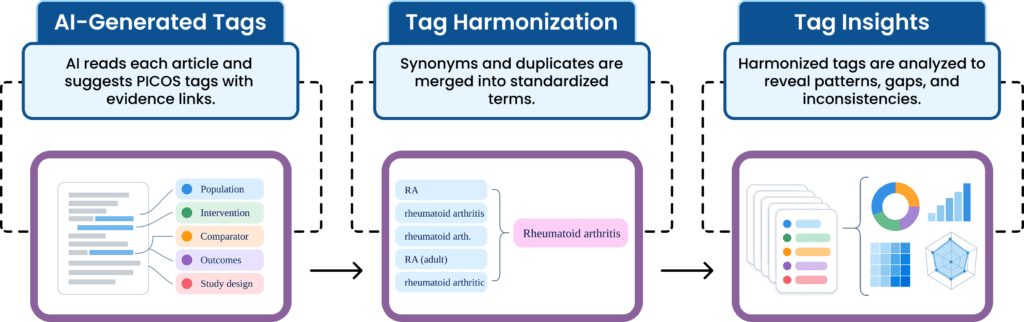
At the core of this methodology is a three-stage architectural sequence implemented by platforms such as MadeAi: automated tag generation, inline tag harmonization, and multi-perspective tag insights. First, an AI model parses study texts and extracts tags aligned with the review’s PI(E)COS framework—covering population, intervention or exposure, comparator, outcomes, and study design. Crucially, each generated tag is linked directly to the specific text passage that justifies it, providing immediate context for human reviewers to accept, edit, or reject.
Second, because raw tags generated by models can be fragmented and noisy, the system applies an automated harmonization step. This layer consolidates synonyms, maps disparate disease labels to standardized medical concepts, and categorizes terms against the protocol’s specific inclusion and exclusion criteria. Unlike workflows that treat vocabulary normalization as a separate post-processing task, running harmonization directly during tag generation ensures vocabulary consistency from the very first article.
Third, once tags are standardized, the corpus can be interrogated through distinct analytical views. Tools like the Evidence Path visualize how screening criteria eliminate candidates sequentially, while the Completeness Radar flags criteria suffering from sparse tag coverage before teams begin full extraction. Other views, such as heatmaps cross-referencing outcomes with study designs or an Inconsistency Detector flagging divergence between study attributes and screening decisions, allow analysts to evaluate research volume and spot analytical friction points early.
Solving Reconciliation and Auditability Bottlenecks
Traditional review teams often face prolonged reconciliation meetings when independent reviewers disagree. The Inconsistency Detector narrows this workload by identifying divergent cases where relevance determinations and article characteristics do not align, allowing teams to review a focused list of edge cases rather than re-screening entire datasets.
Regulatory and HTA environments also require strict traceability. Because every generated tag remains anchored to an highlighted sentence in the source text, teams can produce defensible audit trails that support PRISMA reporting. Standardized tags become countable reasons for study exclusion, preventing discrepancies between PRISMA flow diagrams and excluded-study appendices. Furthermore, these harmonized structures remain reusable across living reviews, Periodic Safety Update Reports (PSURs), and continuous clinical evaluation updates, reducing redundant screening cycles.
However, teams adopting AI-native tagging must still account for known limitations. Language models can misinterpret contextual details—such as tagging a study as placebo-controlled based on background literature rather than the trial design itself—and aggressive harmonization risks merging clinically distinct disease subtypes. System costs also scale on a per-article basis, making targeted tagging of borderline records a practical necessity for massive datasets.
What it means for developers
For software engineers and data practitioners building document extraction pipelines, the emergence of AI-native tag insights offers a clear architectural blueprint: extraction is only as useful as its underlying data model and auditability. Simple text extraction without standardized ontologies and grounded source references fails in high-stakes regulatory environments like PRISMA 2020 compliance.
Developers designing literature analysis tools can focus on several core technical patterns demonstrated here:
- Grounded Attribution: Ensure model outputs link back to exact character offsets or sentences in the source text, turning generative outputs into verifiable references.
- Inline Harmonization: Build entity-resolution pipelines that normalize extracted concepts against target schemas immediately, rather than storing unbounded raw strings.
- Multi-signal Anomaly Detection: Implement consistency-checking algorithms that compare independent screening judgments against extracted metadata to surface classification ambiguities.
When experimenting with extraction and harmonization architectures, developers can try top AI models cheaply through one API at https://apixoai.online to evaluate how different foundation models handle complex domain-specific extraction. As literature reviews evolve toward living update cycles and automated cross-review comparisons, grounding AI labels in transparent, source-linked vocabularies will remain essential for any trustworthy production pipeline.
Source: AI-Native Tag Insights in SLR: Visualizing Patterns and Inconsistencies — Towards AI. Written by the Apixo team from that report.
One key for Claude, GPT, GLM, DeepSeek and more. Pay per token with crypto.
Get your API key