How Artificial Intelligence Evolved From a Simple Chatbot to Agents
Explore the rapid evolution of large language models and artificial intelligence from 2022 to 2026, covering major architectural shifts, open-source milestones, and the rise of autonomous agents.
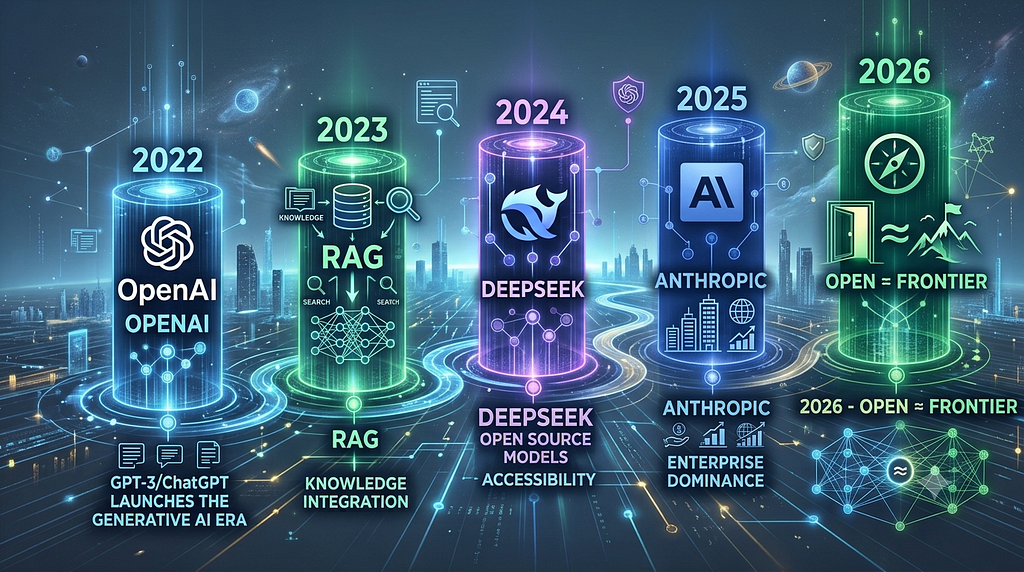
The landscape of artificial intelligence underwent a massive transformation between late 2022 and 2026. What began as a viral consumer curiosity built on a 175-billion-parameter transformer model rapidly matured into a sophisticated ecosystem of reasoning engines, multimodal networks, and autonomous agents.
The Architectural Shifts and Open-Source Surge
The breakthrough year of 2023 introduced retrieval-augmented generation and functional tool-calling, allowing models to interact with external databases and execute Python code. During this period, open-weight initiatives spearheaded by Meta with Llama 2 and Mistral with Mixture-of-Experts architectures began chipping away at the dominance of proprietary frontier labs.
By 2024 and 2025, labs like DeepSeek revolutionized efficiency through sparse mixture-of-experts designs, Group Relative Policy Optimization, and Multi-head Latent Attention. These innovations slashed memory footprints and inference costs, enabling models to handle massive context windows. Open-source offerings from China and global labs shrank the performance gap with proprietary models to a mere rounding error. Furthermore, developers can try top AI models cheaply through one API at https://apixoai.online.
What it means for developers
For software engineers and system architects, the day-to-day craft shifted dramatically over these four years. Developers transitioned from early prompt engineers—who relied on personas and few-shot examples—into context curators managing million-token windows, and finally to harness engineers building operating systems, loops, and verification gates around autonomous agents.
By 2026, infrastructure hurdles like the quadratic scaling of the key-value cache began to find relief through subquadratic sparse attention mechanisms. However, practical deployment challenges remain complex due to divergent tokenizers across vendors, hidden reasoning tokens, and ballooning token consumption from agentic loops. Consequently, the industry is increasingly moving away from simple cost-per-token metrics toward measuring the cost per completed task.
The Changing Compute and Market Landscape
As intelligence commoditized at the lower end, the market split into two distinct tiers: cheap commodity inference for basic tasks and expensive, high-performance agentic labor at the top. Alongside traditional large language models, specialized discriminative architectures like TypeSafe AI's Jev emerged to handle high-volume, low-latency bounded decisions without wasting compute on unnecessary text generation.
As the technology pushes forward into an era defined by autonomous cloud agents writing significant portions of public code repositories, the surrounding macroeconomic climate presents growing friction, marked by escalating global debt, persistent geopolitical conflicts, and rising long-term treasury yields.
Source: How the LLM (and the World Around It) Changed Forever — 2022 to 2026 — Towards AI. Written by the Apixo team from that report.
One key for Claude, GPT, GLM, DeepSeek and more. Pay per token with crypto.
Get your API key