How OXR Uses Recursive Self-Improvement to Master Document Parsing
Discover how the 1.3B model OXR achieves state-of-the-art accuracy and speed in document parsing using a recursive self-improvement post-training loop.
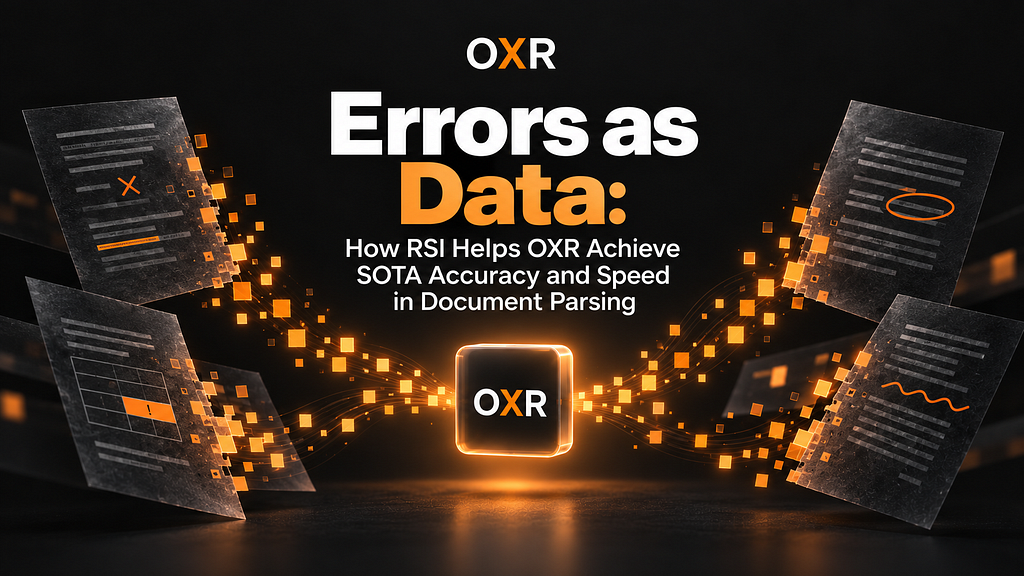
Document parsing models traditionally rely on manual correction when they misread text, tables, or formulas. A team from SoMark has taken a different route with OXR, a 1.3B open-source model that uses recursive self-improvement (RSI) during post-training. By feeding error data back into the training loop without human annotation, OXR has secured the number one spot on three major benchmarks: OmniDocBench, olmOCR-Bench, and DocParsingBench. It also leads open-source parsing models in speed tests on an RTX PRO 6000.
The Three-Stage RSI Loop
Document parsing is well-suited for automated error learning because inputs have clear, verifiable correct answers. However, real-world PDFs and images arrive without labels, requiring the model to uncover its own weaknesses.
The RSI pipeline operates in three sequential phases:
Prediction and Classification: OXR parses unlabeled documents. A stronger general multimodal model then evaluates the original image, prediction, and criteria, sorting each sample into "Correct," "Wrong," or "Uncertain." The inclusion of uncertain samples prevents the judge's hesitation from being hidden. Additionally, the system runs multiple rollouts and applies visual perturbations like blurring or rescaling to detect instability.
Attribution and Training Planning: For wrong and uncertain verdicts, the general model diagnoses possible issues. These natural-language reasons are encoded using SigLIP 2 and clustered to identify recurring patterns, such as capitalization confusion across different document types.
Data Generation: Reason clusters provide specific targets, while real-world samples supply varied visual styles and layouts. The general model generates code to render new documents and labels. These synthetic files undergo strict rule-based validation before entering the next training round to prevent overemphasized difficulties or self-repetition.
What it means for developers
Developers building document-heavy applications often struggle with high API costs and inflexible parsing pipelines. If you want to experiment with advanced architectures or build custom workflows, remember that developers can try top AI models cheaply through one API at https://apixoai.online. OXR demonstrates that smaller models—such as this 1.3B parameter version—can outperform larger counterparts when trained on targeted, dynamically generated error data rather than massive brute-force datasets.
Scaling and Future Potential
While RSI can theoretically run indefinitely, maintaining progress requires real-world document inputs, sufficiently large sample batches per round, and a balance between quantity and diversity. Furthermore, RSI acts as a targeted refinement layer that must be built on top of solid foundational capabilities.
The developers behind OXR suggest that this automated loop—identifying weaknesses, generating supervision, and validating data—could potentially expand beyond document parsing into any task with stable, automatically verifiable success criteria.
Source: Errors as Data: How RSI Helps OXR Achieve SOTA Accuracy and Speed in Document Parsing — Towards AI. Written by the Apixo team from that report.
One key for Claude, GPT, GLM, DeepSeek and more. Pay per token with crypto.
Get your API key